The consumer electronics landscape at IFA Berlin, the world’s leading trade show for consumer electronics and home appliances, was punctuated this year by a significant shift toward large-scale residential energy storage. Among the most notable entries was the Jackery EnergyGuard Max, a robust, whole-home energy management system that challenges the current industry standard for residential battery capacity. By pairing the 100 kWh Energycore battery module with the PowerVault 50 inverter, Jackery is signaling a pivot from portable, camping-oriented power stations to comprehensive, utility-grade residential infrastructure.
The Evolution of Residential Storage
The transition toward renewable energy in the residential sector has historically been constrained by the limited capacity of modular battery systems. While systems like the Tesla Powerwall—often cited as the industry benchmark—typically offer between 13.5 kWh and 14 kWh of capacity, the EnergyGuard Max enters the market with a staggering 104 kWh nominal capacity. This shift represents a move away from simple backup power for essential appliances toward total energy self-sufficiency.

At the core of this development is a design philosophy centered on solving the "pain points" of the energy transition. According to Jack Sun, CEO and founder of Jackery, the development process for the EnergyGuard Max was predicated on rigorous internal inquiry: "What problem are you fixing?" For the engineering team, the answer involved addressing resilience, affordability, and the complexities of high-demand electrification in modern homes.
Chronology and Development
The development of the EnergyGuard Max follows a period of rapid expansion for Jackery’s manufacturing capabilities. Earlier in 2026, the company inaugurated a net-zero factory and advanced product testing laboratory, facilities specifically designed to handle the rigorous certification requirements of large-scale, high-voltage battery systems.
The unveiling at IFA Berlin serves as a critical milestone in a timeline that began with the company’s dominance in the portable power sector. After establishing a foothold with the SolarSaga and Explorer series, Jackery spent the last 24 months pivoting toward fixed, stationary energy solutions. The EnergyGuard Max represents the culmination of this research, moving from pre-production testing to a finalized design that incorporates industrial-grade thermal management and power conversion technology.
Technical Specifications and Performance
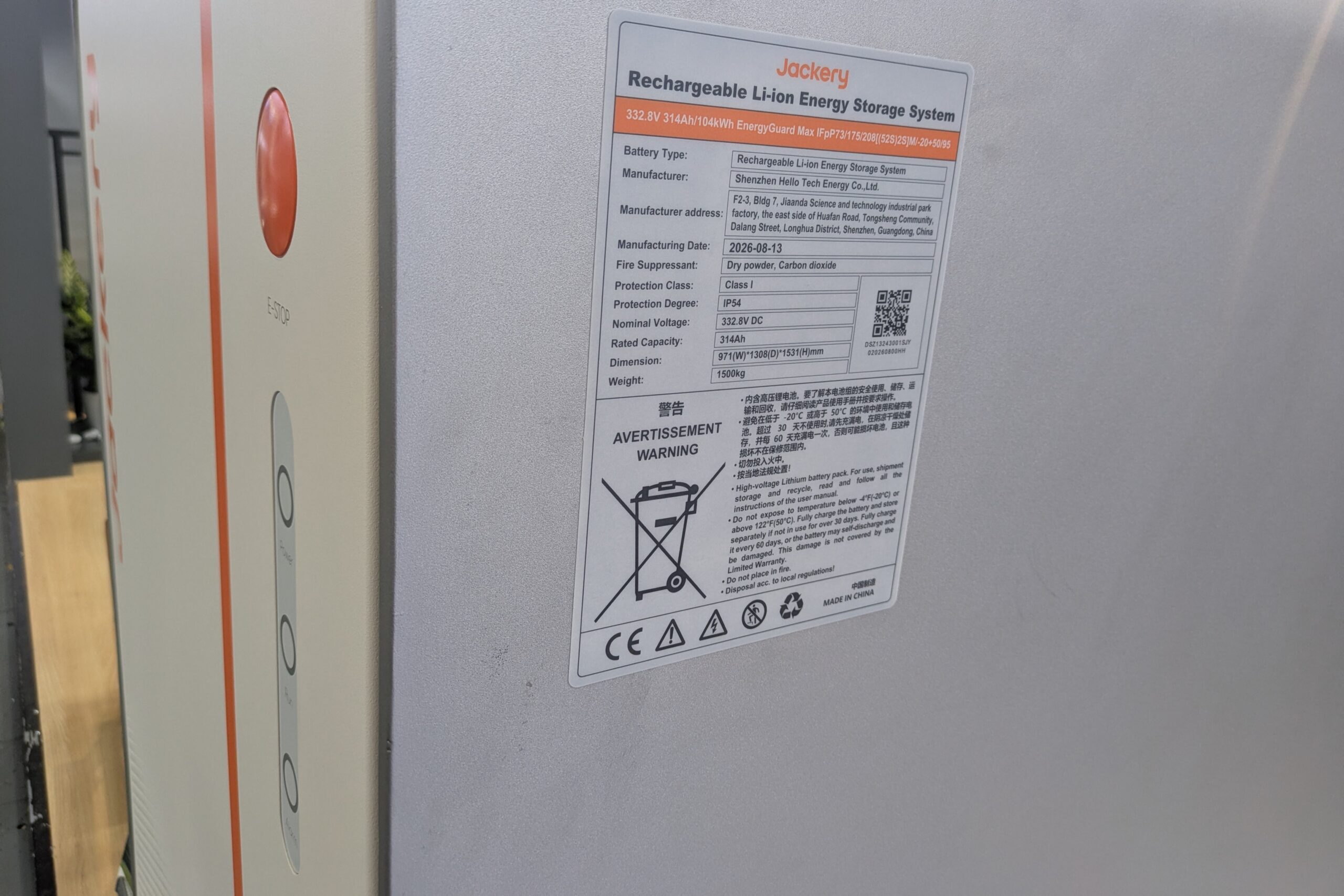
The EnergyGuard Max is engineered for performance that rivals commercial-industrial setups. The system features a Lithium Iron Phosphate (LFP) battery chemistry, which is widely considered the gold standard for residential safety due to its thermal stability and long cycle life. The liquid-cooling system, modeled after high-performance electric vehicle (EV) battery packs, ensures that the unit maintains optimal operating temperatures even during high-current charging and discharging cycles.
Key technical specifications include:
- Nominal Capacity: 104 kWh.
- Operating Voltage: 332.8 V.
- Thermal Resilience: Operates effectively in temperatures as low as -20°C (-4°F), making it viable for most European climates.
- Inverter Compatibility: The PowerVault 50 inverter supports a DC input voltage range of 150 V to 950 V, with a maximum charge/discharge current of 2 x 80A.
- Switching Speed: 10 ms transfer time, meeting the requirements for sensitive electronics and UPS (Uninterruptible Power Supply) applications.
The integration of advanced safety protocols is a defining feature of the system. Jackery’s "FortiShield" 7-layer security framework manages everything from insulation resistance detection to anti-islanding protection. This ensures that the system can be safely connected to the grid without risking back-feeding during maintenance outages, a critical requirement for local utility compliance.

The Synergy Between EVs and Home Storage
One of the most compelling aspects of the PowerVault 50 inverter is its compatibility with high-voltage EV architectures. With a DC input range reaching 950 V, the system is theoretically capable of facilitating faster charging cycles for electric vehicles than standard Level 2 residential chargers.
This creates an "energy ecosystem" where the home battery acts as a central hub. By leveraging Vehicle-to-Grid (V2G) and Vehicle-to-Home (V2H) technologies, the EnergyGuard Max allows for a symbiotic relationship between the vehicle and the home. During prolonged power disruptions, the vehicle can act as an auxiliary energy source or be transported to a functional public charging station, effectively serving as a mobile energy reservoir that can then replenish the home’s main 100 kWh storage bank.
Economic and Environmental Implications
The introduction of a 100 kWh residential battery carries significant implications for grid stability and consumer energy costs. In regions like Germany, where electricity prices are subject to significant volatility and dynamic pricing, the ability to store energy when it is inexpensive and discharge it during peak demand periods (or sell it back to the grid via a Virtual Power Plant, or VPP) offers a clear path to return on investment.

For the average household, which consumes significantly less than 100 kWh daily, this system provides a multi-day buffer during grid failures. However, the true value lies in the electrification of heating and transportation. As more homeowners install heat pumps and own multiple EVs, the base-load requirement of the average home is rising. The EnergyGuard Max is designed to buffer these loads, potentially allowing homeowners to avoid expensive electrical service upgrades that would otherwise be required to support high-draw equipment.
Furthermore, the environmental benefit of such a large capacity system cannot be overstated. By smoothing out the intermittent nature of solar energy production, the system allows households to maximize self-consumption. In northern European latitudes, where solar production is limited by short winter days and frequent cloud cover, the ability to store massive amounts of energy during peak production days becomes essential to maintaining a net-zero footprint year-round.
Market Context and Future Outlook
The shift toward massive residential storage is not merely a trend; it is a response to the aging and increasingly unreliable electrical infrastructure in many developed nations. While the EnergyGuard Max is clearly a premium product, the trend of decreasing battery costs suggests that what was once considered "over-spec" for a private residence is rapidly becoming the new standard.

Industry analysts note that while the initial capital expenditure for a 100 kWh system will be higher than smaller alternatives, the cost per kilowatt-hour is trending downward. For high-energy-demand households or rural properties that frequently face grid instability, the economics of the EnergyGuard Max are likely to compare favorably against the long-term costs of fuel-based generators and utility surcharges.
As Jackery prepares for the broader rollout of the EnergyGuard Max, the focus remains on the "problem-solving" approach articulated by the company’s leadership. By shifting the conversation from "how many gadgets can this charge" to "how can this power a modern, electrified lifestyle," Jackery is aligning itself with the broader goals of the global energy transition.
The success of this product will likely depend on the company’s ability to integrate with existing utility smart-metering programs and the speed at which regional energy markets adopt VPP-friendly regulations. Nevertheless, the presence of such high-capacity systems at a major consumer event like IFA Berlin marks a decisive step toward a future where the home is no longer just a consumer of grid energy, but a localized power plant in its own right. As the industry watches, the question is no longer whether large-scale residential storage is possible, but rather how quickly it will become a standard feature of the modern home.