
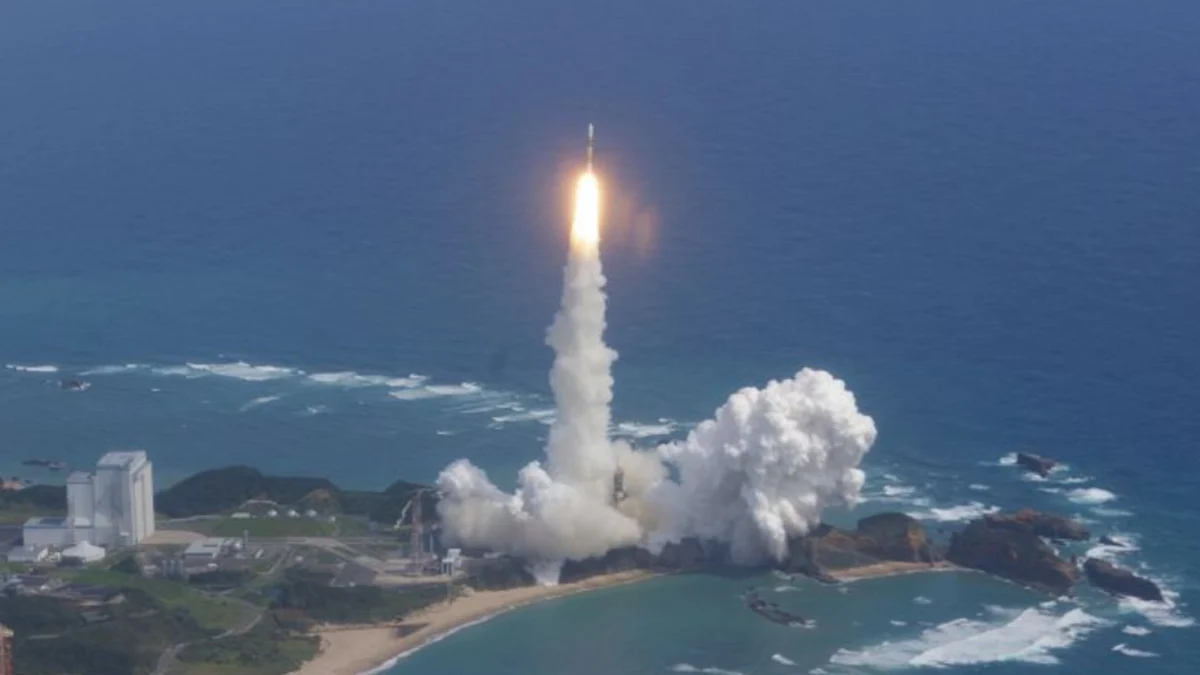
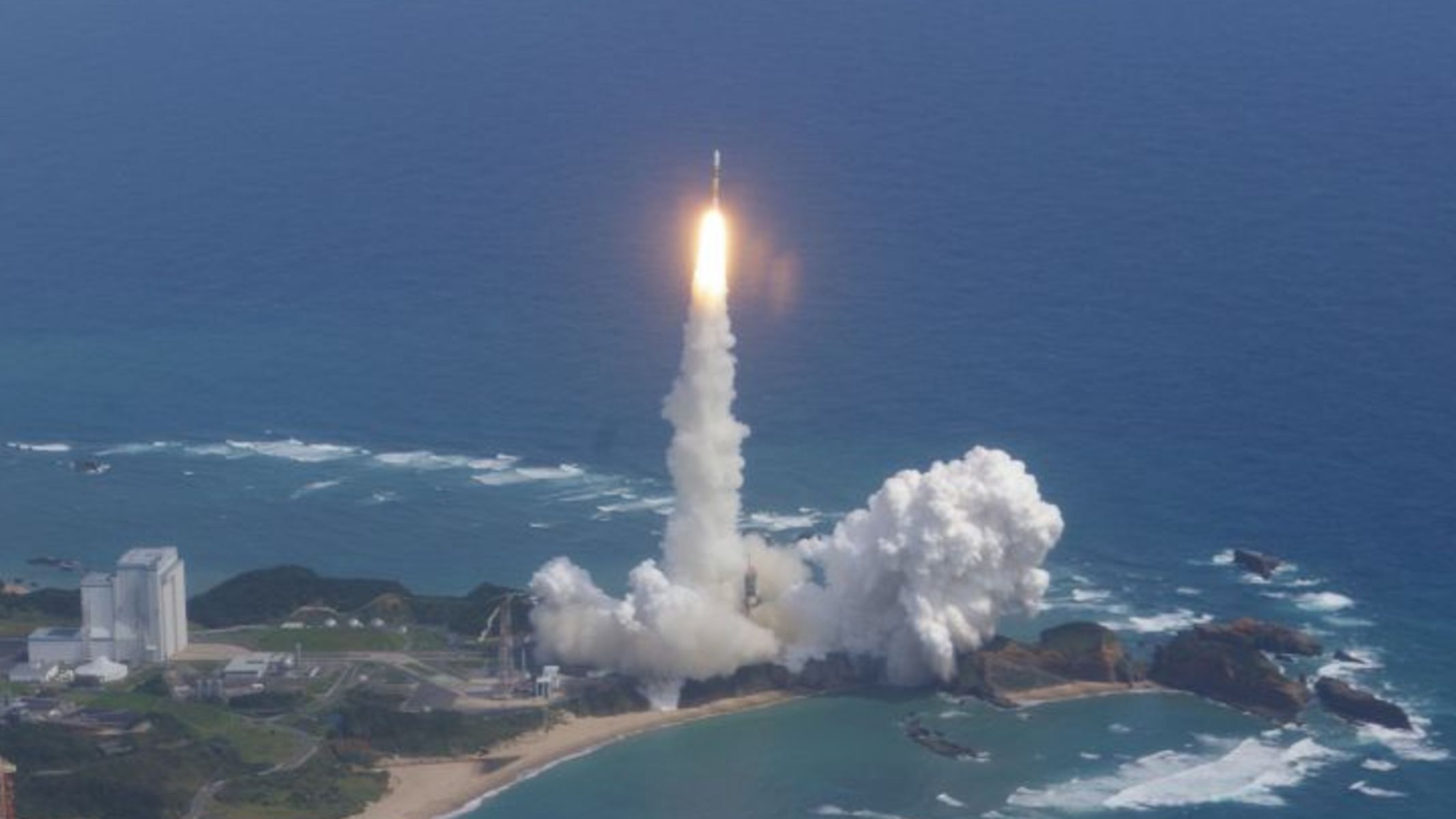
On September 13, 2007, the Japan Aerospace Exploration Agency (JAXA) successfully initiated the SELenological and ENgineering Explorer (SELENE) mission, marking a pivotal advancement in lunar exploration. More commonly known as Kaguya, the mission was designed to conduct a comprehensive survey of the moon’s origin and evolution. Launched aboard a Japanese H-IIA rocket from the Tanegashima Space Center, the spacecraft represented the most significant Japanese lunar undertaking since the 1990s, effectively positioning Japan as a major contributor to international lunar science.
The launch, which took place at 10:31 a.m. local time on September 14 (coinciding with the evening of September 13 in Eastern Time), signaled the beginning of a 20-day transit toward the lunar orbit. The mission was not merely a singular orbiter but a sophisticated, multi-component system comprising a main orbiter and two smaller sub-satellites: Okina and Ouna. Together, these instruments formed a robust investigative suite that would spend the next two years fundamentally altering humanity’s understanding of the lunar landscape.
A Legacy of Technological Evolution
To understand the significance of Kaguya, one must consider the historical context of Japan’s space program. Before the success of Kaguya, Japan’s lunar efforts were characterized by the Hiten spacecraft, launched in 1990. Hiten served primarily as a technology demonstrator. Its mission profile, which involved a complex, highly elliptical trajectory that utilized gravity-assist maneuvers to perform 10 lunar flybys, was intended to prove that Japan possessed the orbital mechanics expertise required for deep space exploration.
While Hiten successfully deployed a small daughter probe named Hagoromo, it was not an orbiter in the modern sense. It lacked the instrumentation necessary for sustained lunar mapping and scientific analysis. Kaguya, by contrast, represented the maturation of Japanese aerospace engineering. It was the first mission to put the theoretical foundations established by Hiten into a sustained, high-resolution scientific practice. By the time Kaguya entered its operational orbit, it was equipped with 14 distinct scientific instruments, far exceeding the capabilities of its predecessor.
The Anatomy of the Mission
The Kaguya system was an engineering feat of precision. The main orbiter, a box-shaped satellite weighing approximately three tons at launch, was the centerpiece of the operation. It was tasked with global mapping, surface composition analysis, and measuring the lunar gravity field.
The two sub-satellites, Okina (the relay satellite) and Ouna (the radio source experiment), were essential to the mission’s success. Because the moon is tidally locked—meaning the same side always faces Earth—direct communication with an orbiter on the far side is impossible. The sub-satellites were placed into specific orbits to act as communication relays, allowing the main orbiter to transmit data back to Earth even when it was positioned behind the moon. This configuration enabled the first-ever detailed, continuous observation of the lunar far side’s gravitational anomalies, a feat that provided geophysicists with unprecedented data on the moon’s internal density and crustal structure.
Scientific Contributions and High-Definition Milestones
Perhaps the most visible achievement of the Kaguya mission was its imaging capability. The mission carried two high-definition (HD) cameras specifically designed to capture the lunar surface in detail that had never before been achieved by an automated probe. For the global public, the Kaguya mission is best remembered for its "Earthrise" footage. These images, showing the blue marble of Earth emerging from the stark, cratered horizon of the moon, provided a poignant reminder of our planet’s fragility, a perspective that had not been captured in high definition since the conclusion of the NASA Apollo program in the early 1970s.
Beyond the aesthetic value, the scientific output was immense. Kaguya’s Laser Altimeter (LALT) provided a topographical map of the moon with a precision that remains a reference standard for lunar science. The data collected by the Spectral Profiler and the Gamma-Ray Spectrometer allowed researchers to map the distribution of minerals across the lunar surface, identifying the presence of iron, titanium, and other elements that help scientists understand the moon’s volcanic history and its relationship to the formation of the early Earth.
One of the mission’s most critical findings involved the interior of the moon’s polar regions. Using its onboard radar and imaging, Kaguya provided the first optical observations of the interior of Shackleton Crater near the lunar south pole. This region is of particular interest to modern space agencies because it contains areas of permanent shadow where water ice could theoretically persist for billions of years. Kaguya’s data helped confirm the harsh, cold environment of these craters, fueling subsequent global interest in lunar base development.
The Final Descent and Mission Closure
By October 2008, Kaguya had completed its primary mission objectives. Mission planners at JAXA initially expressed optimism about extending the mission into 2009. However, space flight is an unforgiving environment, and the hardware began to show signs of age. A malfunctioning reaction wheel—a critical component for maintaining the satellite’s orientation—began to impact the orbiter’s ability to keep its sensors pointed toward the moon.
Recognizing that the mission’s performance was degrading, JAXA made the decision to conclude the flight operations on a high note. Rather than letting the spacecraft drift into an uncontrolled orbit, they performed a controlled, intentional crash. On February 12, 2009, Kaguya was commanded to descend from its orbit, impacting the lunar surface near the Gill Crater. This maneuver was not merely a termination of the mission but a final scientific act; it provided researchers with a final set of data regarding the orbital decay and the structural integrity of the spacecraft as it hit the lunar regolith.
Global Impact and Future Implications
The success of the Kaguya mission had profound implications for Japan’s standing in the international space community. It demonstrated that JAXA could manage a complex, multi-satellite mission, navigate long-duration interplanetary transit, and successfully return massive amounts of scientific data.
The influence of Kaguya can be seen in the subsequent generation of lunar probes, including NASA’s Lunar Reconnaissance Orbiter (LRO) and the various missions launched by China, India, and private enterprises. By providing the first high-definition look at the lunar surface, Kaguya effectively "re-opened" the moon to public imagination, turning it from a static, dusty sphere into a dynamic, complex world worthy of renewed exploration.
Furthermore, the public engagement component of the mission—including the naming of the satellites after characters from Japanese folklore—helped to foster a sense of national pride and global interest in the project. The name "Kaguya," derived from the "Tale of the Bamboo Cutter," connects the advanced technology of the 21st century with the deep cultural heritage of Japan, emphasizing that space exploration is a human endeavor that transcends mere engineering.
Analysis: A Benchmark for Success
The Kaguya mission stands as a masterclass in mission planning. By focusing on a specific, achievable set of goals and integrating redundant communication systems through its sub-satellites, JAXA avoided the pitfalls that have plagued other lunar missions. The mission was relatively low-cost compared to the flagship projects of larger agencies, yet its scientific yield was arguably higher than any single lunar orbiter mission prior to its time.
As we look toward the Artemis era and the future of human habitation on the moon, the data compiled by Kaguya remains an indispensable resource. The topographical maps and gravity models generated by the mission are still used by mission planners today to select landing sites for robotic rovers and future human expeditions. Kaguya proved that a targeted, well-executed mission could provide a foundation for decades of future discovery.
In retrospect, the September 2007 launch was not just a successful deployment of a satellite; it was the moment that the international community recognized Japan as an essential partner in the ongoing exploration of our solar system. The Kaguya mission solidified the moon’s status as a gateway for deep space travel, and its legacy continues to orbit in the vast, detailed archives of lunar data that scientists around the world utilize to this day. Whether it was the high-definition capture of the lunar far side or the precise mapping of polar craters, Kaguya’s contribution to science remains as enduring as the crater it left behind on the surface of the moon.








Leave a Reply