

Nutanix has officially expanded the operational scope of its Nutanix Cloud Platform (NCP) to better support production-grade agentic AI, marking a significant shift in how enterprises manage the convergence of infrastructure and intelligent automation. The company announced the general availability of Nutanix Enterprise AI (NAI) 2.8 and provided a roadmap update for the upcoming Nutanix Kubernetes Platform (NKP) 2.19. These enhancements are designed to allow organizations to deploy, govern, and scale AI agents alongside existing virtualized and containerized workloads, effectively removing the traditional silos that have historically separated AI development from core enterprise infrastructure management.
The announcement, delivered on August 26, arrives at a critical juncture for IT leaders who are struggling to reconcile the rapid proliferation of generative AI with the stringent security and governance requirements of a production environment. By promoting a "dual-native" architectural approach—where both virtual machines (VMs) and containers are treated as first-class citizens—Nutanix aims to alleviate the burden on IT departments that would otherwise be forced to rebuild their data center environments to accommodate AI-specific hardware and software stacks.

The Evolution of the Nutanix AI Strategy
The push toward agentic AI is not a recent development for Nutanix, but rather the culmination of a multi-year strategy to modernize the private cloud. The company’s trajectory toward this current release can be traced through several key milestones. Earlier this year, in August, Nutanix released an open-source Model Context Protocol (MCP) server for its platform, a move that signaled the company’s commitment to interoperability between AI agents and infrastructure operations. This was quickly followed by the August 26 release of NAI 2.8, which formalizes the management of these protocols.
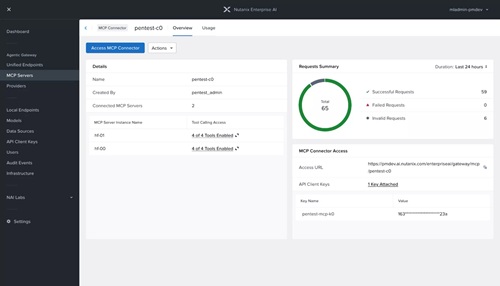
For the modern enterprise, the primary challenge is not just running an AI model, but managing the agents that act upon those models. Agents require secure access to internal systems, data, and infrastructure, which necessitates a robust governance layer. By integrating MCP server management into the Nutanix Agent Gateway, the company has created a centralized control plane. This gateway acts as a broker between AI agents—such as GitHub Copilot, Claude Code, and Cursor—and the underlying infrastructure. Administrators can now implement granular tool permissions, ensuring that an AI agent only interacts with the resources for which it is authorized, while also maintaining an audit trail for compliance purposes.
Technical Deep Dive: NAI 2.8 and MCP Governance
The introduction of NAI 2.8 represents a sophisticated step forward in infrastructure-aware AI. A core component of this release is the enhanced governance provided by the Agent Gateway. Within this framework, administrators can assign specific API keys and permissions to AI agents, effectively creating a "sandbox" for automation. This is particularly relevant for enterprises operating in regulated industries, where the "black box" nature of AI agents has historically been a barrier to adoption.
Furthermore, the extension of Nutanix Private Inference capabilities addresses the hardware-software gap. NAI 2.8 introduces fine-tuning support for models under 8 billion parameters, a sweet spot for many localized enterprise tasks. Perhaps more significant for high-performance environments is the tech preview of multi-node and multi-GPU inference. By allowing organizations to scale across multiple physical nodes, Nutanix is positioning its platform to handle models exceeding 100 billion parameters—a scale previously reserved for massive hyperscale data centers.
However, the company has been transparent about the current limitations of these features. By designating multi-node inference and KV cache offloading from GPU memory to CPU host memory as "tech previews," Nutanix is signaling to the market that while these features are functional, they require further hardening before being deployed in mission-critical, production-heavy workloads. This cautious approach is standard practice in enterprise infrastructure, reflecting a commitment to stability over "bleeding-edge" instability.
NKP 2.19 and the Future of Bare-Metal Orchestration
While NAI 2.8 focuses on the intelligence layer, the upcoming Nutanix Kubernetes Platform (NKP) 2.19 addresses the underlying orchestration challenges. Expected to launch in the near term, NKP 2.19 aims to unify management across virtualized and bare-metal environments. The inclusion of "NKP Metal" is a direct response to the demand for high-performance computing (HPC) and AI workloads that perform optimally when running directly on physical hardware without the abstraction overhead of a hypervisor.

The integration of an AI Applications Catalog within NKP 2.19 further streamlines deployment. By offering validated, pre-configured software stacks for tools like Kubeflow (for machine learning workflows), Milvus (for vector database management), and Slurm (for workload scheduling), Nutanix is effectively acting as a curator for the AI tech stack. This reduces the time-to-value for enterprises that would otherwise spend weeks configuring these complex, interconnected components.
Additionally, the certification of NKP as a CNCF (Cloud Native Computing Foundation) Kubernetes AI Conformant Platform provides a layer of vendor-neutral validation. This is a critical selling point for CTOs and CIOs who are concerned about vendor lock-in. By adhering to open standards, Nutanix ensures that the AI applications developed on its platform remain portable, should the organization decide to shift portions of their workload to public cloud environments in the future.
Broader Implications for the Enterprise
The shift toward agentic AI brings with it a fundamental change in the relationship between IT infrastructure and application developers. Thomas Cornely, executive vice president of product management at Nutanix, emphasized this in the company’s announcement, noting that "Enterprise AI should not require customers to rebuild the systems that already run their business." This philosophy of non-disruptive integration is likely to resonate with large enterprises that have massive sunk costs in existing virtualization stacks.

The introduction of Service Provider Central (SP Central) as a multitenant control plane further underscores the company’s intent to manage the complexity of modern, distributed architectures. As AI becomes an intrinsic part of the application stack, the ability to manage infrastructure, cloud-native services, and AI agents through a single pane of glass is no longer a luxury; it is a requirement for operational efficiency.
From an economic perspective, these updates represent an effort by Nutanix to capture a larger share of the "AI infrastructure" budget. By providing the tools to govern and secure AI, Nutanix is moving up the stack. Rather than merely providing the "plumbing" (storage and compute), the company is providing the "management layer" for intelligence. This creates a higher barrier to exit for customers, as the Nutanix platform becomes deeply embedded in the logic of the enterprise’s AI-driven business processes.
Challenges and Future Considerations
Despite the advancements, the path to fully autonomous production AI remains fraught with challenges. The industry is still in the early stages of establishing best practices for "Agentic Governance." While Nutanix provides the technical controls—such as role-based access, throttling, and metering—the human element remains the most significant variable. Organizations must still define the policies and thresholds that govern how agents behave, what data they can access, and at what point they require human intervention.

Furthermore, the rapid evolution of the AI model landscape means that the infrastructure supporting these models must be exceptionally agile. If a new architecture emerges that requires different memory or compute paradigms, platforms like Nutanix will need to adapt their software-defined layers at an equivalent pace. The company’s move to support NVIDIA NIM microservices in air-gapped environments is a proactive step here, recognizing that many enterprises require the ability to run high-performance AI models in offline or strictly isolated environments for security and data sovereignty reasons.
Conclusion: A Strategic Pivot
The release of NAI 2.8 and the impending arrival of NKP 2.19 mark a pivotal moment for Nutanix. By bridging the gap between infrastructure management and agentic AI, the company is positioning itself as a foundational partner for the next wave of enterprise digital transformation. The emphasis on "dual-native" architecture, combined with robust governance via the Agent Gateway, provides a clear roadmap for organizations that want to embrace AI without compromising the stability and security of their legacy IT environments.
As the industry moves from experimental AI pilots to real-world production deployment, the ability to integrate, monitor, and secure these agents will be the primary determinant of success. For Nutanix, the strategy is clear: provide the tools that allow the enterprise to run production agentic AI on their own terms, within the safety and structure of the platform they already trust. Whether this will successfully fend off the challenges from hyperscale cloud providers and specialized AI hardware vendors remains to be seen, but the company’s focus on governance, portability, and operational continuity provides a compelling value proposition in an increasingly fragmented AI market.










Leave a Reply