
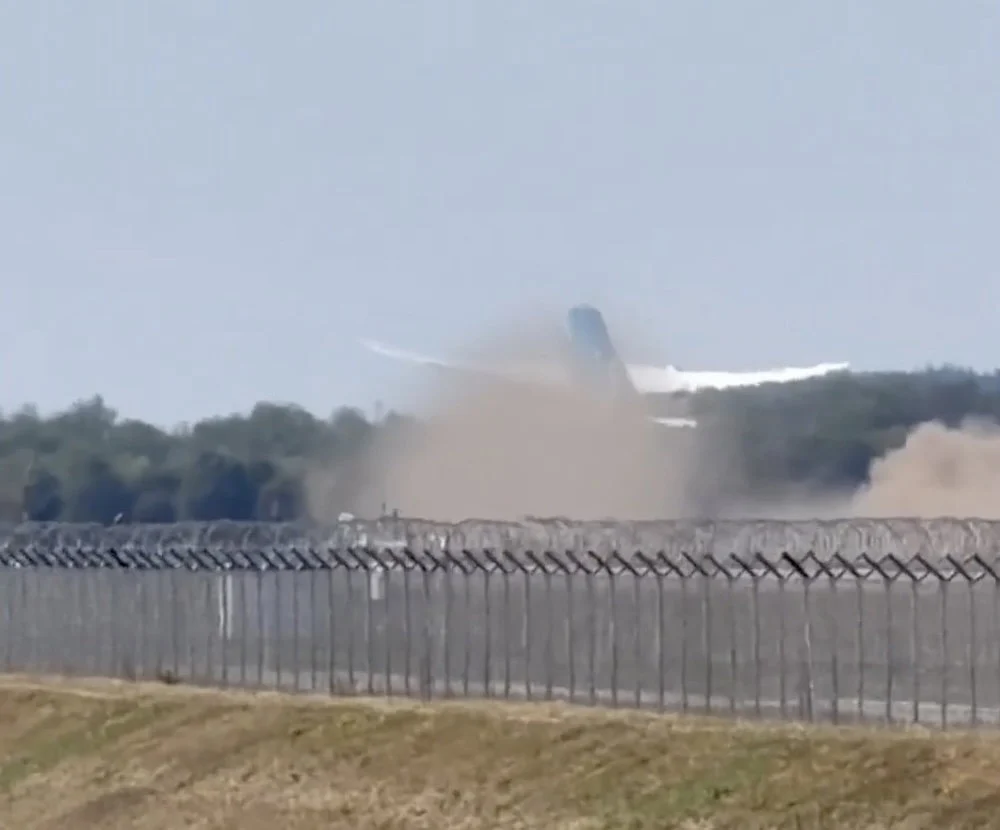
The release of a preliminary investigation report by German aviation authorities has deepened the mystery surrounding a harrowing incident in mid-August 2026, when a Vietnam Airlines Boeing 787-9 narrowly avoided a catastrophic accident during takeoff at Munich Airport. The widebody aircraft, carrying 287 passengers and crew, overran the end of a 13,000-foot runway before finally becoming airborne, sustaining notable damage to ground lighting infrastructure and its own landing gear in the process. While the aircraft ultimately landed safely after entering a holding pattern, investigators are now grappling with an unexpected and perplexing primary finding: physical brake commands were actively recorded from the captain’s station during the critical takeoff roll.
The German Federal Bureau of Aircraft Accident Investigation (Bundesstelle für Flugunfalluntersuchung, or BFU) published its preliminary findings late last month, establishing a baseline of technical data from the aircraft’s flight data recorder (FDR) and cockpit voice recorder (CVR). However, rather than offering immediate clarity on why the heavily laden Dreamliner struggled to achieve the necessary rotational velocity on one of Europe’s longest commercial runways, the disclosure has raised profound operational and human factors questions for global aviation regulators, aircraft manufacturers, and commercial carriers alike.
Chronology of the August 15 Incident
The sequence of events began in the morning hours of August 15, 2026, at Munich Airport (MUC). The Vietnam Airlines flight, scheduled for a long-haul journey back to Southeast Asia, was cleared for departure from one of the airport’s primary, ultra-long runways, which spans well over 13,000 feet—more than sufficient distance for a fully fueled and loaded Boeing 787-9 to safely take off under standard operational conditions.
According to preliminary flight data analysis, the aircraft initiated its takeoff roll normally, with engine thrust levers advanced to takeoff power. However, as the aircraft accelerated down the tarmac, external observers and subsequent telemetry data confirmed that the jetliner was failing to build forward momentum at the expected rate. Despite the immense length of the runway, the aircraft consumed nearly the entire paved surface without reaching rotation speed.
Footage captured by aviation enthusiasts and airport cameras showed the Boeing 787 lumbering past standard takeoff markers, eventually overrunning the paved threshold, colliding with and damaging localizer and runway approach lighting arrays, and dragging its tail structure before finally achieving a marginal, albeit terrifying, positive rate of climb. Following the near-miss, the flight crew declared an emergency, entered a low-altitude holding pattern to burn off excess fuel and assess structural integrity, and successfully executed a precautionary return landing at Munich Airport. No injuries were reported among the 287 occupants, though the aircraft sustained substantial damage to its exterior panels, landing gear assemblies, and tires.
The BFU Preliminary Findings: Active Braking Inputs
In its initial factual report, the BFU confirmed that engine parameters were functioning normally and that the aircraft was properly configured and weighed within legal limits prior to departure. Furthermore, the data showed that takeoff thrust had indeed been applied by the flight crew.
The pivotal breakthrough in the BFU’s preliminary assessment centers on the mechanical control inputs recorded during the high-speed roll. Investigators recovered data indicating repeated and distinct brake pedal depressions originating specifically from the captain’s seating position. During a standard commercial takeoff, pilots rest their feet on the rudder pedals to maintain centerline ground steering, but the top portion of these pedals houses the wheel brakes. Activating the wheel brakes during a takeoff roll directly counteracts engine thrust, robbing the aircraft of the acceleration required to lift off safely.
The revelation that these braking inputs occurred at the captain’s station—rather than the first officer’s—adds a complex human factors layer to the investigation. In commercial aviation protocol, the captain is typically the more senior and experienced aviator, making inadvertent, continuous pedal misapplication an extremely anomalous event.
Unresolved Questions and Operational Implications

The BFU report has left aviation safety experts and investigators with several critical hypotheses to explore, none of which have yet been officially confirmed:
-
Mechanical or Hydraulic Malfunction: Investigators must determine whether a technical anomaly within the Boeing 787’s fly-by-wire rudder and braking systems could have caused unintended hydraulic pressure application to the wheel brakes, independent of pilot foot movement.
-
Pilot Incapacitation or Spatial Disorientation: Human factors specialists are evaluating whether physical interference, medical episodes, or subtle spatial disorientation could have contributed to the captain inadvertently resting their feet heavily on the top of the pedals during the high-stress acceleration phase.
-
Rejected Takeoff Protocol: A secondary mystery centers on cockpit decision-making. If the aircraft was visibly and audibly failing to accelerate correctly down an exceptionally long runway, standard standard operating procedures dictate that the crew should have executed a rejected takeoff (RTO) at a much lower speed rather than attempting to force an underperforming aircraft into the air. Why the crew persisted with the takeoff roll past the normal decision points remains unexplained.
-
Intentional Action: While aviation authorities universally treat intentional acts as a remote and serious possibility requiring exhaustive elimination, comparisons have inevitably been drawn in industry discourse to prior, unrelated widebody incidents involving Boeing 787 aircraft, such as historical control anomalies and tragic takeoff irregularities globally. The BFU has not indicated any evidence of malicious intent, but standard protocol requires all behavioral and operational avenues to be thoroughly vetted.
Broader Industry Context and Safety Standards
The incident at Munich underscores the complex interplay between advanced automated flight deck systems and raw human inputs. Modern commercial aircraft like the Boeing 787 Dreamliner rely on millions of lines of software code and highly sensitive sensors to manage everything from engine performance to braking efficiency. When physical inputs contradict expected aerodynamic performance, modern flight data monitoring systems usually capture the discrepancy immediately, but translating those telemetry spikes into a definitive root cause requires months of laboratory simulation, component testing, and exhaustive interviews.
Vietnam Airlines, a SkyTeam alliance member operating a modern fleet of widebody aircraft, has cooperated fully with German authorities and the manufacturer. Boeing has similarly offered technical assistance to the BFU as the agency reconstructs the physical and digital environment of the flight deck on August 15.
Next Steps in the Investigation
The publication of the preliminary report marks only the initial phase of what is expected to be a multi-month, if not multi-year, comprehensive safety investigation. Over the coming months, the BFU will likely release detailed metallurgical analyses of the braking systems, simulator reconstructions recreating the exact weight and balance conditions of the Munich departure, and exhaustive psychological and professional profiles of the flight crew.
Until the final report is published, the aviation community is left to weigh a stark reality: even on a pristine, ultra-long runway with a modern, fully functional aircraft, the invisible barrier of unwanted brake pressure can transform a routine commercial departure into a near-catastrophe. The final conclusions of the BFU will undoubtedly shape future training regimens, cockpit resource management protocols, and mechanical redundancy checks for widebody operations worldwide.









Leave a Reply