

The modern threat landscape has undergone a chilling evolution, as ransomware operators move beyond the traditional digital extortion of corporate servers to directly targeting the personal safety and domestic lives of employees. According to the 2026 Ransomware Risk Report, published by identity security firm Semperis, the shift marks a significant escalation in the tactics employed by cybercriminal syndicates. By leveraging artificial intelligence to increase the precision and psychological intensity of their campaigns, these actors are no longer merely seeking to paralyze business operations; they are systematically dismantling the firewall between professional duty and personal safety.

The study, which synthesized data from 1,200 information technology and security professionals across nine countries and eight major industry sectors, focuses exclusively on organizations that have endured disruptive ransomware events. This specific methodology provides a stark, ground-level perspective on the current state of cybersecurity, illustrating that for many firms, the question is no longer "if" a breach will occur, but how catastrophic the subsequent pressure campaign will become.
The Weaponization of Artificial Intelligence
The report’s most alarming finding centers on the pervasive use of artificial intelligence in orchestrating these attacks. Data indicates that 84% of surveyed organizations encountered attacks where AI played a pivotal role. This figure is bifurcated into two distinct categories: 40% of victims identified the use of external AI tools to craft more convincing phishing schemes and automated reconnaissance, while 44% reported the more sophisticated exploitation of the victims’ own internal AI agents and automated infrastructure.
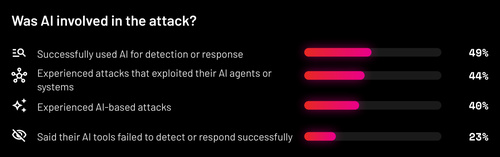
Chris Inglis, the former U.S. national cyber director and a strategic adviser to Semperis, characterizes this new generation of attacks as "slick and sophisticated." Inglis notes that many organizations fail to recognize AI’s presence in a breach until it is too late, precisely because the automation allows attackers to mirror legitimate traffic patterns and administrative behavior. The implication is that as companies rush to integrate AI for operational efficiency, they are simultaneously expanding their attack surface. When a company’s AI-driven resource manager is compromised, the attacker gains an internal vantage point that is difficult to distinguish from an authorized administrator.
Defensive efforts to counter these threats have yielded inconsistent results. While 49% of respondents reported successful integration of AI tools for threat detection and incident response, nearly a quarter of those surveyed—23%—stated that their defensive AI systems failed to identify the breach entirely. This discrepancy suggests a high-stakes arms race where the velocity of offensive AI currently outpaces the maturity of defensive deployments.
A Chronology of Escalation: From Encryption to Intimidation
To understand the severity of this shift, one must examine the evolution of ransomware tactics over the past decade. In the mid-2010s, ransomware was primarily a nuisance, involving the simple encryption of data with a demand for payment in exchange for a decryption key. By 2020, the model shifted toward "double extortion," where attackers exfiltrated sensitive data before encrypting it, threatening to release the information publicly if the ransom remained unpaid.
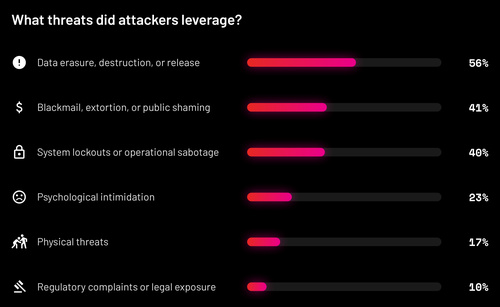
By 2024, the tactics grew more aggressive, incorporating distributed denial-of-service (DDoS) attacks to compound the operational stress on victims. The 2026 data indicates that the industry has now entered the era of "multi-vector intimidation." The core tactics reported by victims are as follows:

- Data Destruction and Leakage (56%): The primary method of extortion, involving the threat of permanently erasing critical corporate data or leaking proprietary intellectual property.
- Public Shaming and Blackmail (41%): An attempt to leverage the reputation of the enterprise by leaking customer data or private communications.
- Operational Sabotage (40%): The deliberate disruption of critical systems to force a quick, panicked payout.
- Psychological Intimidation (23%): Direct contact with employees, using stolen personal information to create a sense of persistent, inescapable surveillance.
- Physical Threats (17%): The most extreme frontier of the current landscape, involving threats against the lives or wellbeing of executives, employees, and their immediate family members.
The Human Cost: Security Beyond the Perimeter
The transition to targeting families represents a profound shift in the psychological warfare of cybercrime. By reaching out to the homes of employees, attackers are bypassing the hardened perimeters of enterprise security. This strategy exploits the emotional vulnerabilities of personnel, forcing them to weigh their corporate responsibilities against the safety of their households.
From a tactical perspective, this is a calculated attempt to break the resolve of the incident response teams. If a Chief Information Security Officer (CISO) or a network administrator is being contacted via their private mobile device with details about their children’s school or their home address, the psychological toll is immense. This shift makes it increasingly difficult for organizations to maintain a unified front in refusing ransom payments, as the pressure moves from the boardroom to the dinner table.
Analytical Implications for Enterprise Strategy
The findings from the Semperis report suggest that current cybersecurity frameworks—which remain heavily focused on perimeter defense and endpoint security—are insufficient to address the human element of these threats. The rise in physical and psychological intimidation necessitates a re-evaluation of how organizations protect their staff.
- Privacy as Security: The ease with which attackers gain access to employee personal data suggests that "security through obscurity" is no longer a viable strategy. Enterprises must help employees scrub their personal data from public information aggregators and social media, as this information is frequently used to facilitate the threats mentioned in the report.
- Crisis Management Evolution: Traditional incident response plans are designed to recover data and restore systems. They are rarely equipped to handle the emotional and physical safety concerns of staff. Future crisis management plans must include protocols for threat assessment regarding employees and the provision of mental health and physical security support.
- The AI Paradox: Organizations are currently trapped in an AI paradox. They must utilize AI to defend against AI-driven threats, yet the deployment of these systems introduces new vulnerabilities. The report underscores the need for "human-in-the-loop" verification for any AI system that holds administrative privileges or access to sensitive data.
Future Outlook and Official Industry Response
While industry bodies and government agencies, such as the Cybersecurity and Infrastructure Security Agency (CISA) and the FBI, have long warned against the payment of ransoms, the emergence of physical threats complicates this policy. When the threat moves from data to human life, the calculus for many victims shifts immediately toward resolution at any cost.

The Semperis report serves as a wake-up call for the broader security industry. The "2026 Ransomware Risk Report" highlights that the digital and physical worlds have effectively merged in the eyes of the cybercriminal. As the barrier to entry for AI-driven attack tools continues to drop, the frequency of these high-pressure campaigns is expected to rise.
The recommendation from security experts is clear: enterprises must move toward a model of "Identity Resilience." This involves ensuring that even if an attacker gains entry, their ability to pivot, exfiltrate data, or identify the personal contact details of employees is strictly limited by robust, identity-centric security controls.

In conclusion, the 2026 data provides empirical evidence that ransomware is no longer just a technical failure—it is a human crisis. The shift toward targeting employees and their families forces a fundamental rethinking of the cybersecurity mandate. It is no longer enough to protect the server; the security community must now recognize the need to protect the individual in a digital environment where the walls of the corporate office no longer provide a sanctuary. As attackers continue to iterate on these predatory models, the resilience of the human element will be tested as severely as the resilience of the underlying IT infrastructure.









