Shania Twain, the undisputed Queen of Country Pop, finally graced the hallowed stage of Toronto’s iconic Horseshoe Tavern on Friday night, a venue that has long held a special place in her aspirations. This intimate "underplay" performance, a stark contrast to the stadium tours that have defined her recent career, offered fans a rare glimpse into the heart of her artistry, weaving together beloved hits with deeply personal narratives from her forthcoming album, Little Miss Twain. The sold-out show, a testament to Twain’s enduring popularity and the mystique of the historic venue, provided a poignant full-circle moment for the global superstar.
The evening commenced with Twain expressing her long-held desire to perform at the Horseshoe, a landmark that has witnessed the rise of countless musical legends. Having recently captivated audiences as a special guest for Harry Styles’ stadium shows in London, Twain’s decision to return to a venue with a capacity of just 500 attendees underscored the significance of this particular performance. It served as a platform to road-test new material from Little Miss Twain, an album deeply rooted in her autobiographical experiences, alongside the pop anthems that have propelled her to sell over 100 million albums worldwide. The contrast between the grand arenas and this intimate setting highlighted Twain’s commitment to connecting with her audience on a more personal level, a characteristic that has always defined her appeal.
The concert was far more than just a musical performance; it was a narrative journey through Twain’s formative years in Timmins, Ontario. She shared evocative anecdotes of her upbringing in "the North," recalling vivid memories of her mother, her father, his truck, and the nascent stages of her love for driving, which began at the tender age of ten. These personal reflections, woven into the fabric of her new songs, spoke of ripped blue jeans, imagined fantasy men, and other deeply resonant moments that have shaped her life and career. The emotional weight of these lyrics was palpable, prompting Twain to repeatedly sing verses unaccompanied after the full band had concluded a song, ensuring that every word resonated with the captivated audience. This dedication to conveying the emotional core of her new work demonstrated a profound artistic integrity.
Tickets for this exclusive event, priced at $40 (approximately $30 USD), vanished within minutes of their release and were strictly non-transferable, reflecting the immense demand for this unique opportunity. A limited number of tickets were allocated to contest winners, industry professionals, media representatives, and invited guests, further intensifying the exclusivity of the night. Those who couldn’t secure entry listened from the sidewalk, their proximity to the legendary venue offering little solace as the stage’s location in the venue’s rear prevented any visual connection to the five-time Grammy winner. The sheer enthusiasm of fans, even those unable to gain entry, underscored Twain’s status as a cultural icon.
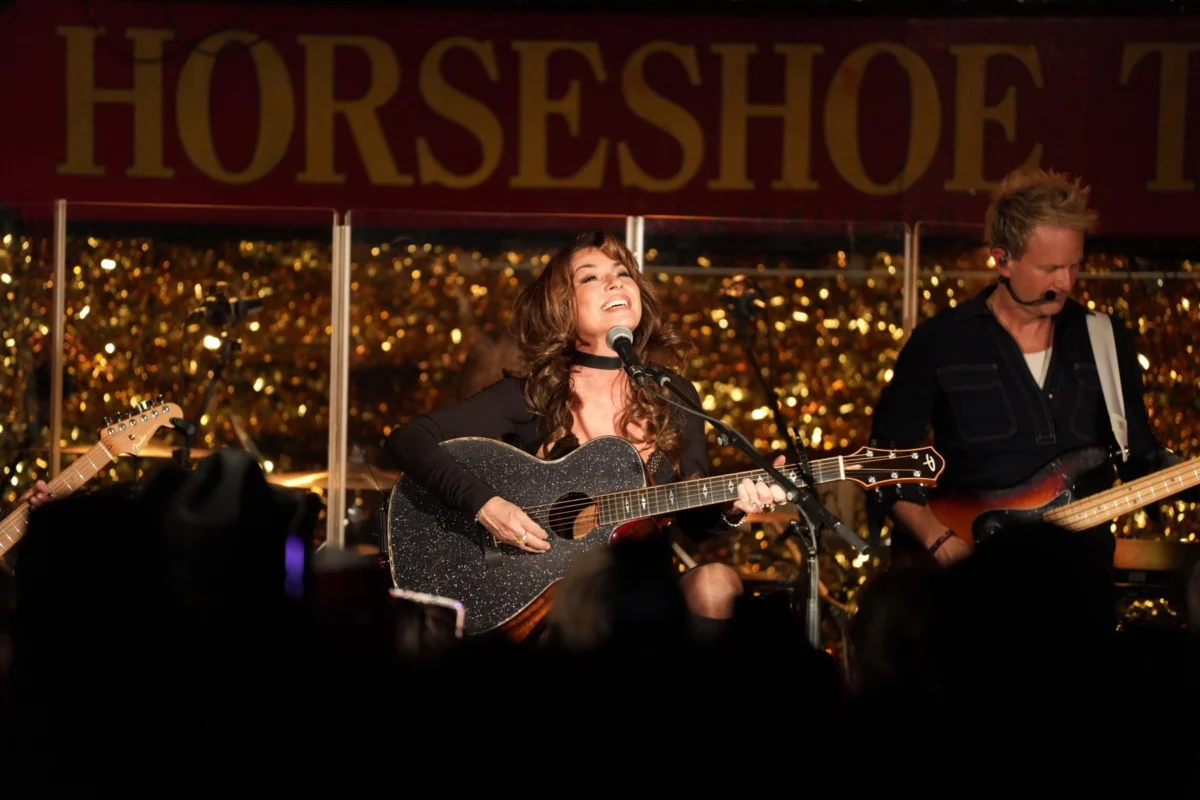
At 60 years old, Twain, still radiating charisma and a youthful spirit, initiated the 75-minute set with two of her most iconic hits: "Come On Over" and "Any Man of Mine." She immediately declared it "the best night ever," a sentiment that seemed to genuinely reflect her joy at finally fulfilling a lifelong ambition. Dressed in a striking black bodysuit, shrug, tights, and knee-high suede boots, her layered, loosely curled hair adding to her timeless glamour, Twain took to the stage. Seated on a stool, her sparkly silver acoustic guitar in hand, she was framed by the venue’s glittering backdrop and its prominent logo, creating a visually compelling tableau.
"I grew up in northern Ontario. The dream in my little bar bands at the time, all through my youth and my teens, and even into my 20s, was to play the Horseshoe Tavern," Twain candidly shared with the audience. "But we just weren’t established enough, so… this is my first time in the Horseshoe Tavern." This admission highlighted the humble beginnings of a career that would ultimately redefine country music and achieve global superstardom. The Horseshoe Tavern, a cornerstone of Toronto’s music scene for nearly eight decades, has a rich history that predates Twain’s own musical journey, making her eventual performance there a significant milestone.
The Historic Canvas: The Horseshoe Tavern’s Enduring Legacy
The Horseshoe Tavern, established in 1947, stands as a venerable institution amidst Toronto’s evolving urban landscape. Its storied walls have absorbed the echoes of countless musical performances, cementing its reputation as a crucible of artistic expression. Originally conceived by Jack Starr as the "Grand Ole Opry of the North," the venue has transcended its country roots to embrace a diverse spectrum of genres. The roster of artists who have graced its stage reads like a who’s who of musical history, including country legends like Waylon Jennings, Loretta Lynn, Conway Twitty, and Willie Nelson, alongside Canadian rising star Josh Ross. The venue’s ability to adapt and remain relevant is evidenced by performances from rock titans such as the Rolling Stones, the Ramones, Foo Fighters, and Bryan Adams.
A particularly poignant connection to the Horseshoe Tavern’s legacy is the enduring memory of Stompin’ Tom Connors. Twain, who has previously paid homage to Connors, even imitating his signature foot-stomping during a performance in London, acknowledged his deep connection to "The ‘Shoe." Connors was such a fixture at the venue that he is immortalized in a mural alongside the late Gord Downie of The Tragically Hip, a powerful visual testament to their indelible impact on Canadian music. Twain’s acknowledgment of these iconic figures underscored her respect for the venue’s history and its place within the broader narrative of Canadian music.
"I’m finally here, and I feel like it’s a very full circle moment," Twain continued, her voice filled with emotion. "This is so historical. It’s a privilege to be here – finally." Her words encapsulated the profound significance of the occasion, a moment where past dreams met present reality on a stage steeped in musical lore.
A Deeper Dive into Little Miss Twain: Autobiographical Roots and Musical Evolution
Backed by a versatile six-piece band, including four female musicians and her long-serving music director Brent Barcus, Twain demonstrated her prowess as a guitarist throughout the evening, accompanying herself on nearly every song. She candidly acknowledged the spontaneous nature of the performance, admitting to occasional minor technical adjustments and lightheartedly confessing to not yet having all the lyrics memorized, having only recently recorded them. This transparency fostered an intimate atmosphere, allowing the audience to feel like active participants in the creative process.
The evening’s narrative thread began to weave with the introduction of "Dirty Rosie," the lead single and opening track from Little Miss Twain, slated for release on July 24th. Twain described the song as being inspired by "my favorite truck," an iconic vehicle that also features prominently in the song’s music video. She vividly recounted her childhood on the unpaved backroads and gravel paths of Timmins, Ontario, a landscape of dense bush where she learned to drive at the age of ten in her father’s pickup truck. "I thought, ‘Someday, if I ever have my own truck, it won’t be shiny and clean; it would be a truck that had purpose,’" she explained, drawing a parallel between the utilitarian nature of her childhood truck and the enduring spirit of resilience she embodies.
The song "I’d Be Loving Me" emerged from a jam session with musicians who had previously collaborated on Motown records, a confluence of influences that Twain described as her "soul side coming out." This track delved into her youthful experiences and her perceptions of the "big city" of Toronto, a place that represented a world of possibilities beyond her northern upbringing. The song served as a bridge between her past and present, reflecting on the dreams and aspirations that fueled her journey.
Following this soulful exploration, Twain presented "Stranger Things," another track from the forthcoming album, characterized by its rich harmonies. She articulated that this song served as a thematic anchor for the entire Little Miss Twain project, encapsulating her reflections on her life growing up in Northern Ontario. "There’s snow and trees and lakes and rivers and gold in the ground and all the things that we are about Ontario," she described, painting a sonic landscape that evoked the natural beauty and inherent richness of her home province.
A particularly charming anecdote accompanied the song inspired by her childhood "fantasy man." Twain reminisced about her idealized vision of a lumberjack-type partner, someone who could match her own robust capabilities. "I mean, I can chop wood, I can trap. Ontario girls, I can change tires," she declared, humorously describing a man twice her size who "filled up a door frame, like a Daniel Boone figure." This song, a testament to youthful imagination and the construction of romantic ideals, resonated with the audience’s own experiences of formative dreams.
Twain then masterfully transitioned back to her extensive catalog, delivering the crowd-pleasing hits "That Don’t Impress Me Much" and "You’re Still the One." The audience erupted with enthusiasm, their phones held aloft as they sang along to every word. She then introduced "Faded Blue Jeans," a new track featuring Queens of the Stone Age singer Josh Homme. This song, she explained, was a literal ode to her perpetually stylish, hole-ridden denim, a garment that had weathered the ebb and flow of fashion trends and served as a silent witness to significant life moments.
While her father featured prominently in her narratives, it was her mother who emerged as a towering influence throughout the evening. Twain fondly recalled her mother as "my driver, my manager and my agent." She revealed her mother’s profound dream: for Twain to become a child country music star. Though her mother tragically passed away before witnessing her daughter’s immense success, her ambition for Twain to be "the next Tanya Tucker" – who also features on the album’s title track – underscored the deep-seated belief in her daughter’s talent. This poignant remembrance added another layer of emotional depth to the performance.
Encore and Enduring Impact
As the concert drew to a close, Twain brought the house down with "Man! I Feel Like A Woman!," a song that has transcended its origins to become a karaoke anthem. She playfully held out the microphone, encouraging the entire venue to join in, creating a unified celebratory moment. Seemingly caught off guard by the audience’s fervor for an encore, Twain acknowledged the spontaneous nature of the evening, stating, "We’re flying by the seat of our pants." Amidst a chorus of fan suggestions, she settled on her 2023 hit, "Giddy Up!." "Don’t forget to lasso," she urged the crowd, inciting them to dance and embrace the song’s infectious energy. "I’ll be broken-hearted if you don’t lasso."
Ultimately, the concert’s success lay in its genuine spontaneity and Twain’s palpable joy in being at the Horseshoe Tavern. Her willingness to delve into the deeply personal narratives of her new songs, which clearly hold immense significance for her, resonated profoundly with the audience. Despite the triumphant performance, the practicalities of touring at Twain’s level were evident; a large trailer occupied the venue’s parking lot, suggesting that while the dive bar’s stage was a dream realized, its green room accommodations were perhaps not quite befitting a superstar of her stature. Nevertheless, the night at the Horseshoe Tavern served as a powerful reminder of Shania Twain’s enduring connection to her roots, her unwavering commitment to authentic storytelling, and her remarkable ability to captivate audiences across generations and venues, from the grandest stadiums to the most intimate, legendary stages.