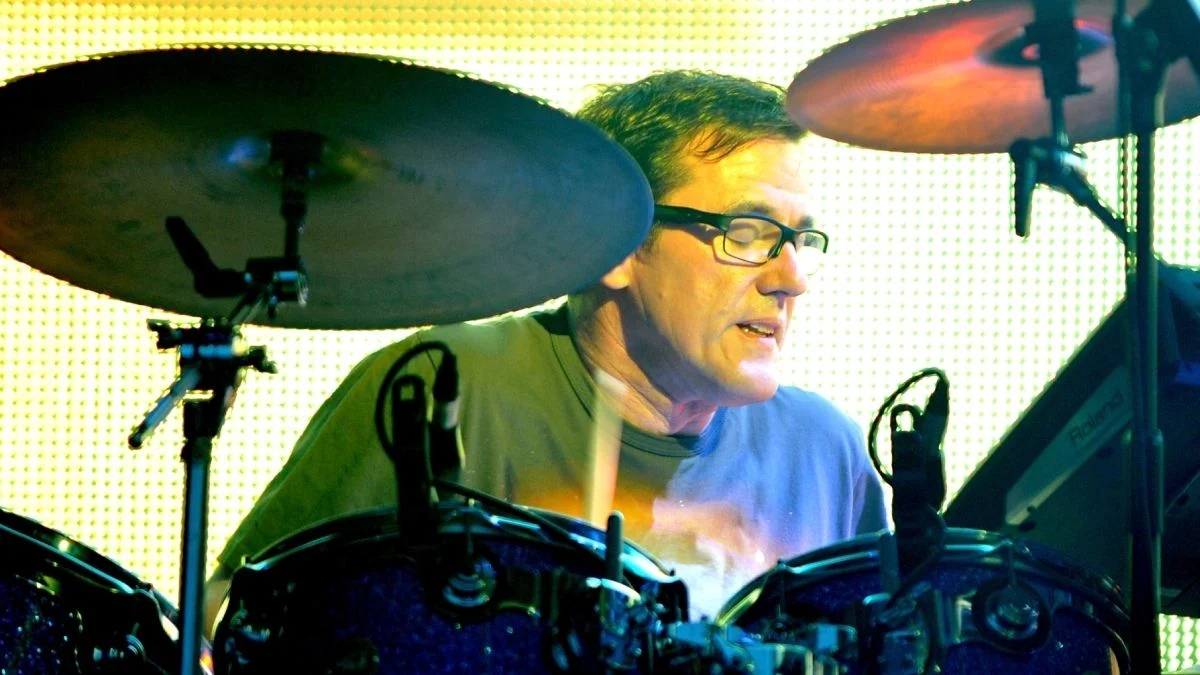
The landscape of post-punk and electronic music history faces a period of profound uncertainty as Stephen Morris, the legendary percussionist for both Joy Division and New Order, has publicly acknowledged that his return to live touring with the latter remains highly improbable. Morris, who has been a foundational pillar of the Manchester music scene for nearly five decades, recently disclosed that he is battling a health condition he characterizes as "pretty serious." This revelation comes on the heels of a formal announcement made in June 2026, wherein both Morris and his wife, keyboardist Gillian Gilbert, signaled their withdrawal from the road for the foreseeable future.
A Career Defined by Rhythm and Resilience
To understand the gravity of this departure, one must look at the immense cultural footprint left by Morris. From his precision-engineered drumming that defined the transition from the melancholic post-punk of Joy Division to the pioneering dance-rock synthesis of New Order, Morris has been an ever-present force. His partnership with Gillian Gilbert—a duo that has maintained a consistent presence through the band’s various iterations, hiatuses, and reunions—has been integral to the sonic architecture of tracks ranging from "Love Will Tear Us Apart" to "Blue Monday."
The decision to step back from live performance is not merely a logistical change for New Order; it represents a significant shift in the band’s operational capacity. The couple’s decision, originally framed as a necessary break for "personal health reasons," has now been clarified by Morris as a chronic and challenging reality. In a candid interview with Rolling Stone, Morris remarked, "I don’t know. I really don’t want to dwell on what this illness is, but it’s pretty serious. It’s not something that someone’s going to come up with a cure for."
Chronology of Recent Events
The trajectory leading to this announcement has been marked by a series of quiet retreats from the public eye.
- June 2026: New Order releases an official statement confirming that Stephen Morris and Gillian Gilbert would cease touring indefinitely due to health concerns.
- Late Summer 2026: The pair attempted a brief excursion to New York City to support an exhibition celebrating the late Ian Curtis’s lyricism. Morris described this attempt as a "disaster," noting that the travel requirements placed an unsustainable strain on his physical condition.
- September 2026: Leading up to the release of the expansive Eternal (Live) box set, Morris provides further context, confirming that his condition limits his ability to travel outside of the United Kingdom for extended periods.
- November 2026 (Upcoming): New Order is scheduled for a significant South American tour, beginning in São Paulo, Brazil. Morris and Gilbert will be absent from these dates, forcing the band to navigate the logistical and emotional challenges of performing without two of their core members.
The Logistics of a Changing Tour
The upcoming South American tour—a key series of performances spanning Brazil, Chile, Argentina, Peru, and Colombia—will serve as a test case for the band’s longevity. Since their formation in 1980 following the dissolution of Joy Division, the internal dynamics of the band have often been scrutinized. However, the current absence of Morris and Gilbert is strictly medical, marking a departure from the interpersonal fractures that previously saw the departure of bassist Peter Hook.
From a production standpoint, the absence of a drummer of Morris’s caliber is difficult to mitigate. His technique—often described as a human metronome blending organic percussion with the programmed precision of early drum machines—is a signature element of the New Order sound. While the band has not yet announced permanent touring replacements, the industry standard for such acts involves high-level session musicians who are tasked with replicating a legacy sound that is deeply embedded in the public consciousness.
Rock & Roll Hall of Fame Induction
Adding a layer of emotional complexity to these health challenges is the band’s impending induction into the Rock & Roll Hall of Fame. The ceremony, slated for November 14, 2026, in Los Angeles, was intended to be a moment of historical consolidation. Joy Division and New Order are being inducted as a collective unit, a recognition that finally honors the legacy of Ian Curtis alongside the remaining original members: Bernard Sumner, Peter Hook, Gillian Gilbert, and Stephen Morris.
Given Morris’s current travel restrictions, his attendance at the gala is considered highly unlikely. The industry is currently watching to see how the ceremony will acknowledge the members who cannot be present. The induction itself is significant, as it acknowledges the band’s role in bridge-building between the DIY ethic of the late 70s and the emergence of the global dance-pop phenomenon in the 80s.
The Creative Future: A "Door Cracked"
Despite the grim prognosis regarding his health and his ability to engage in global touring, Morris has been emphatic about his commitment to the creative process. Music, for Morris, is not merely a vocation but a fundamental aspect of his identity. "I can’t really not do music," he asserted.
This distinction between "touring" and "creating" is vital. While the rigors of long-haul flights, jet lag, and the physical endurance required for two-hour sets have become untenable, Morris remains engaged with his bandmates—Bernard Sumner, Phil Cunningham, and Tom Chapman. He hinted that studio work or localized, low-intensity performances might still be within reach. "If it was a gig down the road, I’m sure we’d be all right," he noted. This suggests that while the "New Order" touring juggernaut may have reached a structural turning point, the creative unit remains intact, potentially shifting its focus toward studio production and smaller, highly curated events.
Market and Cultural Implications
The broader implication of Morris’s withdrawal is the realization that the "classic" era of late 20th-century British alternative music is entering a stage of physical fragility. As these foundational artists age, the industry is witnessing a transition from a touring model to a legacy management model. The release of the Eternal (Live) box set on September 25, 2026, is a reflection of this transition. Comprising 14 CDs, two DVDs, and chronicling 16 distinct concerts, the collection is designed to capture the visceral energy of a time when the band was consistently on the road.
For the music industry, this serves as a reminder of the finite nature of live performance. Ticket holders for upcoming shows are being forced to reconcile their expectations of seeing "the original band" with the reality of medical necessity. As the band moves into this new phase, the focus will likely shift toward protecting the legacy of their work while managing the evolving capabilities of the individuals who created it.
Conclusion: A Legacy Beyond the Stage
The narrative of Stephen Morris is not one of ending, but of adaptation. While the physical toll of his "pretty serious" illness has curtailed his ability to traverse the globe, his contributions to music are firmly established in the canon of rock history. Whether or not he steps back onto a global stage, his influence remains audible in the work of countless electronic and post-punk bands that have emerged in his wake.
As the industry and fans look toward the November induction, the focus remains on celebrating the body of work that has defined generations. The "pretty serious" nature of his health challenges serves as a sobering reminder of the humanity behind the music, yet Morris’s continued dedication to his craft offers a glimmer of hope that the sound of New Order will continue to evolve, even if the methods of its delivery must change to meet the realities of the present.