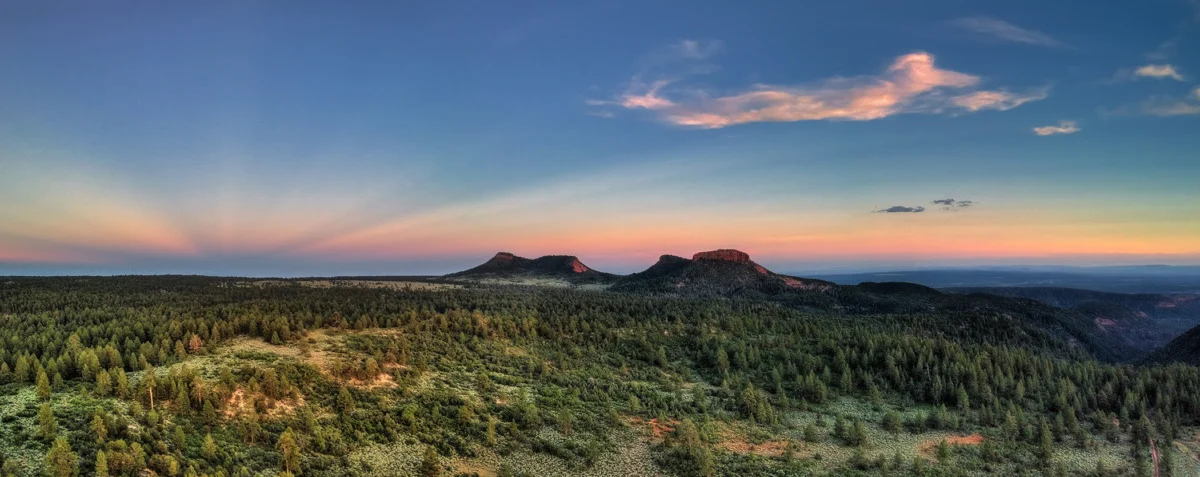
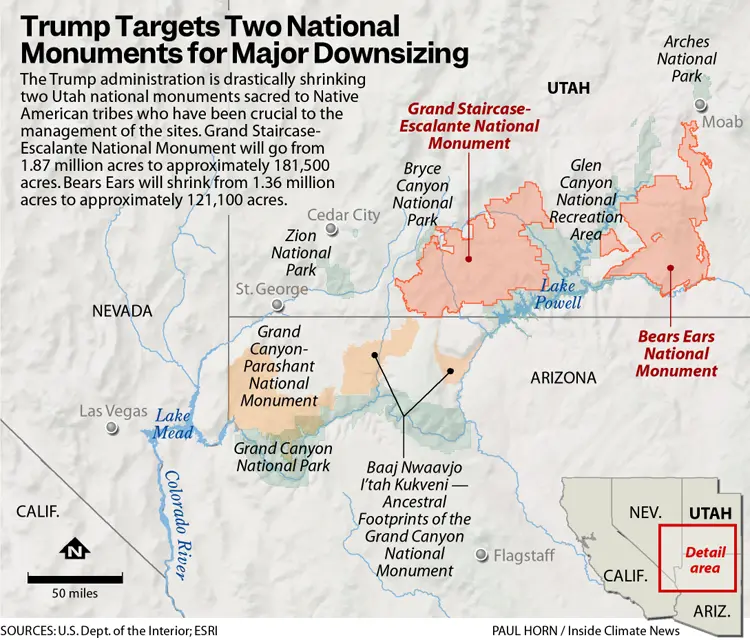
In a move that has reignited one of the most contentious legal and environmental battles in American history, President Donald Trump signed two executive orders on Monday drastically reducing the size of the Bears Ears and Grand Staircase-Escalante National Monuments in southern Utah. The orders effectively strip protections from nearly 3 million acres of public land, downsizing the monuments to a combined total of just 302,600 acres. This action represents a significant escalation from the administration’s previous efforts to shrink the monuments during its first term, signaling a robust shift toward prioritizing industrial extraction and local land control over federal conservation and Tribal co-stewardship.
By Monday evening, the vast landscapes that previously safeguarded thousands of archaeological sites and sensitive ecosystems were partitioned, leaving only a fraction of their former selves. Bears Ears National Monument, which covered 1.36 million acres at the start of the day, was reduced to a mere sliver of its original footprint. Similarly, Grand Staircase-Escalante, which spanned roughly 1.87 million acres, saw its boundaries retracted to levels far below even the 2017 reductions. The administration stated that these changes would take effect in 60 days, at which point the excised lands will be reopened to potential mining, drilling, and commercial grazing.
A History of Contested Borders: The Monument Timeline
The conflict over these Utah lands has spanned three decades, characterized by a "pendulum policy" where successive presidential administrations have used executive power to either expand or contract the protected areas.
Grand Staircase-Escalante was first established by President Bill Clinton in 1996, using his authority under the Antiquities Act of 1906. The move was met with immediate hostility from Utah’s Republican leadership, who viewed it as federal overreach that locked away valuable coal and mineral deposits. Two decades later, in December 2016, President Barack Obama designated Bears Ears National Monument, a move specifically requested by a coalition of five Tribal Nations—the Navajo, Hopi, Zuni, Ute Mountain Ute, and Ute Indian Tribes—to protect sacred sites from looting and uranium mining.
The first major disruption to these protections occurred in December 2017, when President Trump signed proclamations to reduce Bears Ears by 85 percent and Grand Staircase-Escalante by nearly 50 percent. Those reductions were later reversed by President Joe Biden in 2021, who restored the monuments to their original boundaries and added further protections. Monday’s executive orders do not merely return the monuments to their 2017 levels; they go significantly further, leaving the monuments at less than a quarter of the size they were during the first Trump-era reduction.
Extraction and Economic Objectives
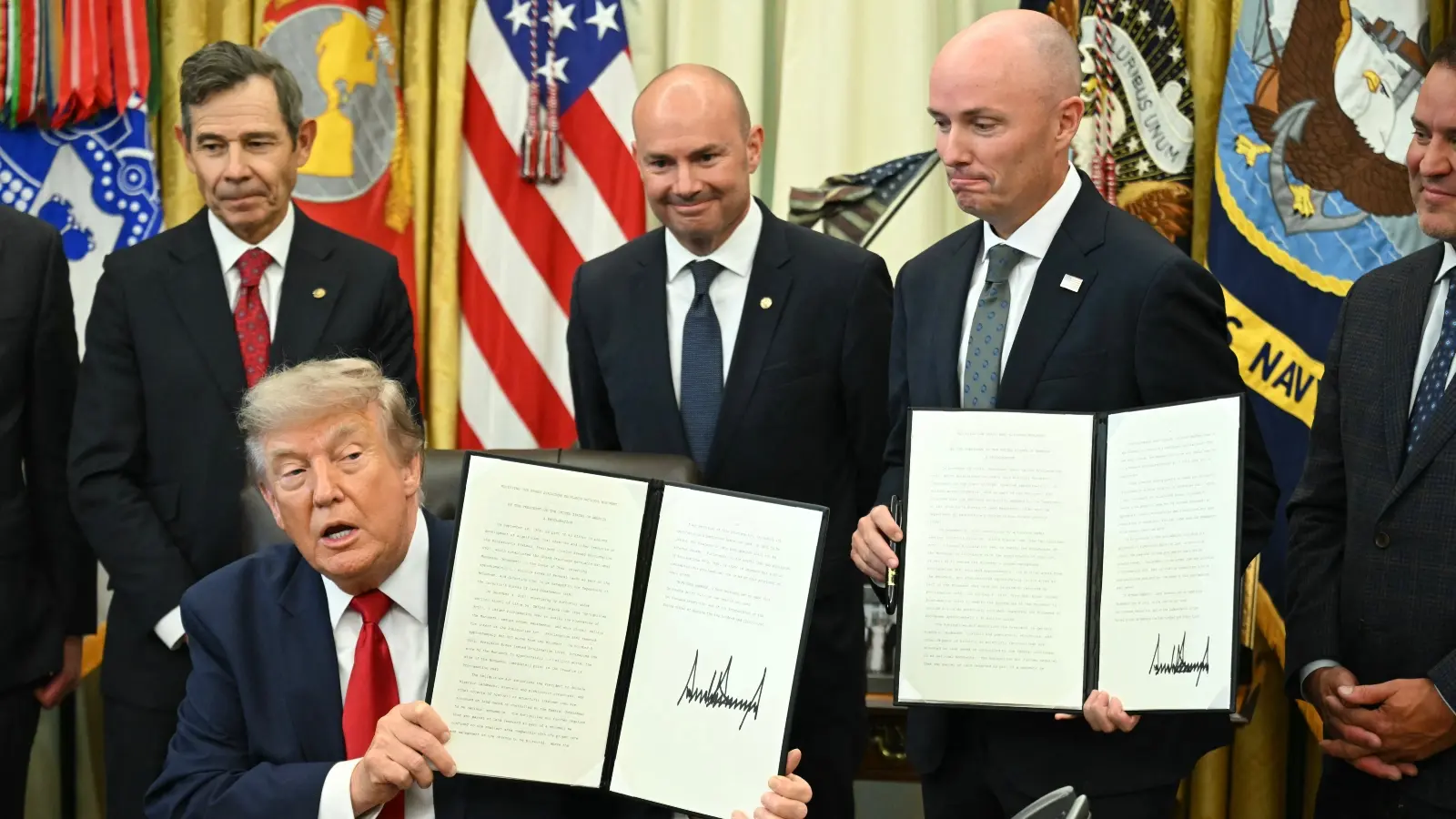
The central justification provided by the White House for the reductions is the promotion of "energy independence" and the removal of federal barriers to economic development. Flanked by Utah’s Republican congressional delegation, President Trump argued that the monument designations had placed "unfair" restrictions on the public. He claimed that the protections made it "virtually impossible" for citizens to hunt, fish, or even walk on the land—claims that have been repeatedly refuted by the Bureau of Land Management (BLM) and the U.S. Forest Service, both of which confirm that these activities remained legal under previous management plans.
However, the primary interest lies beneath the soil. The regions excised from the monuments are known to contain significant deposits of uranium, oil, gas, and coal. In the San Juan County area surrounding Bears Ears, uranium mining has a long and troubled history, particularly for the Navajo Nation. In the Kaiparowits Plateau of Grand Staircase-Escalante, one of the largest untapped coal deposits in the United States remains a focal point for energy companies.
John Ruple, a law professor and program director at the University of Utah’s Wallace Stegner Center, noted that the administration’s transparency regarding its motives is a departure from the more nuanced legal arguments of the past. "He’s saying the quiet part out loud," Ruple said. "He’s being honest: I’m doing this so that we can mine and drill and graze cows."
The Dismantling of Tribal Co-Stewardship
Perhaps the most significant social impact of the executive orders is the termination of the inter-tribal working group for Bears Ears. This coalition was the cornerstone of a historic co-stewardship agreement between the federal government and sovereign Tribal Nations. It was the first of its kind, intended to integrate traditional Indigenous knowledge with federal land management to protect sites that hold deep spiritual and ancestral significance.
Tribal leaders expressed profound disappointment and anger, stating they were not consulted prior to the signing of the orders. Davina Smith-Idjesa, a member of the Navajo Nation and a representative for both monuments’ inter-tribal coalitions, described the decision as a erasure of Indigenous presence.
"Bears Ears is at my back door," Smith-Idjesa said during a press conference on Tuesday. "This is not a political talking point for me. This is home. My ancestors knew this land. I know where our people go to pray, to gather medicines, to gather food and to heal. This is our grocery store, our medicine cabinet, our classroom, our church."
She emphasized that the health of her community is directly tied to the land, citing the legacy of uranium mining in the Four Corners region which has left a trail of illness and environmental degradation among Tribal members.
Legal Precedent and the Antiquities Act
The legal validity of the President’s orders is expected to be challenged almost immediately in federal court. At the heart of the dispute is the Antiquities Act of 1906. The Act grants the President the authority to designate "historic landmarks, historic and prehistoric structures, and other objects of historic or scientific interest" as national monuments. However, the law is silent on whether a President has the authority to abolish or significantly reduce a monument once it has been created.
Legal scholars, including Ruple, argue that the power to rescind or shrink a monument rests solely with Congress. While the Act requires that a monument be "the smallest area compatible with the proper care and management of the objects to be protected," environmental groups argue that the 3-million-acre landscape is an interconnected archaeological and biological unit that cannot be protected in fragmented pieces.
The administration’s move follows a June decision by the 10th Circuit Court of Appeals, which revived a lawsuit from the state of Utah challenging President Biden’s restoration of the monuments. By shrinking the monuments now, the Trump administration may be attempting to render that ongoing litigation "moot," effectively resetting the legal clock and forcing environmental and Tribal groups to start the litigation process from scratch.
Broader Policy Context: Project 2025 and Beyond
The reduction of the Utah monuments is not an isolated event but part of a broader strategy outlined in "Project 2025," a policy blueprint for the second Trump administration coordinated by the Heritage Foundation. The document explicitly calls for the reduction of several national monuments and suggests the total repeal of the Antiquities Act to prevent future presidents from "locking up" federal lands.
Earlier this year, the administration signaled its intent to target other protected areas, including California’s Chuckwalla and Sáttítla Highlands. Furthermore, the Department of Justice recently issued an opinion asserting that the President does indeed have the power to eliminate national monuments, a significant shift in legal interpretation that emboldens the executive branch to bypass congressional oversight in land management.

Responses and Public Sentiment
The reaction from Capitol Hill was swift and divided along party lines. Utah Governor Spencer Cox and the state’s Republican senators praised the move, arguing it restores "balance" to land management and respects the needs of local rural communities. They contend that the large-scale designations were "land grabs" that ignored the economic realities of southern Utah.
Conversely, Democratic members of Congress have condemned the proclamations. Senator Ben Ray Luján of New Mexico characterized the move as a loss for all Americans. "While these monuments are in Utah, they belong to all of us across the United States," Luján said. He and other Democrats expressed concern that the decision sets a dangerous precedent for other iconic American landscapes, including the Grand Canyon and the Boundary Waters.
Public polling consistently suggests that a majority of Americans support the protection of public lands. A 2024 "State of the Rockies" poll conducted by Colorado College found that approximately 80 percent of Western voters support the creation and maintenance of national monuments.
Implications for Conservation and Archaeology
Environmentalists warn that the reduction will lead to immediate and irreparable harm. The lands now excluded from the monuments contain some of the highest densities of archaeological sites in the United States, including cliff dwellings, rock art panels, and ancient roads. Without the increased funding and staffing that comes with monument status, these sites are at heightened risk of vandalism and looting.
Furthermore, the fragmentation of these landscapes threatens biodiversity. The region is home to several endangered species and serves as a critical migratory corridor for mule deer and elk. Industrial development, including the construction of roads and drill pads, could lead to habitat loss that would take centuries to recover.
As Earthjustice and other advocacy groups prepare for a protracted legal battle, the fate of Bears Ears and Grand Staircase-Escalante remains uncertain. The 60-day window before the orders take effect provides a brief period of stasis, but the political and environmental ripples of Monday’s decision are likely to be felt for generations. For now, the "grocery store, medicine cabinet, and church" of the local Tribes stands at a crossroads, caught between the demands of industrial progress and the preservation of American heritage.