
The quest to understand the fundamental forces shaping our universe has taken a monumental leap forward with the recent announcement of the most comprehensive three-dimensional map of the cosmos ever created. The Dark Energy Spectroscopic Instrument (DESI), a cutting-edge observatory situated atop Kitt Peak in Arizona, has successfully cataloged the positions and movements of tens of millions of galaxies, providing scientists with an unparalleled dataset to probe the enigmatic nature of dark energy and the accelerating expansion of the universe. This groundbreaking achievement, revealed on April 14th, represents a significant paradigm shift in our ability to study the cosmic web and the mysterious forces that govern its evolution.
The Enigma of Dark Energy and Cosmic Expansion
For decades, astronomers have grappled with two of the universe’s most profound mysteries: dark energy and dark matter. While dark matter is understood to be a form of invisible matter that exerts gravitational influence, dark energy remains a far more elusive phenomenon. It is the theoretical force or property of space itself that is believed to be driving the observed acceleration in the expansion of the universe. This acceleration, first hinted at by observations of distant supernovae in the late 1990s, defies expectations based on the known laws of physics, which would predict gravity to be slowing down the expansion.
The sheer scale of this expansion and the unknown nature of dark energy mean that approximately 68% of the universe’s total energy density is attributed to this mysterious component. Dark matter, in contrast, accounts for about 27%, with ordinary matter – the stuff that makes up stars, planets, and ourselves – comprising a mere 5%. Understanding dark energy is therefore paramount to comprehending the ultimate fate of the cosmos. Will it continue to expand indefinitely, leading to a cold, dark "Big Freeze," or could its influence change over time, potentially leading to a "Big Rip" where even atoms are torn apart?
DESI’s Ambitious Mission and Technological Prowess
The Dark Energy Spectroscopic Instrument (DESI) was specifically designed to tackle these fundamental questions. Located at the Kitt Peak National Observatory, DESI utilizes a novel approach to map the universe. Its primary instrument is a massive spectroscopic array consisting of 5,000 optical fibers, each capable of precisely measuring the light from individual galaxies. These fibers are arranged in a focal plane that can be reconfigured robotically, allowing DESI to rapidly target and observe up to 10,000 galaxies simultaneously in a single 10-minute exposure.
The instrument’s sensitivity and efficiency are crucial to its success. By analyzing the redshift of light emitted by galaxies – the phenomenon where light from objects moving away from us is stretched to longer, redder wavelengths – DESI can accurately determine their distance from Earth. This allows scientists to construct a three-dimensional map, plotting not only the positions of galaxies but also their velocities and the rate at which they are receding. The survey’s ambitious goal is to observe over 35 million galaxies across an unprecedented volume of space, stretching back billions of years in cosmic history.
A Chronicle of Discovery: From Conception to Data Release
The journey of DESI began with conceptualization and design in the early 2010s, followed by construction and assembly. The instrument was officially commissioned in late 2019, and the first science observations commenced in October 2020, though the initial phase was impacted by the global COVID-19 pandemic. After a period of calibration and initial data collection, DESI entered its full survey mode in May 2021.
The announcement on April 14th marks the release of the first set of data from DESI’s ongoing survey. This initial release includes spectroscopic measurements for over 7.5 million galaxies and quasars, representing a significant portion of the instrument’s target catalog. While this is a preliminary dataset, it already forms the most comprehensive 3D map of the universe assembled to date, providing a rich foundation for scientific analysis. The full DESI survey is expected to continue until July 2024, with subsequent data releases anticipated to further refine our understanding of cosmic evolution.
The Visual Representation: A Galactic Tapestry
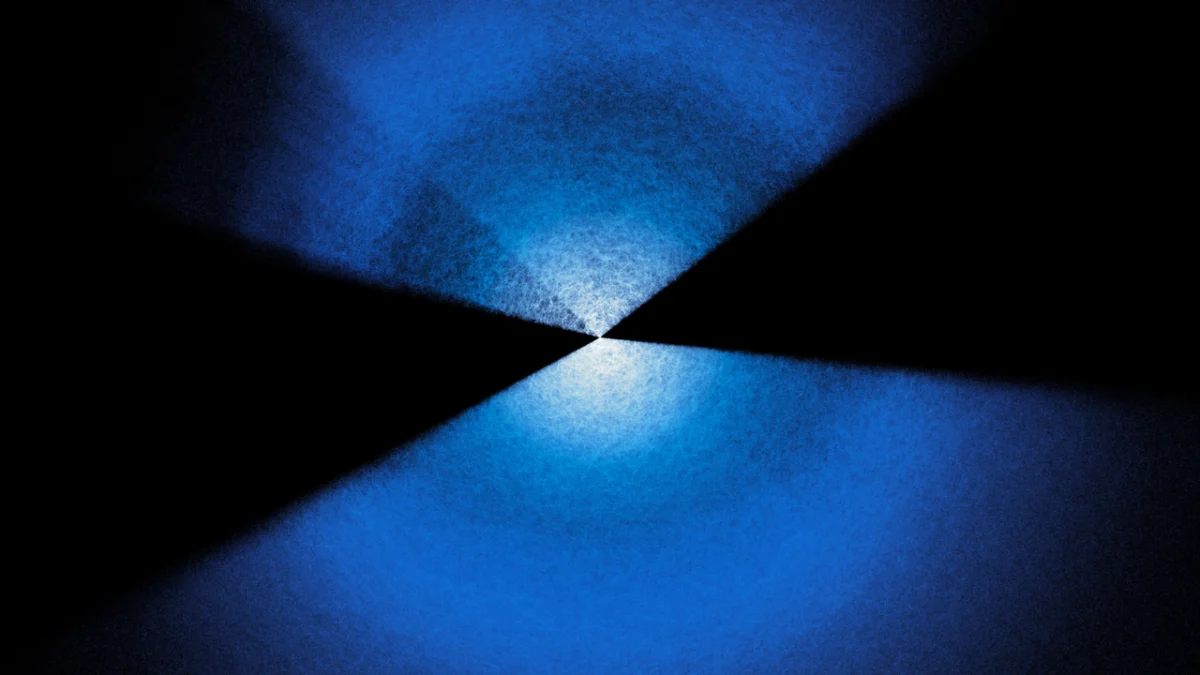
The accompanying image, a stunning visualization generated from DESI’s data, serves as a powerful testament to the instrument’s capabilities. At the center of this intricate cosmic tapestry lies Earth, our home planet. Radiating outwards are countless points of light, each representing an individual galaxy or a cluster of galaxies. The deep blue gradients and intersecting black triangular shapes create an abstract yet profound depiction of the universe’s vastness and complexity. This visual representation is not merely artistic; it is a scientifically accurate portrayal of the distribution of matter in the observable universe, a testament to the power of observational cosmology.
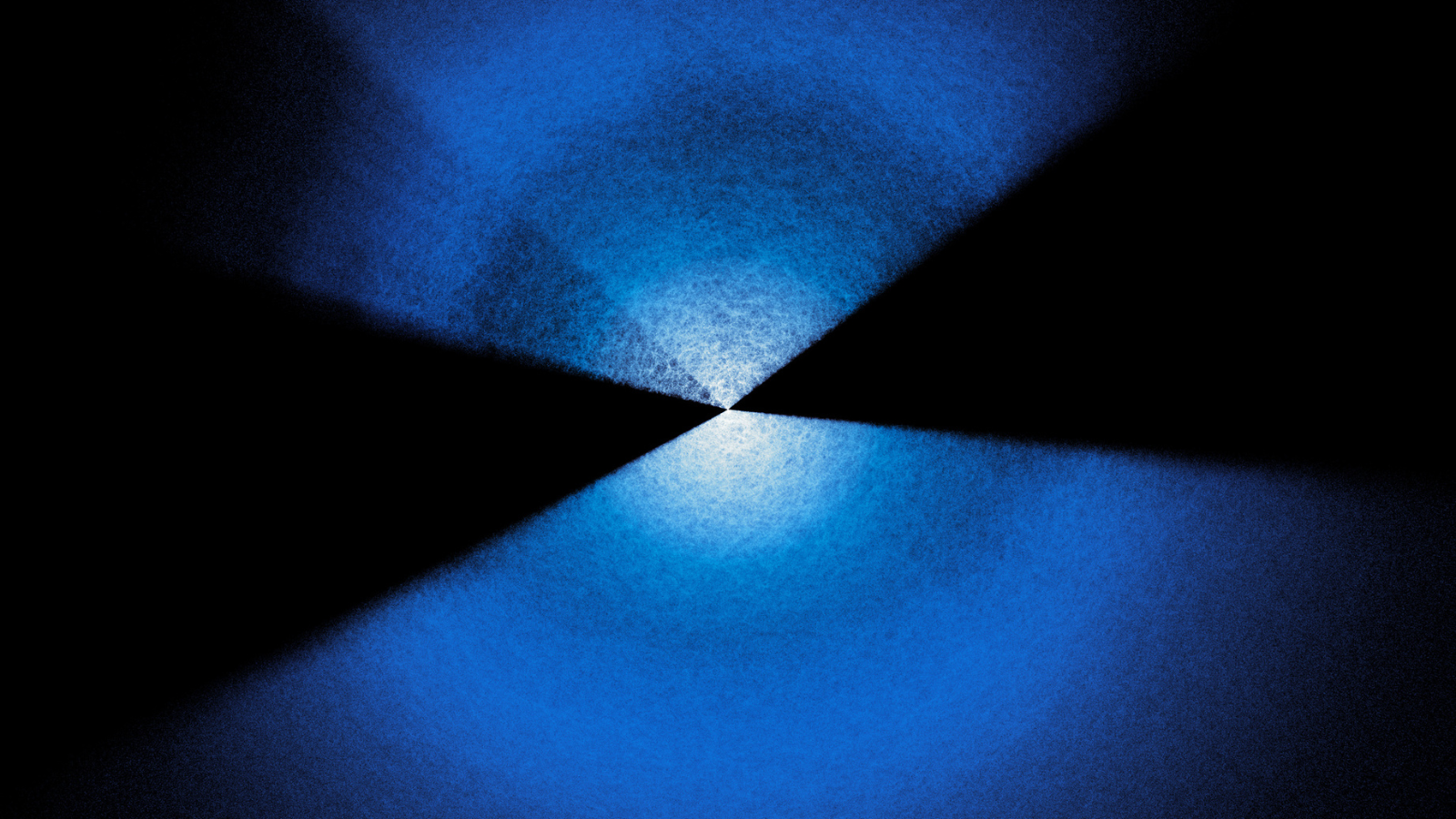
The map reveals the large-scale structure of the universe, often referred to as the "cosmic web." This structure consists of vast filaments of galaxies and clusters, separated by immense voids. By precisely charting the positions of these galaxies, DESI allows astronomers to study the patterns of this cosmic web, how it has evolved over billions of years, and how dark energy has influenced its growth.
Supporting Data and Scientific Implications
The scientific implications of DESI’s data are far-reaching. By mapping the distribution of galaxies with unprecedented precision, DESI can provide crucial constraints on cosmological models, including the properties of dark energy. One of the key scientific objectives of DESI is to measure the expansion history of the universe with high accuracy, particularly during the epoch when dark energy’s influence began to dominate.
Researchers are employing various cosmological probes using the DESI data, including:
- Baryon Acoustic Oscillations (BAO): These are characteristic patterns in the distribution of matter that act as a "standard ruler" in the universe. By measuring the apparent size of these patterns at different redshifts, scientists can infer the expansion rate of the universe at those epochs. DESI’s vast number of galaxies allows for highly precise measurements of BAO, providing robust constraints on dark energy.
- Redshift-Space Distortions (RSD): The peculiar velocities of galaxies (their motion relative to the overall expansion of the universe) cause distortions in their observed redshift. By analyzing these distortions, astronomers can map the growth of cosmic structure over time, which is influenced by the interplay between gravity and dark energy.
- Supernovae: While DESI’s primary focus is on spectroscopic surveys, it can also observe supernovae, which serve as "standard candles" to measure cosmic distances. Combining DESI’s spectroscopic data with supernova observations can further refine our understanding of cosmic expansion.
The preliminary results from DESI are already generating excitement within the scientific community. Early analyses of the data are expected to provide tighter constraints on the equation of state of dark energy, a parameter that describes how its pressure relates to its density. This could help distinguish between different theoretical models of dark energy, such as a cosmological constant (Einstein’s original concept) or more exotic explanations.
Expert Reactions and the Future of Cosmic Exploration
The scientific community has widely lauded DESI’s achievement. Dr. Michael Vance, a cosmologist not directly involved with the DESI collaboration, commented, "This is an absolutely remarkable feat of engineering and scientific collaboration. Having such a detailed 3D map of such a vast region of the universe opens up entirely new avenues for research. We are entering an era where we can truly begin to unravel the physics behind cosmic acceleration with unprecedented precision."
Another leading researcher, Dr. Anya Sharma, a member of the DESI collaboration, stated, "The sheer volume of data we have collected is staggering. This map is not just a collection of points; it’s a snapshot of the universe at various stages of its evolution. It allows us to test our fundamental cosmological models like never before and potentially uncover new physics that we haven’t even conceived of yet."
The implications of DESI’s findings extend beyond the immediate study of dark energy. A more precise understanding of the universe’s expansion history can shed light on other fundamental cosmological parameters, such as the Hubble constant (the current rate of expansion) and the nature of inflation, the period of rapid expansion in the very early universe. Furthermore, the detailed maps of galaxy distribution can aid in the search for other exotic phenomena, such as the nature of neutrinos and the potential existence of modifications to gravity on cosmic scales.
Broader Impact and Ongoing Research
The success of DESI underscores the power of international collaboration in tackling grand scientific challenges. The DESI collaboration comprises hundreds of scientists from institutions across the globe, working together to design, build, operate, and analyze the data from this complex instrument. This collaborative spirit is essential for pushing the boundaries of human knowledge.
As DESI continues its survey, the data it collects will undoubtedly fuel numerous research papers, advance theoretical models, and potentially lead to paradigm-shifting discoveries. The insights gained from this comprehensive 3D map will not only deepen our understanding of the universe’s past and present but also provide crucial clues about its ultimate destiny. The ongoing analysis of this galactic tapestry promises to be one of the most exciting chapters in the history of cosmology, bringing us closer to answering some of humanity’s oldest and most profound questions about our place in the cosmos. The mysteries of dark energy and the accelerating universe are slowly but surely beginning to yield to the persistent inquiry of science, illuminated by the light of millions of distant galaxies.







Leave a Reply