
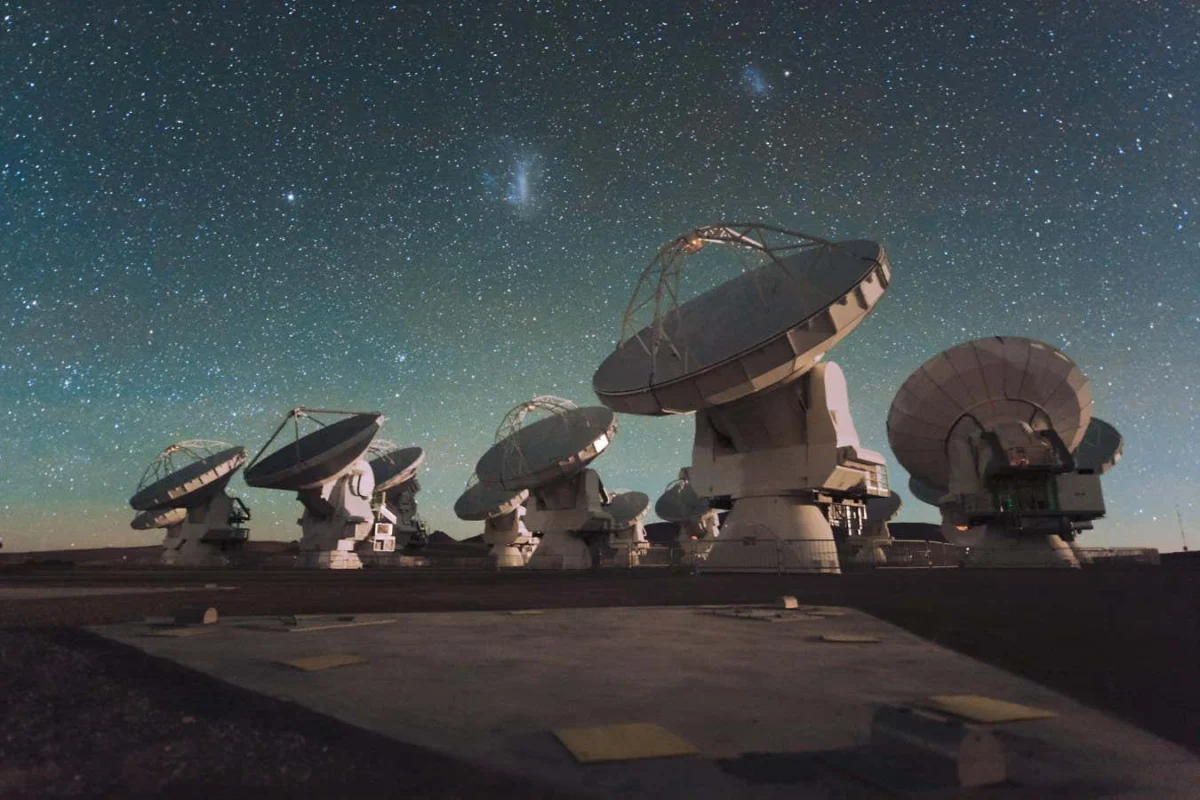
Physicist Emma Chapman, much like Albert Einstein in his youthful contemplation of light, embarks on a profound journey through the cosmos, not by physically traversing its vast distances, but by deciphering the universe’s most ancient and eloquent messenger: light. In her compelling new book, Radio Universe: How to explore space without leaving Earth (published in the US as The Echoing Universe), Chapman invites readers to tune into the cosmic symphony of radio waves, revealing how these often-unseen signals offer an unparalleled window into the universe’s most profound mysteries.
Chapman, a distinguished radio astronomer, draws a parallel between Einstein’s thought experiment that spurred his theory of special relativity and her own work. While Einstein sought to experience the universe at its fastest speed, Chapman’s focus is on light as a carrier of information, an explorer, and a guide. "The universe already speaks the language of light," she eloquently states, underscoring the central premise of her book: humanity’s growing fluency in this cosmic dialect through the ingenious application of radio telescopes.
The Electromagnetic Spectrum: A Broad Canvas for Cosmic Discovery
Light, in its broadest sense, is a form of electromagnetic radiation, a spectrum of waves characterized by their varying wavelengths. Ultraviolet (UV) light, for instance, possesses a short wavelength, with its crests and troughs compressed closely together. In stark contrast, radio waves, the domain of Chapman’s expertise, occupy the opposite end of this spectrum. Their wavelengths can span meters, with peaks and troughs spread far apart.
This significant difference in wavelength bestows radio waves with remarkable properties. Their extended nature allows them to travel immense distances unimpeded by interstellar dust and gas that can obscure visible light. This capability means that radio telescopes, whether transmitting or receiving signals, can probe deeper into the universe and observe phenomena that remain hidden from their optical counterparts. Furthermore, unlike optical telescopes, which are limited by daylight, radio telescopes can operate around the clock, significantly expanding the observational time available to astronomers. Chapman passionately highlights their astonishing versatility, using them as the thread to guide readers from our own Moon to the potential abodes of extraterrestrial civilizations.
A Journey Through the Cosmos: From Our Solar System to the Universe’s Edges
Radio Universe is meticulously structured into three overarching sections: "Our Solar System," "Our Galaxy," and "Our Universe." This organization mirrors the journey of a radio signal, progressively venturing further into the cosmic expanse.

In the initial chapters, Chapman explores how humanity’s first tangible connection with the Moon was not through the boot prints of astronauts, but via the subtle touch of a radio wave. She details how contemporary radio observations are pivotal in unraveling the Moon’s complex origin and geological history. This early exploration of our celestial neighbor underscores the profound utility of radio astronomy, even within our immediate cosmic vicinity.
The book then turns its gaze to Venus, a planet whose extreme environment, characterized by scorching temperatures and crushing atmospheric pressure, renders most visible-light observation techniques ineffective. Here, radio waves emerge as the indispensable tool, their "superpower," as Chapman describes it, being their ability to penetrate and communicate with these otherwise unknowable environments. This capability has been crucial in mapping Venus’s surface and understanding its volatile atmosphere.
As the narrative progresses to broader cosmic scales, Chapman delves into how some of the most iconic images of black holes, enigmatic cosmic entities, are rendered possible by radio data. She illuminates how radio astronomers provided the first indirect evidence of gravitational waves – ripples in spacetime predicted by Einstein – through meticulous observations of pulsars. Moreover, she highlights the role of radio waves in the groundbreaking discovery of some of the earliest known exoplanets, planets orbiting stars beyond our Sun.
The Search for Extraterrestrial Intelligence: Listening to the Cosmic Conversation
A particularly captivating segment of Radio Universe addresses the potential role of radio astronomy in the enduring quest for extraterrestrial civilizations. Chapman posits that "Far more likely than any invasion is contact by radio signal." She elaborates on the profound implications of this, suggesting that regardless of the specifics of an alien world – its atmospheric hues, the number of its moons, or the physiology of its inhabitants – radio waves are likely to be the universal medium for long-distance communication. This optimistic yet scientifically grounded perspective fuels the imagination about the possibility of a cosmic dialogue waiting to be initiated.
Unraveling the Universe’s Greatest Enigmas: Dark Matter and Dark Energy
The latter chapters of Radio Universe tackle two of the most significant and perplexing mysteries in modern physics: dark matter and dark energy. These elusive substances are believed to constitute the vast majority of the universe’s mass-energy content, yet their fundamental nature remains largely unknown. Chapman explains how radio telescopes are instrumental in indirectly detecting these phenomena. For instance, by observing radiation emitted by interstellar hydrogen gas, astronomers can map the distribution of dark matter in galaxies, inferring its presence and gravitational influence even though it does not interact with light. This indirect detection method exemplifies the ingenuity required to study the universe’s invisible components.
A Masterclass in Accessibility and Enthusiasm

Throughout the book, Chapman’s writing style is consistently lauded for its accessibility, imagination, and compelling narrative. Her descriptions are vivid and engaging, transforming complex scientific concepts into readily understandable ideas. When detailing the orbital speed of Mercury, for example, she manages to convey the planet’s swift passage around the sun in a way that makes the reader feel the dynamic movement within their own mental map of the solar system.
Her approach to the asteroid belt is described as a masterclass, not just in radio astronomy, but in fundamental astronomy as a whole. The reviewer likens her guidance to that of a knowledgeable friend or an exceptional seatmate on a long flight, suggesting a warm and approachable delivery of profound scientific insights. Chapman’s humor is also noted, adding a layer of enjoyment to the educational content. The author’s sincere passion for her field as a radio astronomer permeates every page, creating an infectious enthusiasm for the subject matter. The inclusion of an appendix listing visitable radio telescopes further enhances the book’s practical appeal for amateur astronomers and curious readers alike.
Critical Reflections on Space Exploration and Inclusivity
While the book largely maintains an optimistic and inviting tone, the reviewer notes a moment of disappointment regarding Chapman’s discussion of contemporary space exploration initiatives, particularly the colonization of Mars and commercial ventures on the Moon. Chapman observes the "new generation of tech billionaires" sparking a "second space age." However, the reviewer questions whether the author, an ardent astronomer, sufficiently challenges the underlying assumptions of this new space race. The reviewer suggests that an astronomer dedicated to understanding the universe might advocate for a more democratic and egalitarian future for space exploration and research, rather than accepting a trajectory driven primarily by commercial interests.
Furthermore, the reviewer points out a relative lack of focus on international contributions to radio astronomy. While several American and British astronomers and observatories are prominently featured, the narrative devotes less detail to researchers and facilities from other parts of the world. This oversight is particularly noticeable given the historical and ongoing significance of major radio telescopes located in places like Puerto Rico and Chile, which have been instrumental in many key discoveries. This suggests a potential area for further enrichment in future discussions of global scientific endeavors.
The Universe is Not Silent: A Call to Listen
Despite these minor critiques, Chapman’s core message resonates powerfully: the universe is far from silent. "Wherever you are, you are surrounded by radio waves," she explains, painting a picture of a cosmos brimming with activity. These signals, she reveals, carry tales from the most extreme environments, including those that have escaped the gravitational pull of black holes, the echoes from ancient asteroids, and even the faint whispers from the Era of the First Stars. Her concluding thought offers a profound invitation: "We just have to close our eyes, and listen." This evocative suggestion encourages readers to engage with the universe in a new, auditory dimension, transforming the night sky from a visual spectacle into an audible testament to cosmic history.
The reviewer concludes by reflecting on how this final sentiment will undoubtedly linger, prompting a more mindful and attentive engagement with the night sky, even amidst the distractions of urban light pollution and the clamor of daily life. The book effectively instills a sense of wonder and encourages a deeper connection with the unseen forces that shape our universe.

Further Reading: Expanding Your Cosmic Horizons
For those captivated by the profound questions explored in Radio Universe, two other notable works offer complementary perspectives on the vastness and mysteries of the cosmos:
Fear of a Black Universe: An Outsider’s Guide to the Future of Physics
By Stephon Alexander
Stephon Alexander’s Fear of a Black Universe presents a unique and deeply personal exploration of cosmology and theoretical physics. Alexander, a cosmologist, theorist, and musician, weaves together complex scientific concepts with his own life experiences, drawing inspiration from diverse sources such as Zen Buddhism and the art of Jean-Michel Basquiat. This book offers a compelling narrative where advanced mathematical tools like Feynman diagrams coexist with reflections on Alexander’s journey as a Black man in science. It challenges conventional approaches to understanding the universe, inviting readers to consider a more holistic and interdisciplinary view of physics.
The Disordered Cosmos: A Journey into Dark Matter, Spacetime & Dreams Deferred
By Chanda Prescod-Weinstein
Chanda Prescod-Weinstein, a regular columnist for New Scientist, delivers a potent blend of rigorous scientific inquiry and incisive social commentary in The Disordered Cosmos. The book delves into phenomena such as dark matter and spacetime, while also critically examining the sociopolitical contexts that have shaped our understanding of these cosmic mysteries. Prescod-Weinstein notably addresses the complex ethical considerations surrounding the establishment of astronomical observatories, including issues of consent and the impact of scientific endeavors on local communities. Her work demonstrates that scientific rigor can extend beyond the mere collection and analysis of data, encompassing a broader responsibility towards ethical and equitable practices in research.








Leave a Reply