
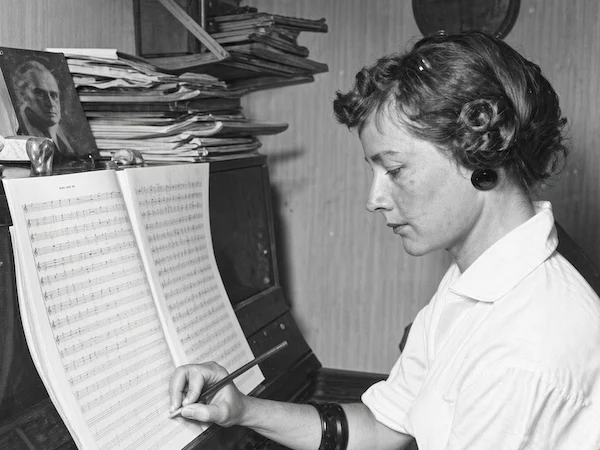
The intersection of political oppression and avant-garde artistic innovation often yields extraordinary narratives of human resilience. Among the most compelling is the life and career of Else Marie Pade, whose journey from a bedridden, sound-obsessed child to a World War II resistance fighter, political prisoner, and ultimately Denmark’s pioneer of electronic music redefined the boundaries of sonic art. Pade’s trajectory challenges conventional notions of musical education, proving that profound creative vision can emerge from the darkest corners of human confinement and political terror.
Main Facts and Biographical Overview
Else Marie Pade was born in Denmark in 1924, entering a world that would soon be shaken by global conflict. Long before she handled electronic oscillators or experimented with tape loops, her relationship with sound was forged through isolation. Plagued by chronic kidney inflammations during her childhood, Pade spent prolonged periods confined to her bed. Deprived of the typical physical freedoms of youth, she developed an acute auditory awareness. The ambient noises of her immediate environment—dripping sponges, whistling tea kettles, singing birds, and the rhythmic trotting of horses on cobblestone streets—served as her primary source of entertainment and imaginative escape.
This early sensitization to everyday acoustics laid the subconscious groundwork for her later revolutionary approach to composition. However, her life took a sharp and dramatic turn with the onset of World War II and the Nazi occupation of Denmark. Rather than succumbing to the climate of fear that gripped the nation, a young Pade engaged in active defiance against the occupying forces. Her most famous early act of resistance occurred when she openly spat upon a column of marching German soldiers. Evading immediate capture, she fled directly into the arms of the Danish Resistance, marking the beginning of her clandestine career.
Chronology of Resistance, Imprisonment, and Awakening
The chronology of Pade’s wartime activities illustrates a rapid escalation from youthful defiance to high-stakes sabotage. As a member of the Danish Resistance, her responsibilities were both vital and perilous. She undertook the dangerous task of distributing underground newspapers, working to counter Nazi propaganda and keep the local populace informed. Furthermore, she received specialized training in the handling and deployment of explosives. Her specific mission was to sabotage and cut off enemy telephone and communication lines in the event of an anticipated Allied invasion of Denmark.
However, the Gestapo infiltrated her network before the invasion plans could be executed. In 1944, Pade was arrested by the Nazi secret police, plunging her into a harrowing period of imprisonment and interrogation. It was within the brutal confines of a solitary confinement cell that her life’s defining artistic pivot occurred. The psychological weight of captivity, combined with the absolute isolation, pushed her to the brink of despair.
Reflecting on this ordeal in an essay published years later in the British music publication The Wire, Pade detailed the psychological crucible that transformed her: “I screamed out loud in fear and helplessness in my solitary cell — but no one came. It was then I promised myself that if I survived this I would work with music for the rest of life. And then I felt a strange calm: light, warmth and love were all around me. I was no longer alone. This was the turning point in my life.”
The physical manifestation of this epiphany occurred the very next day. Using the metal fastener from her garter belt, Pade began scratching musical staves directly onto the stark concrete walls of her prison cell. There, she transcribed a musical theme inspired by the hallucinatory peace and vision she had experienced the night before.
While prison guards and authorities were initially infuriated by the damage to state property, the camp commandant’s reaction ultimately aided her creative persistence. Recognizing her unyielding determination, the commandant promised that the Red Cross would supply her with legitimate music paper and writing utensils. His rationale was pragmatic: providing her with the tools to compose would prevent further acts of defiance and stop her from defacing the facility’s infrastructure.
Following her subsequent transfer to the Frøslevlejren internment camp, Pade’s artistic output continued under slightly ameliorated conditions. There, she was reunited with Karen Brieg, the piano teacher who had initially recruited her into the resistance movement. Together, the prisoners collaborated on musical projects to sustain morale and prepare for the future. Brieg transcribed traditional Danish songs for a three-part women’s choir, while Pade composed light-hearted schlagers—popular, catchy tunes designed to generate income for her formal music studies once hostilities finally ceased. Her fellow prisoners in the women’s barracks made a solemn pact to ensure she would secure admission to the Royal Danish Academy of Music once peace returned, a promise that was successfully fulfilled at the war’s conclusion.
Supporting Data and the Evolution of Electronic Sound
Upon entering the Royal Danish Academy of Music, Pade initially pursued traditional compositional paths, envisioning a career as a classical pianist. Yet, the trajectory of mid-century European music was shifting rapidly, and a single broadcast permanently altered her artistic destiny.
In 1952, a Denmark Radio broadcast introduced Pade to the pioneering work of French composer Pierre Schaeffer and his revolutionary concept of musique concrète—a genre of electroacoustic music that uses recorded natural sounds as raw material. This broadcast acted as a powerful catalyst, instantly reconnecting Pade with the childhood auditory landscapes she had cataloged during her bedridden bouts of sickness. The incidental noises of the physical world were no longer mere memories of isolation; they were legitimate, high-art musical components.
Synthesizing Schaeffer’s techniques with her own imaginative sensibilities, Pade composed A Day at Dyrehavsbakken, widely recognized as the first piece of electronic musique concrète ever created in Denmark. Her ambitions did not stop at national borders. She subsequently sought out and studied alongside the giants of the burgeoning European avant-garde, including Karlheinz Stockhausen, György Ligeti, and Pierre Boulez.
The stylistic contrast between her wartime compositions and her post-war avant-garde work is stark. The austere, mathematically precise, and experimental soundscapes championed by Stockhausen and Boulez were light-years away from the sentimental schlager ballads she had hastily scribbled in the barracks of Frøslevlejren. Yet, the underlying aesthetic remained anchored to her unique psychological makeup. The same acute imagination that once heard complex polyphonic symphonies in dripping sponges and whistling kettles now possessed the institutional tools to bring those internal worlds into external reality.
Broader Impact and Implications
Else Marie Pade’s contributions to electronic music extend far beyond her status as a Danish trailblazer. Historically, the narrative of early electronic and experimental music has frequently marginalized the substantial contributions of women. Pade’s career—alongside contemporary female pioneers such as Daphne Oram and Delia Derbyshire at the BBC Radiophonic Workshop—underscores the crucial, foundational roles women played in shaping the sonic architecture of the modern era.
The implications of Pade’s life story offer a profound commentary on the relationship between trauma and artistic creation. Psychologists and musicologists alike have analyzed how extreme confinement can heighten sensory perception, a phenomenon clearly evidenced in Pade’s work. Denied freedom of movement, her mind expanded its auditory horizons, transforming the mundane and the restrictive into a limitless acoustic universe.
Furthermore, her transition from political resistance to avant-garde composition illustrates an unbroken line of rebellion. To spit on a Nazi soldier, to distribute underground newspapers, and to scratch musical staves into a Gestapo-controlled cell wall are fundamentally acts of defiance against an imposed reality. Embracing musique concrète and the radical aesthetics of Stockhausen was, in many ways, a continuation of that same spirit—challenging traditional bourgeois expectations of what constitutes "music" and insisting on the validity of alternative, non-traditional sonic experiences.
Today, Pade’s legacy is celebrated through retrospectives, academic analyses, and archival audio collections that capture her remarkable output spanning from the mid-20th century into her later years. Her archival works, including recordings compiled across decades, demonstrate an uncompromising dedication to acoustic exploration. Else Marie Pade stands not only as Denmark’s first female electronic composer, but as an indomitable testament to the power of the human imagination to transcend physical imprisonment, political tyranny, and the rigid dogmas of traditional art.










Leave a Reply