A hypothetical, long-overlooked subatomic entity known as the right-handed neutrino may have held absolute dominion over the cosmos during the fraction of a second immediately following the Big Bang. According to groundbreaking theoretical research published in the September 8 issue of the journal Physical Review Letters, this elusive "ghost particle" could have single-handedly dictated the expansion rate of the infant universe and fundamentally altered the conditions that allowed matter to triumph over antimatter.
For decades, physicists have wrestled with a profound existential conundrum: standard cosmological models dictate that the Big Bang should have produced equal amounts of matter and antimatter, which would have annihilated one another completely upon contact, leaving behind a sterile universe composed exclusively of light. Instead, the universe is brimming with stars, planets, galaxies, and human observers. The new study suggests that the missing piece of this cosmic puzzle may lie in the heavy, sterile properties of right-handed neutrinos, which could explain not only how matter ultimately won out, but why anything exists at all.
The Standard Model and Its Blind Spots
To understand the magnitude of the recent theoretical proposition, one must examine the limitations of the Standard Model of particle physics. For half a century, the Standard Model has served as the foundational framework describing three of the four fundamental forces of nature—electromagnetism, the strong nuclear force, and the weak nuclear force—along with all known elementary particles.
However, the Standard Model is notoriously incomplete. It fails to account for gravity, offers no candidate for dark matter, and completely glosses over neutrino mass. For a long time, standard neutrinos—subatomic particles with minuscule mass that interact only rarely with ordinary matter, earning them the moniker "ghost particles"—were assumed to be completely massless. The discovery that neutrinos actually oscillate between different flavors, which earned the Nobel Prize in Physics in 2015, definitively proved that these particles possess a small but non-zero mass.
This revelation forced physicists to look beyond the Standard Model for a mechanism that gives neutrinos their mass. The leading candidate has long been the "seesaw mechanism," which posits the existence of heavy, sterile neutrinos that do not feel the weak nuclear force like their lighter, left-handed counterparts. Because they are completely blind to electromagnetism, the strong force, and mostly the weak force, these right-handed neutrinos interact with the rest of the universe almost exclusively through gravity. Consequently, detecting them directly in modern particle accelerators or underground detectors remains nearly impossible, relegating them to the realm of theoretical physics—until now.
A Brief History of the Primordial Cosmos
To evaluate how these hypothetical particles could have influenced the early universe, researchers constructed sophisticated cosmological models mapping the timeline of the universe’s first fractions of a second.
Within the first picosecond (one trillionth of a second) following the Big Bang, the universe was an unimaginably hot, dense soup of fundamental particles and energy. Temperatures soared into the quadrillions of degrees, and space was expanding at an incomprehensible rate through a process known as cosmic inflation. As the universe began to cool slightly, particles acquired mass through the Higgs mechanism, and the foundational interactions of physics began to take shape.
According to the new study, right-handed neutrinos would have been produced in abundance during these scorching early moments. Because of their immense mass relative to standard neutrinos, these particles could have briefly amassed more energy than all other matter and radiation in the infant universe combined.
This localized hyper-dominance would have created profound gravitational ripples throughout the cosmos. A universe dominated by heavy, sluggishly interacting particles expands differently than one filled purely with radiation or lighter particles. By temporarily hijacking the universe’s energy budget, right-handed neutrinos would have accelerated the overall expansion rate of space during a critical window.
Furthermore, this accelerated expansion would have delayed key particle interactions and thermal equilibriums. In standard cosmology, particles have ample time to interact, decay, and balance their populations. By speeding up the clock and stretching the fabric of space, the right-handed neutrinos would have altered the timing of baryogenesis—the physical process that generated an asymmetry between baryons (protons and neutrons) and antibaryons. This delay would have provided the precise window needed for matter to outpace antimatter before annihilation wiped the slate clean.
Quantitative Insights and Theoretical Calculations
The research team, led by theoretical physicists specializing in cosmology and particle interactions, utilized advanced numerical simulations to track the energy density of the universe alongside the thermal decay rates of right-handed neutrinos.
By running thousands of iterations varying the mass of the hypothetical right-handed neutrinos—typically scaled between the tera-electron-volt (TeV) and peta-electron-volt (PeV) ranges—the researchers discovered a robust statistical sweet spot. In models where right-handed neutrinos possess masses within specific theoretical boundaries, the math naturally yields the exact matter-antimatter asymmetry observed in the universe today, roughly one extra matter particle for every one billion particle-antiparticle pairs that annihilated.
Moreover, the calculations demonstrated that the presence of these particles would leave subtle, lingering signatures in the cosmic microwave background (CMB)—the residual thermal radiation from the Big Bang. While the direct detection of a right-handed neutrino is currently beyond technological capabilities, future high-precision cosmological surveys mapping the polarization of the CMB could detect the indirect gravitational footprints left by these ancient, invisible titans.
Expert Reactions and Scientific Discourse
The publication of the study in Physical Review Letters has generated considerable discussion within the global theoretical physics community. While external researchers acknowledge that right-handed neutrinos have long been a favored theoretical tool, many praise the new study for tying them so explicitly to cosmological expansion dynamics and baryogenesis simultaneously.
"For a long time, right-handed neutrinos were treated as mathematical accessories designed simply to fix neutrino mass anomalies," noted Dr. Elena Vance, a theoretical cosmologist unaffiliated with the study. "What this paper does is elevate them from quiet background actors to the absolute directors of the early universe. If these calculations hold up under peer scrutiny, it solves two of the biggest problems in physics—matter-antimatter asymmetry and neutrino mass—with a single elegant mechanism."
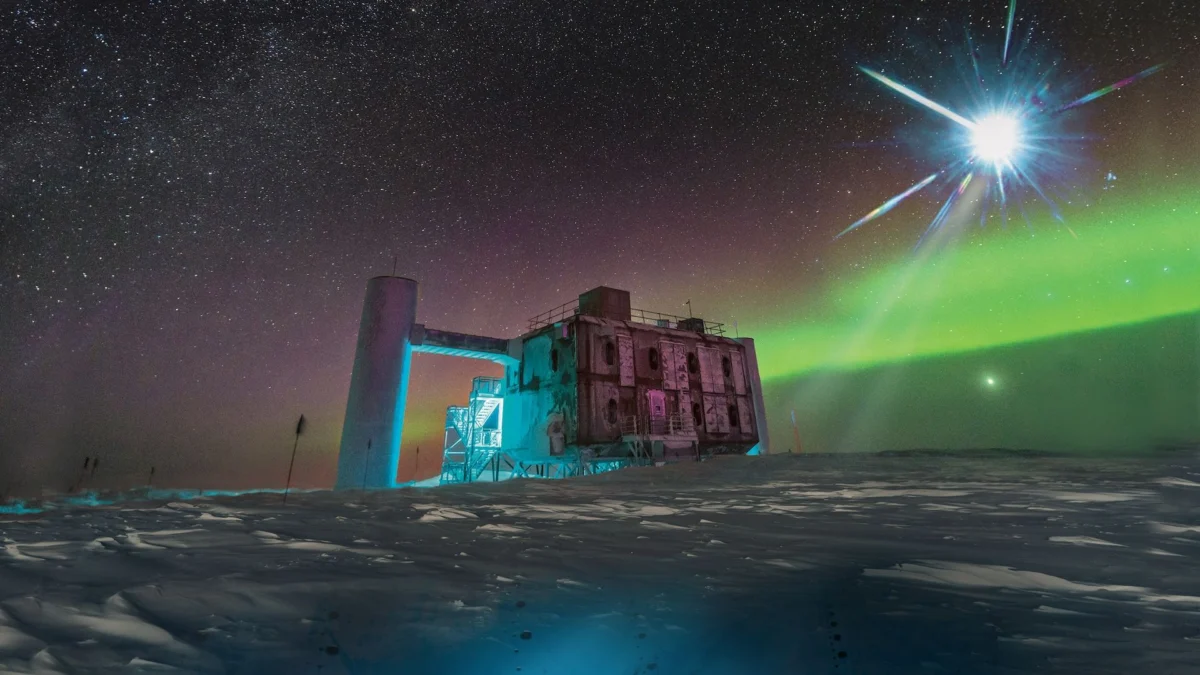
Other physicists emphasize the caution necessary when dealing with entirely unobserved particles. Because right-handed neutrinos are "sterile," meaning they lack standard gauge interactions, testing their existence experimentally requires pushing the boundaries of indirect observation. Researchers look toward upcoming upgrades to neutrino observatories like IceCube at the South Pole and deep-underground detectors, as well as next-generation space telescopes designed to probe the earliest epochs of the cosmos.
Broader Implications for Modern Physics
The implications of this research extend far beyond the opening microseconds of the cosmos. If right-handed neutrinos truly dictated the expansion of the early universe, they serve as a critical bridge uniting the micro-world of particle physics with the macro-world of cosmology.
For decades, these two disciplines have struggled to find a unified language. Particle physics deals with the smallest scales and highest energies, while cosmology deals with the largest structures in existence. By demonstrating that the properties of an invisible, highly massive subatomic particle could alter the large-scale geometry and expansion rate of the entire universe, this study provides a textbook example of why the two fields are fundamentally inseparable.
Furthermore, solving the matter-antimatter asymmetry problem remains the holy grail of modern physics. Without a viable mechanism to explain why matter survived, our current understanding of the universe remains fundamentally incomplete. While experimental confirmation may take decades of technological advancement, this theoretical framework offers a compelling roadmap.
As researchers continue to refine their cosmological models and peer deeper into the cosmic microwave background, the legacy of the humble ghost particle comes into sharper focus. What was once dismissed as a minor mathematical quirk in particle equations may ultimately be revealed as the architect of our entire existence—the invisible force that tipped the cosmic scales and ensured that, out of absolute nothingness, a universe of matter could finally arise.