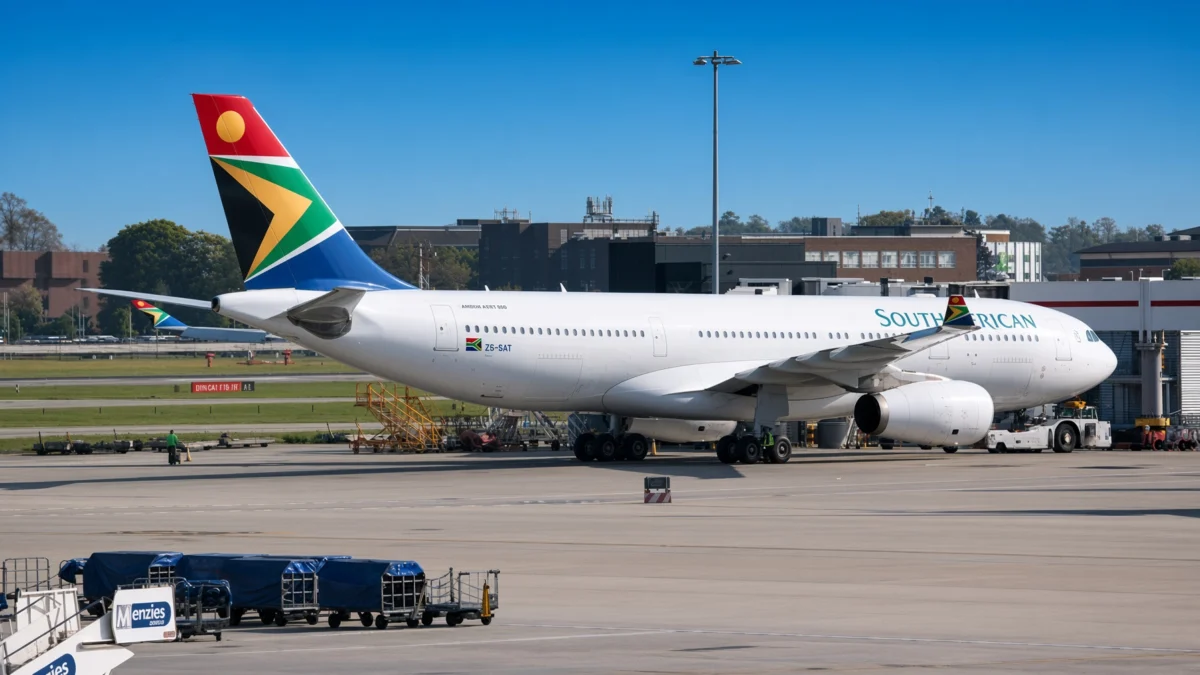
South African Airways (SAA), the national carrier of South Africa and a long-standing member of the Star Alliance, has once again been forced to delay salary payments for a significant portion of its workforce. This latest fiscal setback, marking the second consecutive month of payroll disruptions, highlights the deepening volatility within the state-owned enterprise. The airline, which has struggled for years to maintain liquidity despite the sale of lucrative assets, is currently operating under a government-mandated ultimatum to secure a private buyer by February.
The decision to stagger salary payments—affecting pilots, management, and executive staff while prioritizing ground and cabin crew—has sparked intense debate regarding the airline’s operational viability. While SAA maintains that the majority of its staff received compensation on time, spokespeople confirmed that roughly 30% to 40% of the workforce faced delayed disbursements. This development arrives against a backdrop of mounting pressure from the South African Treasury, which, on August 5, approved a R1 billion (approximately $61 million) government guarantee contingent upon the airline identifying additional assets for divestment within a 90-day window.
A Legacy of Financial Instability and State Bailouts
The current crisis is not an isolated incident but rather the latest chapter in a decades-long saga of financial distress. Since its founding in 1934, SAA has evolved from a fledgling national carrier into a symbol of South Africa’s broader economic challenges. Over the past twenty years, the airline has become synonymous with the "state capture" phenomenon, a period where political interference and systemic corruption severely eroded the governance structures of several major South African public entities.
Data suggests that SAA has received upwards of $3 billion in direct government subsidies since the early 2000s. When accounting for wider taxpayer losses, debt write-offs, and the costs associated with its prolonged entry into "business rescue" proceedings between 2019 and 2021, analysts estimate the total cost to the South African public exceeds $8 billion. Despite these massive capital injections, the carrier has failed to achieve sustained cash-generative operations.
The decline of the airline was punctuated by the tenure of former board chair Dudu Myeni, whose leadership was formally condemned by the South African judiciary. In 2020, a landmark court ruling declared Myeni a "delinquent director for life," citing her interference in critical procurement decisions, including failed partnerships with Emirates and Airbus that could have modernized the fleet and improved financial performance. These findings were subsequently corroborated by the Zondo Commission of Inquiry into State Capture, which detailed how political patronage led to the systematic hollow-out of the airline’s internal controls.

The Mirage of Profitability: Audits and Accountability
SAA’s recent financial disclosures have drawn sharp criticism from oversight bodies. In its financial statement for the year ended March 31, 2025, the airline reported a nominal profit, a figure that appears to rely heavily on the divestment of key assets rather than operational efficiency. Excluding the sale of a valuable pair of London Heathrow takeoff and landing slots—a move that effectively "sold the furniture to pay the rent"—the airline recorded a pretax loss of R996 million.
The Auditor General of South Africa, in its most recent report, issued a disclaimed audit opinion—the seventh consecutive year the airline has failed to provide sufficient, appropriate evidence to support its financial statements. The report highlighted approximately R500 million in "irregular expenditure," a term used to describe spending that violates public finance management laws. This lack of transparency has made it increasingly difficult for the government to justify continued financial support to a public that is already grappling with high unemployment and infrastructure deficits.
Operational Volatility and Executive Turnover
Leadership instability has further complicated the airline’s recovery efforts. The departure of the CEO in April 2025 left a leadership vacuum that was only partially filled by an acting head, who was subsequently placed on leave in August. Currently, the airline’s chief legal officer is serving as the acting CEO, a move that critics argue reflects a lack of deep aviation-industry expertise at the helm during the most critical juncture in the company’s modern history.
The airline’s inability to file its 2025/26 annual report by the September deadline has further soured its relationship with Parliament. Legislators have summoned the airline’s board to provide clarity on the deepening financial turmoil, questioning how a carrier with a modest fleet of roughly 19 aircraft can continue to justify its massive administrative and operational overhead.
The Strategic Shift in African Aviation
For the Star Alliance, the potential collapse or continued degradation of SAA represents a shift in the regional aviation landscape. When SAA joined the alliance in 2006, it was the primary gateway for international carriers looking to tap into the Southern African market. However, the rise of other African carriers has diluted this dependence.
Ethiopian Airlines, now widely considered the continent’s most successful carrier, has built a robust hub in Addis Ababa that effectively connects global traffic to African destinations. Similarly, Egyptair has expanded its influence from the north. Perhaps most significantly, the rise of Airlink—a regional airline that has secured partnerships with major carriers like United Airlines, Lufthansa, and a recent 25% equity acquisition by Qatar Airways—has created a more reliable alternative for global travelers. As Airlink expands its footprint to over 45 destinations, the necessity of a bloated, state-subsidized SAA for international network connectivity has diminished.

Implications and Future Outlook
The immediate future of South African Airways remains tethered to the government’s willingness to provide further support. While the Treasury has publicly stated that it expects the airline to become self-sustaining, the reality of its cash-burn rate suggests that the "12 to 18-month" runway previously touted by government officials is rapidly evaporating.
Analysts point to three potential paths for the carrier:
- Privatization: The government continues its search for a strategic equity partner, though the failed 2024 negotiations with the Takatso Consortium suggest that potential investors are wary of the airline’s legacy debt, governance issues, and the high cost of restructuring.
- Managed Liquidation: Should the airline fail to meet the February deadline for a buyer or run out of liquidity before then, the government may be forced to initiate a formal liquidation process. This would protect the fiscus from further bleeding but would result in significant job losses and the loss of the "national flag carrier" status.
- Continued State Subsidy: The most likely, albeit politically unpopular, scenario involves further, smaller tranches of state funding to keep the airline afloat, effectively kicking the problem down the road until it becomes the burden of a future administration.
The broader implications for South Africa extend beyond the aviation sector. SAA serves as a test case for the government’s ability to manage its portfolio of state-owned enterprises (SOEs), many of which are similarly struggling with debt and mismanagement. As the national treasury faces a tight fiscal space, the continued support of SAA will remain a flashpoint in national debates regarding fiscal responsibility versus the preservation of national assets.
Ultimately, the airline’s survival will depend on its ability to demonstrate, for the first time in nearly two decades, a clear path to operational profitability that is not dependent on the sale of assets or taxpayer bailouts. Until such a transformation occurs, SAA remains a fragile entity, navigating a turbulent environment where its history of prestige is increasingly eclipsed by its record of financial failure.