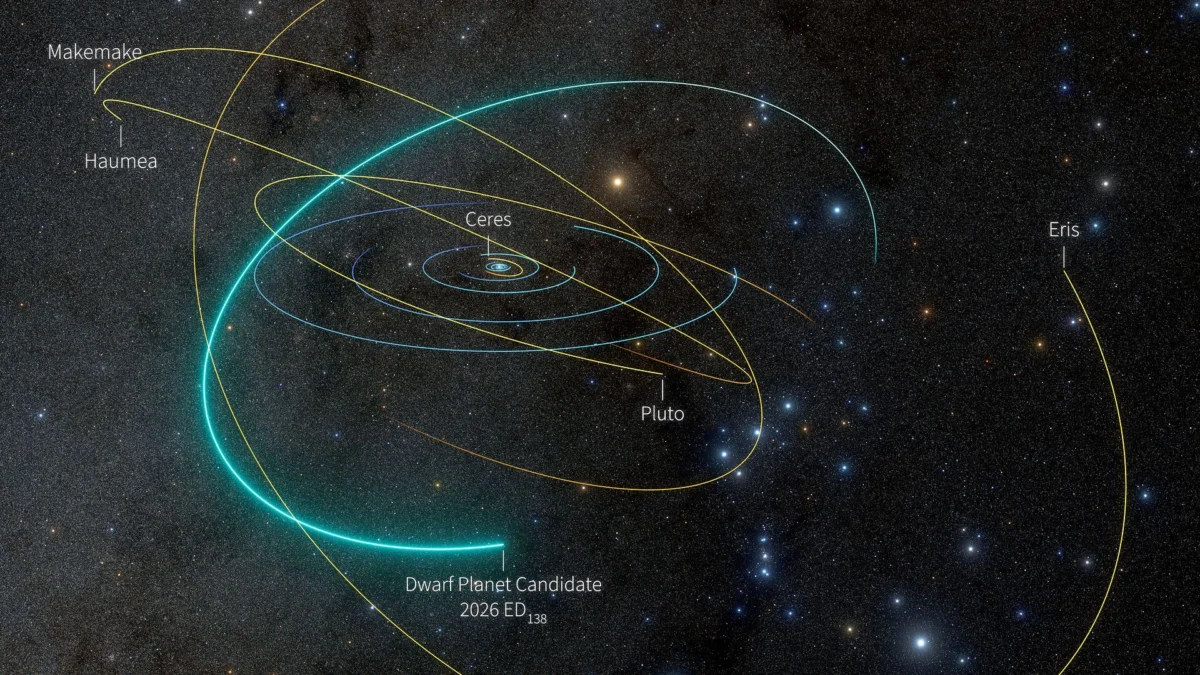
Astronomers scanning the distant horizons of our solar system have made a remarkable discovery that is already reshaping our understanding of the cosmic neighborhood beyond Neptune. Utilizing the unprecedented capabilities of the National Science Foundation and Department of Energy’s (NSF–DOE) Vera C. Rubin Observatory, researchers have identified a massive distant world temporarily designated as 2026 ED138. If ongoing observations confirm its status, this icy newcomer will not only become one of the most significant planetary bodies found in the outer solar system in decades, but it will also dramatically expand our roster of officially recognized dwarf planets.
Positioned comfortably beyond the orbit of Neptune in the frigid realms of deep space, 2026 ED138 stands out due to its exceptional brightness and sheer physical scale. Preliminary measurements indicate that it ranks among the largest and most luminous objects ever detected in the trans-Neptunian region. Upper estimates of its diameter suggest it could measure more than half the size of Pluto itself, placing it in an elite category of distant celestial bodies and sparking renewed enthusiasm within the planetary science community.
Main Facts of the Discovery
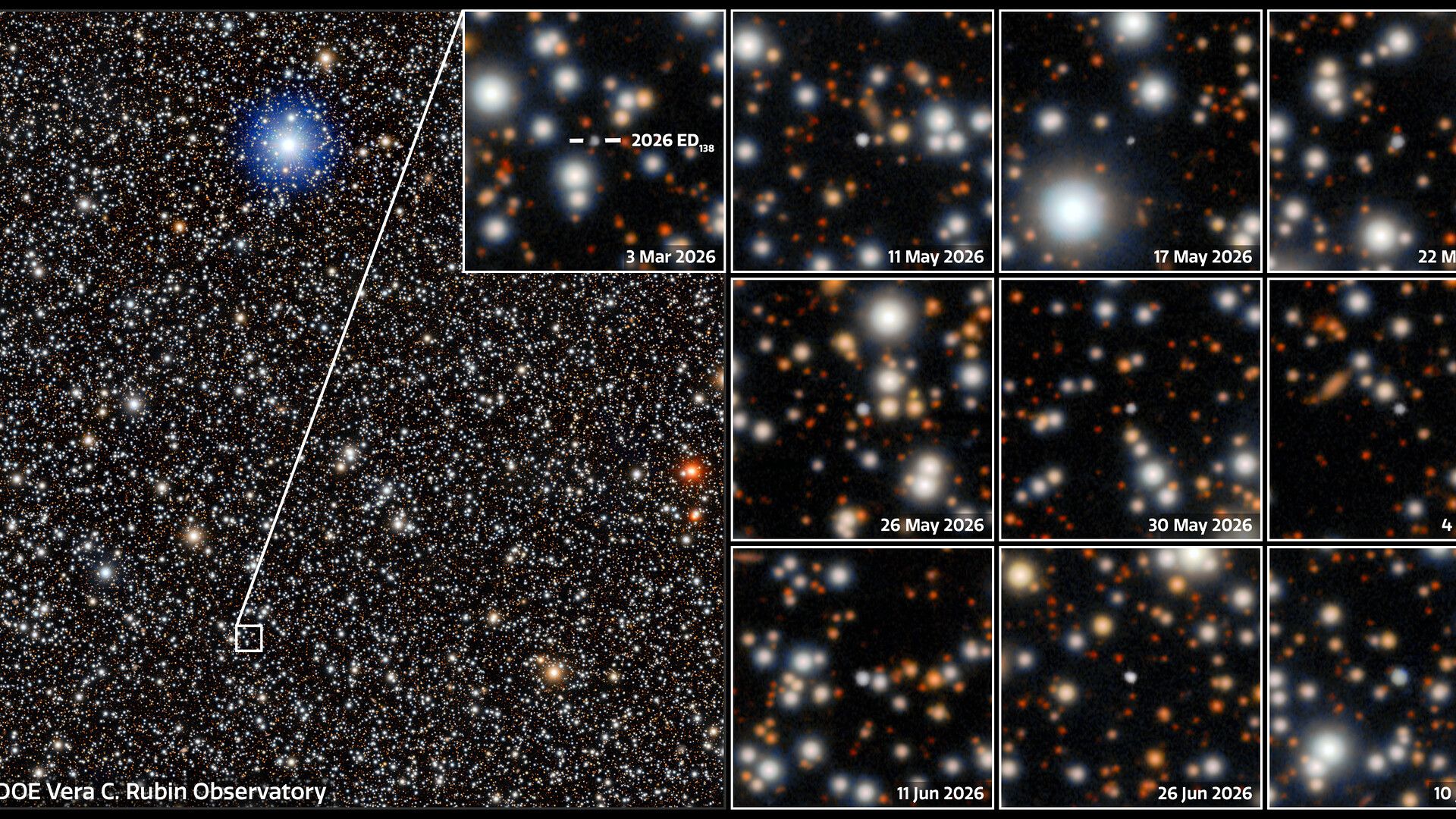
The newly revealed candidate, 2026 ED138, was captured in a mosaic of tracking images compiled by the Vera C. Rubin Observatory across multiple dates in 2026. The observatory—jointly funded by the NSF and the DOE, and operated in partnership with NOIRLab, SLAC National Accelerator Laboratory, and the Association of Universities for Research in Astronomy (AURA)—demonstrated its extraordinary potency for outer solar system exploration almost immediately after entering its operational phase.
Unlike traditional telescopes that require long, targeted exposures of specific patches of sky, the Rubin Observatory is equipped with an 8.4-meter Simonyi Survey Telescope and a revolutionary 3,200-megapixel digital camera. This setup allows the facility to map the entire southern sky every few nights with unprecedented depth. This wide-field, high-sensitivity survey capability was instrumental in spotting 2026 ED138, which had remained hidden from older sky surveys due to its immense distance and faint sunlight reflection.
If subsequent data analysis confirms its dimensions and spherical hydrostatic equilibrium—the defining characteristics of a dwarf planet—2026 ED138 will join an exclusive club. Currently, the International Astronomical Union (IAU) officially recognizes only five dwarf planets in our solar system: Pluto, Eris, Haumea, Makemake, and Ceres. The addition of a sixth member of this caliber, especially one residing so far from the sun, underscores how much of our solar system remains unmapped and poorly understood.
The Chronology of Detection
The journey to discovering 2026 ED138 represents the culmination of advanced technological development and rapid data processing. The timeline leading up to this monumental announcement highlights the speed at which modern astronomical surveys operate:
- Early Construction and Commissioning: Over the preceding decade, the Vera C. Rubin Observatory underwent rigorous construction atop Cerro Pachón in Chile, culminating in the integration of its massive primary mirror and the world’s largest digital camera built for astronomy.
- Survey Commencement: Upon achieving first light and entering its operational survey phase, the observatory began capturing petabytes of astronomical data, scanning for transient events, near-Earth asteroids, and distant Kuiper Belt objects.
- Initial Detection (2026): During routine processing of wide-field sky images, automated algorithms flagged a faint, slow-moving point of light exhibiting orbital characteristics inconsistent with standard main-belt asteroids or nearby comets.
- Follow-Up Astrometry: Subsequent observations across multiple dates in 2026 verified the object’s trajectory, confirming that it resides far beyond Neptune in a stable, distant orbit.
- Public Announcement: Following orbital verification and preliminary size estimations, scientists released the initial imaging mosaic and data, classifying 2026 ED138 as a top-tier dwarf planet candidate.
Supporting Data and Comparative Scale
To understand the significance of 2026 ED138, astronomers look at its projected size and reflective properties. Pluto, the benchmark for large trans-Neptunian objects, has a diameter of approximately 2,376 kilometers (1,476 miles). Upper-tier estimates place 2026 ED138 at more than half that diameter, potentially putting it well over 1,000 kilometers wide.
In the context of the Kuiper Belt and the scattered disk—the distant, icy debris fields remaining from the formation of the solar system—finding an object of this magnitude is a statistical milestone. Most objects in these outer regions are small, irregularly shaped planetesimals measuring only a few kilometers across. Discovering a body large enough to pull itself into a round shape under its own gravity is a rare event that provides crucial data points on the upper limits of planetary accretion in the early solar system.
Furthermore, the exceptional brightness of 2026 ED138 suggests it possesses a high albedo, meaning its surface is likely coated in reflective volatile ices such as nitrogen, methane, or water ice. These reflective properties make it an ideal target for spectroscopic analysis, which could soon reveal the chemical composition of its ancient, frozen crust.
Official Responses and Scientific Reactions
While the scientific community awaits formal peer-reviewed confirmation of the object’s precise mass, density, and orbital parameters, reactions from researchers have been overwhelmingly enthusiastic. Astrophysicists specializing in planetary formation note that discoveries like 2026 ED138 validate theoretical models predicting a population of large, undiscovered bodies lurking in the shadows of the outer solar system.
"Finding an object of this scale changes our census of the outer solar system," noted one planetary astronomer familiar with trans-Neptunian dynamics. "It demonstrates that the Rubin Observatory is living up to its promise of revealing the unseen architecture of our cosmic backyard almost immediately upon deployment."
Space agency officials and observatory partners have also emphasized the collaborative nature of the discovery. By combining the technological might of the NSF and DOE, the project bridges the gap between particle physics instrumentation—utilized in the camera’s silicon sensors—and large-scale optical astronomy, paving the way for even more profound discoveries in the years ahead.
Broader Impact and Implications for Solar System Science
The identification of 2026 ED138 extends far beyond the excitement of adding a new name to textbook diagrams of the solar system. It holds profound implications for how scientists understand planetary migration, the distribution of mass in the early solar nebula, and the dynamical stability of the outer planets.
For decades, anomalies in the orbits of distant Kuiper Belt objects have fueled hypotheses regarding unseen massive bodies, ranging from distant rogue planets to hypothetical "Planet Nine." While 2026 ED138 is not Planet Nine, charting its precise orbit will help astronomers map the gravitational currents and historical disturbances that shaped the outer reaches of our stellar system billions of years ago.
Moreover, as the Vera C. Rubin Observatory continues its decade-long survey, astronomers anticipate that 2026 ED138 will be merely the first of many such giants to step out of the dark. The detection serves as a powerful reminder that our solar system remains a vast, largely unexplored frontier, holding secrets of our cosmic origins just waiting for the right lens to bring them into focus.