For more than a decade, the vibrant Ghana cuckooshrike (Lobotos lobatus) existed largely as a ghost in the annals of West African ornithology. Unseen by scientists and undocumented by formal surveys since 2013, the bird was feared by some conservationists to be sliding quietly toward extinction. However, a recent and breakthrough expedition into the dense canopy of Côte d’Ivoire’s Taï National Park has shattered that silence. Researchers from the International Bird Conservation Partnership (IBCP) successfully spotted, photographed, and documented the elusive avian species, proving that pockets of this rare bird still endure within the vanishing rainforests of West Africa.
The rediscovery marks a major triumph for global conservation initiatives, specifically the Search for Lost Birds (SLB) project, which catalogues species that have evaded scientific detection for a decade or more. Yet, while the reappearance of the Ghana cuckooshrike brings a renewed sense of hope to ornithologists, it also serves as a stark reminder of the fragile state of West Africa’s biodiversity hotspots, which continue to face relentless pressure from human activity, deforestation, and illegal industrial encroachment.
The Moment of Discovery in Taï National Park
The breakthrough occurred during a rigorous, multi-month field expedition organized to survey avian life within Taï National Park, a UNESCO World Heritage site renowned for its rich ecological diversity. Stephanie Bartlett, a field research fellow with the IBCP, captured the historic photographic evidence, while fellow IBCP researcher Paulo Ditzel navigated the dense foliage and tracked the bird’s movements by sound, calling out directions to his colleague.
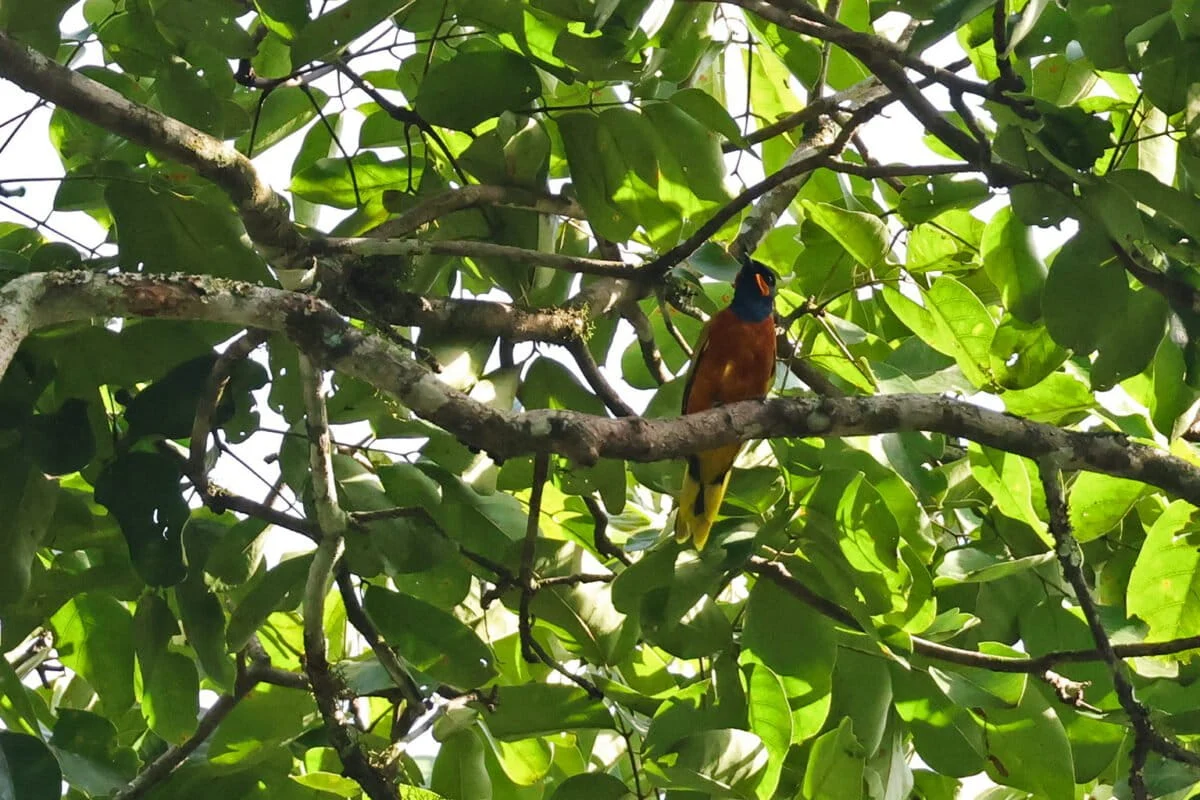
Because the Ghana cuckooshrike is exceptionally shy and sensitive to human presence, getting close enough for a visual identification with the naked eye proved nearly impossible. Bartlett relied on her camera lens as a primary observational tool, snapping a photograph of the bird before she had even consciously registered its physical form in the branches above.
"They’re scared of you," Bartlett explained regarding the evasive nature of the species. "You don’t get to get close to them, and so often you have to use the camera as a tool for identification."
When Bartlett reviewed the resulting image, it revealed the unmistakable features of the Ghana cuckooshrike: a striking, small-statured bird boasting a vivid orange body contrasted sharply by bold black and yellow wing patterns. The photograph immediately silenced years of speculation regarding whether the species had completely vanished from the national park or the broader Upper Guinean Rainforest ecosystem.
Crucial Collaboration with West African Researchers
While the international research team spearheaded the expedition, project leaders were quick to emphasize that the rediscovery would have been impossible without the deep local knowledge and logistical expertise of West African scientists, field assistants, and local guides.
"To say they were vital for this project is an understatement," noted Paulo Ditzel, highlighting the indispensable contributions of regional experts who understand the nuanced micro-habitats and seasonal behaviors of Taï National Park’s resident wildlife.
Among those local leaders was Saint Guillaume Odoukpe, an ornithologist and assistant professor at Côte d’Ivoire’s Université Félix Houphouët-Boigny, who organized and accompanied the IBCP expedition. Odoukpe’s institutional support and regional insight bridged the gap between international conservation frameworks and boots-on-the-ground fieldwork.
"Taï is a treasure for biodiversity conservation in Côte d’Ivoire and indeed throughout West Africa," Odoukpe stated following the expedition. "I think there is plenty more to discover in this forest."
A Timeline of Silence: The Disappearance and Search for the Lost Bird
The Ghana cuckooshrike has long confounded biologists due to its sparse population distribution and elusive lifestyle. Prior to the recent expedition in Côte d’Ivoire, the last verified, scientifically documented sighting of the species occurred in 2013 within Ghana’s Atewa Forest.
For the thirteen years intervening between 2013 and 2026, the species languished in scientific obscurity. Historically, ornithologists understood the bird’s geographic range to span across fragmented sections of West Africa—stretching from Guinea through Liberia and Sierra Leone to Ghana and Côte d’Ivoire. This entire expanse forms part of the Upper Guinean Rainforest, a globally recognized biodiversity hotspot that has suffered catastrophic habitat loss over the past century.
As the years ticked by without a single verified record, conservation biologists faced a data vacuum. Without modern sightings, assessing the true population size, identifying critical breeding grounds, or determining the precise conservation status of the cuckooshrike became nearly impossible.

John Mittermeier, director of the Search for Lost Birds and an expert with the American Bird Conservancy (ABC), underscored the profound challenges that prolonged absence creates for conservationists.
"You can’t really make an effective conservation plan for a species that nobody’s seen in 10 years," Mittermeier noted. "You’re not sure how it’s doing. You’re not sure where it is."
The Search for Lost Birds initiative classifies such organisms to direct funding, scientific attention, and expedition resources toward regions where species might be holding on in isolated habitat fragments. The calculated gamble by the IBCP and SLB to target Taï National Park ultimately paid off, transforming the cuckooshrike from a missing data point into a living, breathing subject for future research.
Habitat Fragmentation and Environmental Pressures
The rediscovery of the Ghana cuckooshrike offers a brief celebration, but it occurs against a backdrop of severe environmental degradation across the Upper Guinean Rainforest. Over generations, the continuous expanse of ancient forest that once dominated West Africa has been whittled down to isolated, fragmented patches.
This severe habitat fragmentation is primarily driven by expanding agricultural conversion—such as cocoa and palm oil plantations—along with commercial logging and infrastructure development. When forests are broken into smaller, disconnected islands of green, resident bird populations become isolated, losing genetic diversity and facing heightened vulnerability to local extinction events caused by storms, disease, or human disturbance.
Furthermore, protected areas like Taï National Park are not entirely immune to anthropogenic pressures. Conservationists note that the park—despite its legal protections—faces persistent threats from illegal artisanal gold mining (often referred to locally as galamsey), unauthorized poaching, and illegal logging. These activities not only destroy the delicate forest understory and canopy layers required by arboreal birds like the cuckooshrike, but they also degrade vital watershed ecosystems, impacting local drinking water and regional microclimates.
The Implications for Regional Conservation Strategies
The documentation of Lobotos lobatus in Côte d’Ivoire carries immediate implications for conservation policy and resource allocation. By confirming that a viable population of the cuckooshrike persists within Taï National Park, researchers now possess a geographic anchor point around which to build targeted protection frameworks.
First, the sighting validates the ecological integrity of Taï National Park as a crucial stronghold for rare West African fauna. While many large mammals and primates receive substantial conservation focus within the park, lesser-known endemic birds often slip through the cracks of funding priorities. The cuckooshrike serves as an umbrella species; efforts to protect its remaining canopy habitat will inherently benefit a wide array of other threatened flora and fauna sharing the same ecosystem.
Second, the discovery provides renewed momentum for legislative and enforcement bodies in Côte d’Ivoire to crack down on illicit activities within protected boundaries. Demonstrating that the forest harbors globally significant, rare species increases the international visibility of Taï National Park, bringing potential leverage for increased funding, ecotourism initiatives, and tighter government oversight against illegal mining syndicates.
A Call to Action and Exploration
Beyond its immediate scientific and conservation value, the return of the Ghana cuckooshrike serves as a powerful psychological reminder of the mysteries still hidden within the Earth’s remaining wild spaces. In an era dominated by digital mapping and satellite surveillance, it is easy to assume that every corner of the planet has been fully catalogued and understood.
John Mittermeier reflected on this broader philosophical shift prompted by the expedition’s success, noting that nature still holds profound capacities for surprise.
"We have this sense sometimes [that] there’s nothing left to explore," Mittermeier told Mongabay. "Pero actually, there’s so many things left to explore, and in a way, these lost birds are a call to exploration."
As researchers pore over the data collected during the IBCP expedition, plans are already underway to expand survey efforts, monitor the newly identified cuckooshrike territory, and collaborate with local communities to ensure the forest remains intact. For now, the bright orange and black flash captured by Stephanie Bartlett’s camera lens stands as proof that resilience exists in the canopy—and that with persistence, even the most elusive species can step out of the shadows and back into the light.