The Dutch government’s ambitious vision for a green hydrogen-powered industrial sector is encountering significant structural headwinds, forcing a painful re-evaluation of both fiscal commitments and energy infrastructure planning. What began in 2022 as a high-profile, state-subsidized initiative to establish a robust domestic electrolysis industry has, four years later, devolved into a cautionary tale of mismatched market expectations and the high cost of over-optimistic energy forecasting.
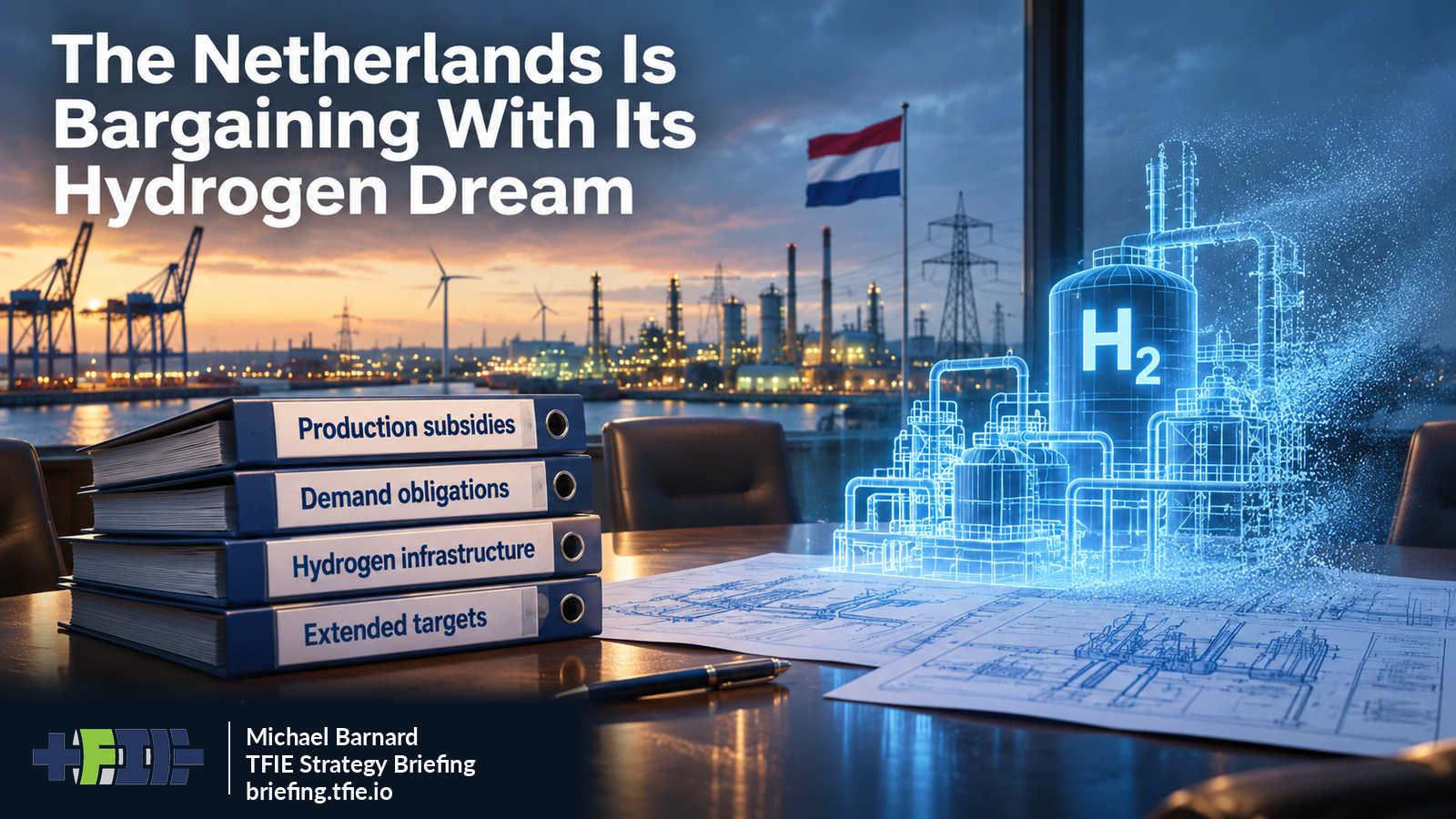
As of November 2026, the reality on the ground contradicts the initial enthusiasm that drove the allocation of €783.5 million in subsidies to seven flagship green hydrogen projects. Not a single one of these projects has reached an operational status, and four of them—representing a combined capacity of 550 megawatts (MW)—have been formally cancelled. This significant attrition rate, representing nearly half of the originally planned 1,150 MW of electrolysis capacity, has prompted serious questions regarding the viability of state-led industrial transitions that rely on heavy subsidies in the absence of clear commercial demand.
A Chronology of Stalled Ambitions
The trajectory of the Dutch hydrogen strategy has been defined by a gap between policy intent and market reality. In 2022, the government launched a comprehensive subsidy scheme designed to kickstart the production of green hydrogen, betting that the price of renewable energy would drop rapidly enough to make electrolytic hydrogen competitive with fossil-fuel-based alternatives by 2030.
By 2025, however, the economic assumptions underpinning these projects began to fracture. The Netherlands Court of Audit, in a December 2025 report, highlighted the growing instability of the national hydrogen infrastructure project. The estimated investment for the network had ballooned from an initial €1.5 billion to a staggering €3.8 billion. Furthermore, the state-owned infrastructure operator, Gasunie/Hynetwork Services, signaled that the project could face startup losses of up to €2.5 billion, even against a substantial government grant of €750 million.
This year, the government’s own energy planning has undergone a significant revision, acknowledging that hydrogen will play a more limited role in heating and electricity generation than previously anticipated. Despite this pivot, the government remains committed to a pipeline network and ongoing subsidy rounds, creating a situation where policy continues to chase volumes that the current market cannot support.
The Mathematics of Production Costs
The primary driver of the current crisis is the fundamental disconnect between the cost of electricity and the market value of the resulting hydrogen. The original subsidy decisions were predicated on a target production cost of approximately €2/kg of green hydrogen by 2030. This figure assumed that renewable energy would be readily available at prices and volumes that have yet to materialize in the European industrial market.
To produce one kilogram of hydrogen via electrolysis, an operator typically requires between 50 and 55 kWh of electricity. Even if a facility could secure power at an exceptionally low rate of €50/MWh, the energy input cost alone—before accounting for capital expenditures, maintenance, water purification, compression, storage, and transport—ranges between €2.50 and €2.75 per kilogram.
These calculations suggest that the original €2/kg target was, from its inception, highly optimistic. When electricity prices fluctuate, as they have throughout the volatility of the mid-2020s, the economic argument for domestic electrolysis collapses. Operators who attempt to mitigate costs by running electrolyzers only during hours of peak renewable energy supply face the secondary challenge of idle capital equipment, which drives up the amortization cost per kilogram produced. Consequently, the reliance on subsidies has become a permanent feature rather than a temporary bridge to commercial viability.
Infrastructure Exposure and Economic Risk
The infrastructure dimension of the Dutch hydrogen strategy represents perhaps the most significant long-term liability for the state. A pipeline network, by nature, is a long-term capital investment designed to transport massive volumes of product. When the projected demand for that product declines, the unit cost of transportation rises, creating a "death spiral" for the project.
If the hydrogen market does not reach the scale initially projected, the tariffs required to cover the €3.8 billion investment cost will be prohibitively high for industrial end-users. If the government chooses to absorb these costs through additional subsidies, it risks shifting the financial burden onto taxpayers to support an infrastructure network that serves only a fraction of its intended capacity. The Court of Audit’s warning in late 2025 regarding the uncertainty of this network was a clear signal that the project’s financial architecture is as fragile as its industrial demand projections.
Shifting Industrial Strategy
The Dutch industrial sector, spanning chemical manufacturing, steel production, and port logistics, is currently navigating a period of profound change. As hydrogen expectations shrink, the focus is shifting toward more immediate and cost-effective decarbonization routes. Industrial heat pumps and direct electrification of processes are emerging as more credible alternatives to hydrogen-intensive methods, as these technologies often offer higher efficiency and lower capital intensity.
Furthermore, the globalization of the hydrogen market suggests that the Netherlands does not necessarily need to be a primary producer of green hydrogen to remain a competitive industrial hub. Certain energy-intensive feedstocks can be produced in regions with lower renewable energy costs and imported for further processing, a strategy that aligns more closely with the realities of global energy trade than the pursuit of national self-sufficiency in hydrogen production.
Smaller petroleum refineries, which are also facing long-term demand declines, will require less hydrogen than they did in previous decades, further dampening the business case for large-scale electrolysis facilities. These shifts necessitate a move away from rigid volume-based targets toward a more flexible industrial strategy that prioritizes the economic efficiency of the end product.
The Path Forward: A Call for Policy Reform
The Dutch government now finds itself at a critical juncture. With a new subsidy round on the horizon, it faces a mounting body of evidence that its initial premises were flawed. The combination of project cancellations, cost overruns, and diminished demand projections creates an urgent need for a shift in policy focus.
Observers and industry analysts argue that the government should pause further funding to critically evaluate the actual requirements of the industrial sector. A fact-based approach would require an assessment of the most efficient decarbonization pathways for each industry segment—be it steel, chemicals, or refined products—and a determination of the precise amount of hydrogen actually needed to facilitate these transitions.
Continuing to fund projects based on 2022-era forecasts risks locking the Netherlands into a high-cost energy infrastructure that may ultimately be underutilized. The challenge is not merely one of technology or engineering, but of institutional discipline. As the nation grapples with these challenges, the broader European energy policy landscape will be watching, as the Netherlands serves as a bellwether for the continent’s wider industrial decarbonization strategy.
Moving forward, the success of the Dutch energy transition will likely be measured not by the amount of hydrogen produced, but by the ability of its industrial sector to remain competitive in a changing global market. By decoupling the desire for "green" labels from the economic reality of energy production, the government has the opportunity to pivot toward a more sustainable and economically sound industrial future. Failure to do so, however, threatens to make the current generation of energy policies a recurring financial burden rather than the foundation of a modern, low-carbon economy.