
The ambitious promise of physical artificial intelligence (AI) envisions a future where engineers can program physical agents with the same fluidity and efficiency currently applied to digital counterparts. This paradigm shift holds immense potential for industries ranging from manufacturing and logistics to healthcare and defense, promising unprecedented levels of automation and capability. However, the journey to this future is fraught with significant technical hurdles, primarily stemming from a critical scarcity of real-world data and scalable testing environments for physical AI systems. Robotics, in its current state, is largely tethered by this data deficit, necessitating costly and time-consuming physical infrastructure for development and validation.
Companies today are often compelled to construct elaborate mock-up warehouses, industrial settings, or specialized test tracks to rigorously test their robotic machines. This process is not only capital-intensive but also inherently limited in scope and speed. Furthermore, an entire ancillary industry has emerged, dedicated to the surveillance of factory lines and gig workers, meticulously gathering the granular data required to train the sophisticated deep learning models that empower these robots. While effective, these methods are far from scalable, sustainable, or ethically unproblematic, particularly as the complexity and deployment ambitions of physical AI continue to grow.
An alternative, increasingly recognized as the cornerstone for future robotics development, lies in advanced simulation. The creation of detailed, high-fidelity virtual replicas of real-world environments offers a compelling solution, capable of providing the vast quantities of data and versatile workspaces that roboticists desperately need to accelerate their work in a truly scalable manner. It is within this burgeoning and critical domain that Antioch, a burgeoning startup, is positioning itself as a pivotal player.
Antioch’s Mission: Conquering the Sim-to-Real Gap
Antioch is specifically engineered to develop cutting-edge simulation tools for robot developers, with the explicit goal of addressing what the industry commonly refers to as the "sim-to-real gap." This formidable challenge encapsulates the difficulty of ensuring that robots trained within virtual environments can translate their learned behaviors and operational proficiencies reliably and safely into the unpredictable nuances of the physical world. The fidelity and accuracy of the simulation directly dictate the success or failure of this transition.
"How can we do the best possible job reducing that gap, to make simulation feel just like the real world from the perspective of your autonomous system?" posed Harry Mellsop, CEO and co-founder of Antioch, articulating the company’s core technological imperative. This question lies at the heart of their innovation, driving the development of tools that aim to blur the lines between virtual training and physical deployment.
To power this ambitious undertaking, Antioch recently announced to TechCrunch the successful closure of an $8.5 million seed funding round. This significant capital injection values the New York-based company at a robust $60 million, signaling strong investor confidence in its vision and technological approach. The round was co-led by prominent venture firms A* and Category Ventures, with additional substantial participation from MaC Venture Capital, Abstract, Box Group, and Icehouse Ventures. This diverse group of investors underscores the widespread recognition of the critical need Antioch is addressing within the rapidly expanding physical AI landscape.
The Foundational Need for Superior Simulation
The imperative for superior simulation capabilities resonates deeply across the entire autonomy sector. Major players in the self-driving car industry, for instance, have long recognized and invested heavily in this area. Waymo, a leader in autonomous vehicle technology, leverages Google DeepMind’s advanced world models to meticulously test and evaluate its sophisticated driving models. In theory, this rigorous simulation-based testing technique promises to significantly reduce the data collection requirements for deploying Waymo vehicles in new geographical areas—a factor that represents a key cost and logistical bottleneck in scaling autonomous vehicle technology globally.
However, the development and application of such complex simulation models for generalized robotics often demand a distinct set of skills and resources compared to those required for highly specialized applications like self-driving cars. Antioch aims to democratize access to these sophisticated capabilities, building a comprehensive platform designed to solve these simulation challenges for newer companies and startups that typically lack the immense capital and in-house expertise to develop such extensive systems from scratch. These smaller entities simply cannot afford to construct dedicated physical testing arenas or embark on multi-million-mile sensor-studded vehicle test drives.
"The vast majority of the industry doesn’t use simulation whatsoever, and I think we’re now just really understanding clearly that we need to move faster," Mellsop stated, highlighting a critical industry gap and the urgent need for accessible, high-quality simulation tools. His assertion points to a broad reliance on traditional, slower development cycles, which are increasingly unsustainable in the face of accelerating AI advancements and market demands.
Antioch’s Technological Edge and Market Strategy
Antioch executives draw a compelling analogy between their product and Cursor, the popular AI-powered software development tool, to illustrate its functionality and impact. Antioch’s platform empowers robot builders to effortlessly "spin up" multiple digital instances of their physical hardware. These virtual replicas are then seamlessly connected to simulated sensors that are meticulously designed to mimic the exact data streams that the robot’s software would receive in a real-world operational environment. These dynamic virtual environments serve as invaluable sandboxes, allowing developers to rigorously test complex "edge cases" – unusual or rare scenarios that are difficult and dangerous to replicate physically. Furthermore, the platform facilitates reinforcement learning, where AI agents learn through trial and error in a simulated world, and enables the rapid generation of vast quantities of new, diverse training data, which is crucial for improving model robustness.
The core challenge, and Antioch’s competitive advantage, lies in ensuring the "sufficiently high fidelity" of these simulations. This means that the physics engine governing the virtual environment must accurately replicate real-world physical interactions, including friction, gravity, collisions, and material properties. Any discrepancy between simulated and real-world physics could lead to catastrophic failures when the trained model is deployed on an actual machine. To achieve this, Antioch builds upon foundational models provided by industry leaders such as Nvidia and World Labs, then develops domain-specific libraries that make these complex tools intuitive and accessible for developers. By working with a diverse portfolio of customers, Antioch benefits from a rich and varied depth of context, enabling them to continuously refine and enhance their simulations in ways that no single physical AI company could achieve in isolation.
Ayça Kaymaz, a partner at Category Ventures, elucidated the investment rationale, drawing a parallel yet highlighting a crucial distinction: "What happened with software engineering and LLMs is just starting to happen with physical AI. We do a lot of work on dev tools, and we love that vertical, but the challenges are different. With software, you can have these bad coding tools, and the risk is generally pretty contained to the digital world. In the physical world, the stakes are much higher." This underscores the profound responsibility and criticality of Antioch’s work, where errors in simulation can translate to tangible risks to safety and assets in the physical realm.
Currently, Antioch’s primary focus is on sensor and perception systems, which constitute the bulk of the developmental needs in autonomous vehicles (cars and trucks), advanced farm and construction machinery, and aerial drones. While the grander aspirations for physical AI to power generalized robots capable of replicating complex human tasks remain a longer-term objective, Antioch’s immediate impact is on these critical, commercially viable applications. Interestingly, while Antioch’s pitch is particularly appealing to startups seeking to accelerate their development without prohibitive capital outlays, some of its earliest engagements have been with established multinational corporations already heavily invested in robotics, indicating a broader market appeal for its solutions.
A Proven Team and Strategic Backing
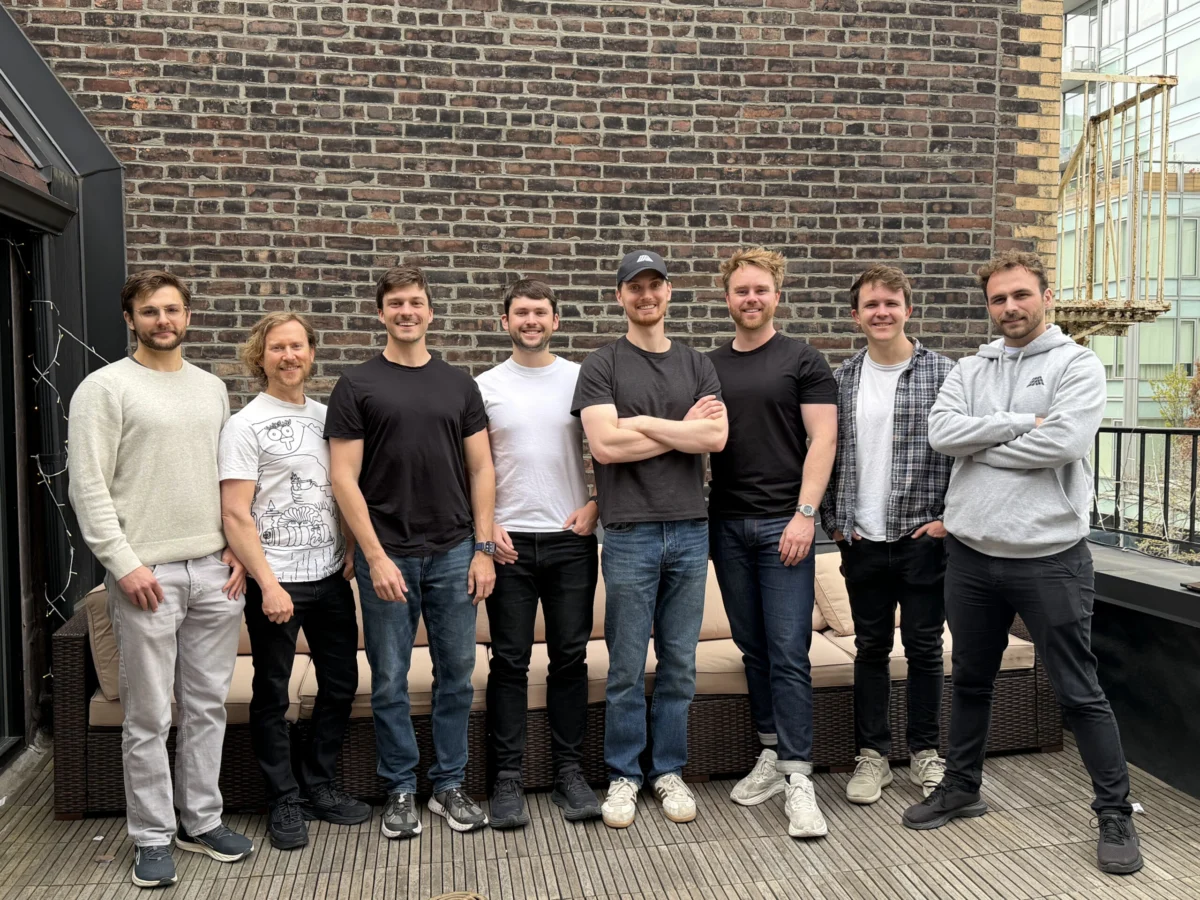
Antioch was founded in May of last year in New York by a team of five co-founders, each bringing a wealth of relevant experience to the venture. Harry Mellsop leads the company as CEO and co-founder. He is joined by Alex Langshur and Michael Calvey, both of whom previously co-founded Transpose, a security and intelligence startup, alongside Mellsop. Their collective entrepreneurial acumen was demonstrated through the successful sale of Transpose to Chainalysis for an undisclosed amount, showcasing a proven track record of building and scaling successful technology ventures. The other two co-founders, Collin Schlager and Colton Swingle, contribute deep technical expertise from their prior roles at Google DeepMind and Meta Reality Labs, respectively. This combination of entrepreneurial success and cutting-edge AI/robotics experience provides Antioch with a formidable leadership team.
The strategic importance of Antioch’s work is further validated by angel investors like Adrian Macneil, a highly respected figure in the autonomous systems space. Macneil, who previously built the data infrastructure at the self-driving startup Cruise and later founded Foxglove (a company offering similar data pipelines to physical AI startups), possesses a profound understanding of the challenges and opportunities in this domain. His investment in Antioch speaks volumes about the startup’s potential.
At the Ride.AI conference in San Francisco, Macneil articulated the necessity of simulation: "Simulation is really important when you’re trying to build a safety case or dealing with very high-accuracy tasks. It’s not possible to drive enough miles in the real world." This statement underscores the inherent limitations of physical testing and positions simulation as an indispensable tool for achieving the safety and precision required for widespread autonomous system deployment. Macneil envisions a future where the physical AI sector benefits from the same kind of robust "off-the-shelf" developer tools that fueled the SaaS revolution – platforms like Github for code collaboration, Stripe for payments, and Twilio for communication APIs. "We need a lot more of the entire toolchain to be available off the shelf," he told TechCrunch, directly aligning with Antioch’s mission to provide foundational simulation infrastructure.
Broader Impact and Future Outlook
The implications of Antioch’s success extend beyond individual companies, promising to significantly accelerate the entire physical AI ecosystem. As Mellsop confidently predicts, "We genuinely all think that anyone building an autonomous system for the real world is going to do so in software primarily in two to three years. It’s the first time you can have autonomous agents iterate on a physical autonomy system, and actually close the feedback loop." This vision paints a picture of a rapid shift towards software-defined robotics, where development cycles are dramatically shortened and innovation is supercharged through continuous, simulated iteration.
Early experiments already hint at the transformative potential. David Mayo, a researcher at MIT’s Computer Science and Artificial Intelligence Laboratory (CSAIL), is actively utilizing Antioch’s platform to evaluate large language models (LLMs) in novel ways. In one groundbreaking experiment, Mayo leverages AI models to design robots, subsequently employing Antioch’s simulator to rigorously test these designs. The platform even allows for pitting rival AI-designed bots against each other in simulated contests, such as pushing an opponent off a platform. This innovative approach to giving LLMs a realistic "sandbox" could usher in a new paradigm for benchmarking and understanding the capabilities of advanced AI in physical contexts.
Before the full realization of a world teeming with AI engineers seamlessly programming physical agents, considerable work remains in further narrowing the gap between digital models and real-world performance. However, if Antioch and similar ventures can achieve this elusive goal, developers will be empowered to create the kind of powerful "data flywheel" that Adrian Macneil identifies as key to the sustained success of industry leaders like Waymo. This flywheel effect, where each iteration and deployment generates data that refines and improves subsequent models, leads to a continuous cycle of enhancement, fostering a growing confidence among engineers that "next month’s model will be more capable than the last."
The global robotics market is projected to grow substantially, with industry analysts forecasting it to reach upwards of $200 billion by 2030, driven significantly by advancements in AI and automation. Within this burgeoning market, the segment for robotics simulation software is also expected to witness robust growth, underscoring the increasing reliance on virtual environments for efficient development and testing. Antioch’s timely entry and substantial funding position it to capture a significant share of this expanding market.
Ultimately, for a multitude of companies aspiring to replicate the success of category leaders in autonomous systems, a fundamental choice emerges: either undertake the monumental task of building these complex simulation tools themselves – a path requiring immense capital and specialized talent – or strategically acquire them from innovative providers like Antioch. The substantial investment in Antioch suggests that the latter option is becoming an increasingly attractive and necessary pathway for accelerating the future of physical AI.










Leave a Reply