
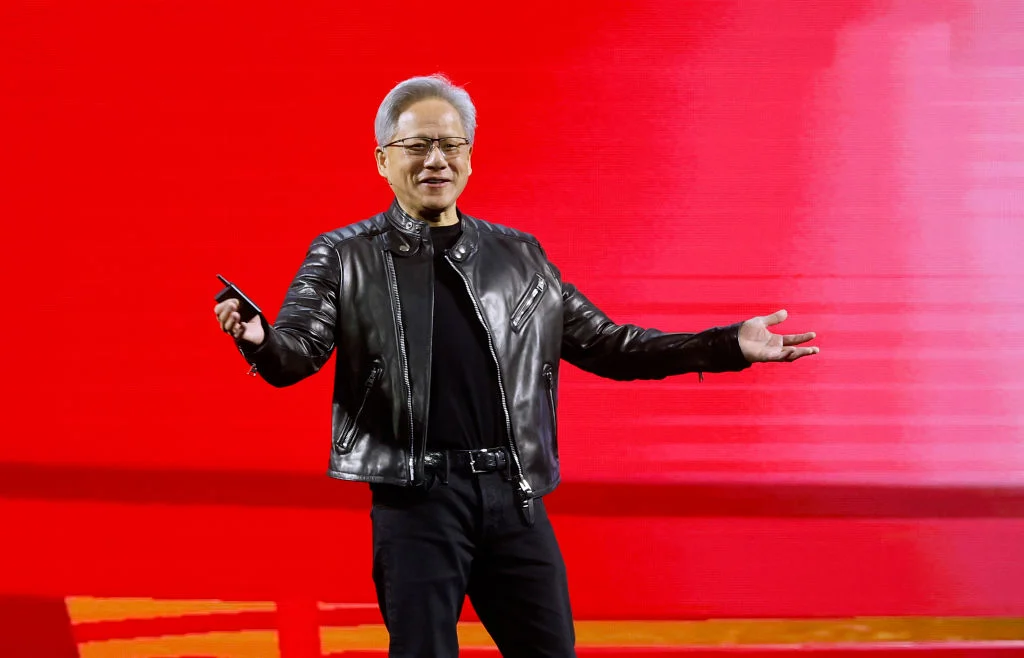
During a compelling conversation Monday night at the prestigious Milken Institute Global Conference, Jensen Huang, the charismatic CEO of Nvidia, firmly pushed back against the widespread apprehension surrounding artificial intelligence and its potential to displace human labor. Speaking with MSNBC’s Becky Quick, Huang articulated a vision of AI not as a harbinger of mass unemployment, but as a powerful catalyst for unprecedented job creation and a critical driver for the re-industrialization of the United States. His remarks, delivered to an audience of global leaders and economic influencers, aimed to reframe the narrative from one of fear to one of immense opportunity, emphasizing that the American worker has "nothing to fear" from this transformative technology.
The Milken Institute Global Conference: A Nexus for Global Dialogue
The setting for Huang’s optimistic pronouncements was the Milken Institute Global Conference, an annual gathering renowned for convening the brightest minds across finance, business, government, philanthropy, and academia. Held in Beverly Hills, California, the conference serves as a crucial forum for discussing solutions to pressing global challenges. In this environment, where economic trends and policy implications are rigorously debated, the future of work in the age of AI naturally took center stage. Becky Quick, a veteran financial journalist known for her insightful interviews, facilitated a discussion that delved into the heart of the economic anxieties currently gripping many sectors. She directly addressed the speed of AI’s development, asking Huang, "This is happening so quickly. Is there a bigger dislocation than we’ve seen in the past that leads to greater inequality? And what do we do about that?" This question underscored the prevailing concerns that Huang sought to assuage.
Nvidia, under Huang’s leadership, has become an undisputed titan in the AI landscape, primarily through its dominant position in the design and manufacture of Graphics Processing Units (GPUs)—the foundational hardware for AI computation. This makes Huang’s perspective uniquely informed; he is not merely an observer but a principal architect of the AI revolution, with direct insight into its technological and economic underpinnings. His assertions carry significant weight, representing a powerful counter-narrative to the often-dire predictions emanating from certain corners.
Deconstructing "Job" vs. "Task": A Nuanced Perspective
A central tenet of Huang’s argument hinges on a critical distinction between a "task" and a "job." He asserted that those who believe AI will wholesale replace human roles "misunderstand that the purpose of a job and the task of a job are related but not ultimately the same thing." This nuanced view suggests that while AI is undoubtedly adept at automating discrete, repetitive, or data-intensive tasks, the broader, more complex purpose an employee serves within an organization — involving judgment, creativity, interpersonal skills, strategic thinking, and emotional intelligence — is far less susceptible to full automation.
For instance, an AI might efficiently draft legal documents, analyze vast datasets for financial patterns, or generate initial marketing copy. However, the legal professional’s role still requires client consultation, courtroom advocacy, ethical reasoning, and strategic case planning. A financial analyst’s job still involves interpreting complex market dynamics, advising clients, and navigating regulatory landscapes. The marketing specialist’s role requires understanding human psychology, building brand narratives, and adapting strategies based on real-world feedback. In each case, AI acts as a powerful co-pilot, augmenting human capabilities and freeing up individuals to focus on higher-value, more inherently human aspects of their work, rather than rendering them obsolete. This concept aligns with the growing academic consensus on "augmented intelligence," where humans and AI collaborate to achieve superior outcomes.
AI as an Industrial Engine: Powering Re-Industrialization
Huang passionately championed AI as the United States’ "best opportunity to re-industrialize itself." This vision extends beyond mere software innovation, encompassing a tangible resurgence in industrial production and infrastructure development. He highlighted that the burgeoning AI industry is fueled by a "new breed of industrial factories" dedicated to producing the critical hardware—like advanced semiconductors, data center components, and specialized AI accelerators—that form the backbone of the AI business. Nvidia, of course, plays a pivotal role in supplying much of this hardware.
The creation and operation of these advanced manufacturing facilities and their associated ecosystems necessitate a vast and diverse workforce. This includes highly skilled engineers and technicians for semiconductor fabrication plants (fabs), construction workers for new data centers, logistics experts for supply chain management, and a wide array of support staff. Furthermore, the downstream applications of AI across virtually every industry—from healthcare and automotive to finance and entertainment—will spawn countless new businesses and require new skills. The development, deployment, and maintenance of AI systems will create demand for AI researchers, data scientists, machine learning engineers, prompt engineers, AI ethicists, cybersecurity specialists, and technical support personnel. This industrial shift is not merely about Silicon Valley software startups but about a profound transformation of the global manufacturing and service economy.
Addressing the "AI Doomer" Narrative: A Call for Engagement
A significant portion of Huang’s address was dedicated to critiquing the "AI doomer" rhetoric—the alarmist narratives suggesting AI will dominate humanity or cause catastrophic economic collapse. He expressed deep concern that such exaggerated fears could paralyze progress: "My greatest concern is that we scare…people—all the people that we’re telling these science fiction stories to, to the point where AI is so unpopular in the United States, or people are so afraid of it, that they don’t actually engage it."
Huang’s point resonates with a broader debate within the tech community. Critics, including some within the AI industry itself, have pointed out the ironic self-serving nature of some "doomer" prophecies. Such hyperbolic claims, they argue, can act as a marketing gimmick, generating buzz and excitement for products whose actual capabilities might not yet match the lofty rhetoric. This hype cycle can attract significant venture capital investment and media attention, even if it creates an unrealistic public perception of AI’s current power and future trajectory. By instilling excessive fear, it risks stifling innovation, hindering public acceptance, and deterring crucial investment in AI research and development that could address real-world challenges. Instead of retreating in fear, Huang advocates for active engagement, understanding, and responsible development to harness AI’s immense potential.
Economic Perspectives and Supporting Data: A Balanced View
While Huang’s optimism is clear, it is important to acknowledge the multifaceted economic forecasts surrounding AI. Reputable financial and academic organizations indeed suggest that significant job displacement is possible. For instance, reports from institutions like McKinsey, PwC, and the World Economic Forum, while often emphasizing net job creation or transformation, also predict that a certain percentage of existing jobs will be eliminated or significantly altered. The original article mentions that "as much as 15% percent of jobs in the U.S. will be eliminated over the next several years as a result of AI."
However, it is crucial to contextualize such figures. These are often gross displacement figures, not necessarily net. Many analyses suggest that for every job displaced, new jobs are created, or existing roles are augmented, leading to a net positive or a significant shift in job types. For example, a 2023 World Economic Forum report predicted that AI would lead to a net creation of 69 million jobs globally by 2027, even as it displaced 83 million, highlighting a substantial churn rather than a pure loss. Similarly, a 2018 study by PwC projected that AI could contribute up to $15.7 trillion to the global economy by 2030, a growth fueled by increased productivity and new products and services, which inherently require human ingenuity and labor.
Historically, major technological shifts—from the agricultural revolution to the industrial revolution, and more recently the internet boom—have always led to significant job displacement in certain sectors while simultaneously creating entirely new industries and job categories. The transition has often been challenging, marked by periods of economic dislocation and social unrest, but ultimately led to higher productivity, new opportunities, and often an improved quality of life. The key challenge lies in managing this transition effectively.
The Future of Work: Challenges and Opportunities
The broader impact and implications of AI extend beyond mere job numbers. The rapid evolution of AI technology necessitates a proactive approach to education and workforce development. If not managed effectively, the displacement of tasks could indeed exacerbate economic inequality, particularly for workers in routine, automatable roles who lack access to reskilling opportunities. Labor organizations and policy makers frequently raise concerns about the need for robust social safety nets, universal basic income discussions (though controversial), and massive investments in lifelong learning programs.
Economists and futurists generally agree that the jobs of the future will increasingly demand skills that complement AI, such as critical thinking, creativity, complex problem-solving, emotional intelligence, and digital literacy. Universities, vocational schools, and corporate training programs will need to adapt rapidly to equip the workforce with these essential competencies. The concept of "human-in-the-loop" AI systems, where human oversight and intervention remain crucial, underscores the ongoing need for human workers in complex AI deployments.
Beyond employment, AI promises to drive innovation across countless fields, from accelerating scientific discovery and drug development to optimizing energy grids and improving disaster response. This innovation itself creates new markets, new companies, and new demands for human expertise. Huang’s vision of re-industrialization through AI implies not just the manufacturing of chips, but the application of AI to revitalize traditional industries and foster entirely new ones, thereby strengthening national competitiveness.
Conclusion: Engagement Over Apprehension
Jensen Huang’s remarks at the Milken Institute served as a powerful counterpoint to the prevalent anxieties surrounding artificial intelligence. His optimistic yet pragmatic outlook emphasizes AI’s potential as a powerful engine for job creation and economic revitalization, particularly for the United States. By distinguishing between task automation and job purpose, highlighting the industrial infrastructure AI demands, and challenging the paralyzing effects of "doomer" rhetoric, Huang advocates for engagement and proactive adaptation rather than fear. While acknowledging that technological shifts inevitably bring challenges, including potential job displacement in certain sectors, the broader historical context and emerging economic data suggest that AI, when managed responsibly and embraced strategically, can indeed usher in an era of unprecedented productivity, innovation, and new opportunities for the global workforce. The imperative now lies in fostering an environment that supports continuous learning, strategic investment, and responsible development to fully realize AI’s transformative potential.










Leave a Reply