
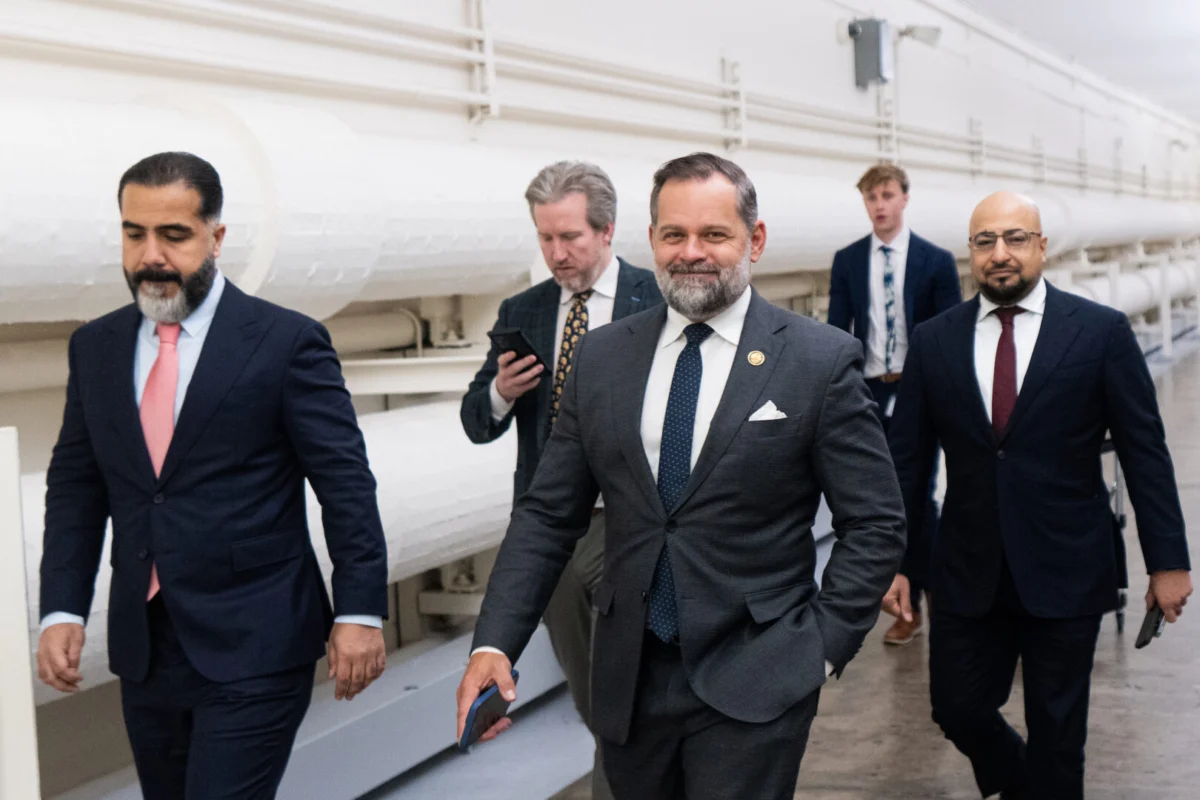
The halls of Congress are once again abuzz with calls for accountability as two Florida representatives, Sheila Cherfilus-McCormick, a Democrat, and Cory Mills, a Republican, find themselves embroiled in serious ethics controversies, prompting demands for their resignations. This comes on the heels of the recent departures of Representatives Eric Swalwell, D-Calif., and Tony Gonzales, R-Texas, both of whom resigned following separate sexual misconduct allegations, setting a recent precedent for heightened scrutiny. The current situation highlights the House’s ongoing struggle to uphold ethical standards within its ranks, with the House Ethics Committee playing a pivotal role in these unfolding dramas.
The pressure, however, is not evenly distributed. Representative Cherfilus-McCormick is facing a more immediate and widespread clamor for her departure, particularly from Republican colleagues, stemming from accusations of misusing FEMA overpayment funds to bolster her 2021 congressional campaign. Conversely, Representative Mills, facing allegations of sexual harassment, assault, and campaign finance misrepresentation, has seen comparatively fewer public calls for his resignation, with his investigation still in earlier stages. This disparity underscores the complex political dynamics at play in a narrowly divided House, where partisan considerations often intertwine with matters of ethics and accountability.
The Allegations Against Representative Sheila Cherfilus-McCormick
Representative Sheila Cherfilus-McCormick’s legal and ethical woes are multifaceted and have progressed significantly through formal channels. The Democrat from Florida is accused of a severe breach of public trust, specifically misusing funds intended for disaster relief. The core of the allegations centers on her purported use of FEMA overpayment funds to support her 2021 congressional campaign. This charge is not merely an internal ethics violation; it has escalated to a federal indictment. Cherfilus-McCormick faces 15 federal counts, including serious charges such as theft of government funds and money laundering. These allegations paint a picture of diverting crucial public resources, earmarked for aid in times of crisis, towards personal political gain.
The House Ethics Committee has taken an unusually public and swift approach to her case. In a rare procedural move, the committee conducted a public "trial" in March, an event not typically open to public scrutiny. Following this proceeding, the committee found her guilty of violating ethics rules. This finding has paved the way for a public hearing scheduled for April 21, where the committee is expected to determine and impose "sanctions" against her. The scheduling of this hearing has effectively created a natural deadline for holding Cherfilus-McCormick accountable, a timeline that her critics are eager to see enforced.
Her response to the allegations has been steadfast denial. Cherfilus-McCormick has publicly maintained her innocence, labeling the indictment as "unjust, baseless, [and a] sham." Despite her assertions, the formal processes of both the federal judiciary and the House Ethics Committee are moving forward, indicating the gravity with which these accusations are being treated by authorities. The potential sanctions from the Ethics Committee could range from a reprimand or censure to a recommendation for expulsion from the House, a fate that Speaker Mike Johnson has openly suggested is possible and appropriate.
The Allegations Against Representative Cory Mills
In contrast to the advanced stage of Cherfilus-McCormick’s case, the ethics investigation into Representative Cory Mills, a Republican from Florida, remains ongoing, with fewer public details available regarding its progression. Mills faces a range of serious accusations, including sexual harassment of his ex-girlfriend, assault, and misrepresentation of campaign finances. While these allegations are severe, they have not yet resulted in a public "trial" or a finding of guilt by the Ethics Committee, nor have they led to a federal indictment as in Cherfilus-McCormick’s case.
The nature of the allegations against Mills — particularly those involving sexual harassment and assault — touches upon a sensitive area that has gained increasing prominence in political discourse and public accountability movements in recent years. Concerns about workplace conduct and the treatment of individuals by those in power have led to greater scrutiny of public figures. The campaign finance misrepresentation charge, while distinct, also speaks to potential abuses of power and a lack of transparency in political funding.
Mills has vehemently denied the allegations, specifically pushing back against comparisons to the recently resigned Representatives Swalwell and Gonzales. "One, I’m not married, so there’s one thing. Two, I’ve never sexually harassed or had any complaints by any staffers or interns on the hill. It’s just not even a fair comparison," Mills stated to NewsNation this week. He further characterized the scrutiny as a "political Democratic tit for tat," suggesting the motivations behind the renewed focus on his conduct are partisan rather than purely ethical. He asserted, "I’m not even going to entertain it, but I’ve not heard anything as far as myself." His defense primarily hinges on distinguishing his situation from those of previous members who resigned under a cloud of sexual misconduct allegations, while also questioning the political motivations of his accusers.
The Role of the House Ethics Committee and Procedural Nuances
The House Ethics Committee, officially known as the Committee on Ethics, is a unique bipartisan body tasked with enforcing ethical standards for all members, officers, and employees of the U.S. House of Representatives. Its jurisdiction covers a wide array of potential violations, from campaign finance irregularities and conflicts of interest to personal conduct deemed unbecoming of a member of Congress. The committee operates under strict rules of confidentiality, particularly during its initial stages of inquiry, to protect the privacy of individuals and the integrity of investigations.
Typically, an ethics investigation begins with a preliminary review, often initiated by a complaint or referral. If sufficient evidence warrants it, an investigative subcommittee (ISC) is formed. The ISC conducts a thorough investigation, interviewing witnesses, reviewing documents, and potentially issuing subpoenas. At the conclusion of its investigation, the ISC can recommend dismissal of the charges, a letter of admonition, or that the full committee pursue further action.
The case of Representative Cherfilus-McCormick has deviated from the typical, more private, procedural path. The committee’s decision to hold a public "trial" in March was an exceptional measure, signaling the severity and apparent clarity of the evidence against her. This public forum allowed for a transparent, albeit rare, airing of the findings before a broader audience, culminating in the committee’s finding of guilt on ethics violations. The upcoming public hearing on April 21 for sanctions is a direct consequence of this unusual public process and underlines the committee’s determination to bring the matter to a definitive conclusion.
For Representative Mills, the investigation is still "ongoing," meaning it is likely in an earlier stage, possibly a preliminary review or an active ISC investigation, where confidentiality rules remain paramount. The absence of a public trial or a definitive timeline for a decision contributes to the perception of a less urgent or less developed case compared to Cherfilus-McCormick’s. This procedural difference is a key factor in the disparate levels of public pressure and calls for resignation currently being observed.
Political Dynamics in a Closely Divided House
The calls for resignation and the ongoing ethics investigations are unfolding within the highly charged atmosphere of a closely divided House of Representatives. In such a political climate, every seat is critical, and the potential loss of a member, whether through resignation or expulsion, carries significant weight for both parties. This delicate balance invariably injects a partisan dimension into matters of ethics, even when the underlying allegations are serious.
Republican Representative Anna Paulina Luna of Florida has been particularly vocal in her demands for Cherfilus-McCormick’s resignation, having previously played a role in the ouster efforts concerning Representatives Swalwell and Gonzales. Luna tweeted pointedly, "Sheila McCormick, we have your expulsion vote ready to be called up on the 21st. Either resign or be expelled. Those are your two options." Her strong stance, supported by Speaker Mike Johnson’s prediction of a recommended expulsion, suggests a unified Republican front pushing for a decisive outcome in Cherfilus-McCormick’s case. Johnson’s statement, "I expect that they will come forward with a recommended punishment for the Congress, and I suspect that may be expulsion," and his assertion that such a response would be "appropriate," clearly signal the Republican leadership’s inclination. His subsequent call for every member to "serve with the dignity of your office that is required and expected of you," notably without mentioning Mills, further highlights the partisan focus.
Democrats, keenly aware of the political implications, are signaling that any move to expel Cherfilus-McCormick will be met with a robust response. House Democratic Caucus Chair Pete Aguilar, D-Calif., warned that if Republicans vote to expel Cherfilus-McCormick, "all options are on the table for Democrats." He explicitly linked the two cases, stating, "In this case, Cory Mills also has an ethics process that is moving forward, but we reserve the right to respond based on how Republicans treat this. If they want to treat this overly political, then we respect that, and we’ll respond to that." This "tit-for-tat" mentality underscores the deep partisan mistrust and the strategic calculations inherent in congressional discipline. Democrats are essentially laying down a marker, suggesting that if a Democratic member is expelled, they will likely escalate calls for action against Republican members facing ethics issues, particularly Mills.
Some members, like Republican Representative Chip Roy of Texas, advocate for caution, arguing that members should be wary of "policing ourselves" too aggressively. Roy suggests that voters should ultimately decide whether Cherfilus-McCormick or Mills should remain in Congress, emphasizing the democratic process over internal disciplinary actions for certain types of allegations. This perspective reflects a broader debate about the appropriate balance between congressional self-governance and the will of the electorate.
Historical Context of Congressional Discipline
Congressional discipline, ranging from reprimand and censure to expulsion, has a long and complex history in the U.S. House of Representatives. Expulsion, the most severe form of punishment, requires a two-thirds vote of the chamber and has historically been reserved for the most egregious offenses, often involving disloyalty to the country or severe criminal misconduct. Since 1789, only five members have been expelled from the House, most notably for supporting the Confederacy during the Civil War. More recently, in 2023, George Santos, R-N.Y., became the sixth member expelled, primarily for a litany of federal charges including fraud and money laundering, and for defying the trust of his constituents and colleagues.
Censure, which requires a simple majority vote, is a formal statement of disapproval. It carries significant weight, often involving the member standing in the well of the House to receive the rebuke. Reprimand is a less severe form of public condemnation. In recent decades, the Ethics Committee has more frequently issued letters of admonition or recommended less severe sanctions, making the public "trial" and potential expulsion for Cherfilus-McCormick a particularly notable development.
The resignations of Representatives Swalwell and Gonzales, mentioned as a backdrop to the current events, reflect a different outcome. While the specific details of their sexual misconduct allegations are not fully outlined in the original article, their decisions to leave office pre-empted potential disciplinary action or protracted ethics battles. This often serves as a strategic move for members facing intense pressure, allowing them to avoid a formal vote on their conduct and potentially mitigate further damage to their reputations or their party. The current calls for Cherfilus-McCormick and Mills to resign align with this trend, offering a quicker resolution than a lengthy ethics process or an expulsion vote.
Broader Implications for Congressional Accountability and Public Trust
The ongoing ethics investigations and the calls for resignation against Representatives Cherfilus-McCormick and Mills carry significant implications for congressional accountability and public trust. At a fundamental level, these cases test the House’s commitment to upholding its own ethical standards and demonstrating that no member is above the law. The perception of fairness and consistency in the application of ethics rules is crucial for maintaining public confidence in the institution.
The disparity in the pace and public nature of the two investigations, combined with the partisan rhetoric, risks reinforcing public cynicism about congressional ethics. If one member faces swift and severe consequences while another, accused of serious misconduct, appears to be shielded by a slower, more private process, it can lead to accusations of selective enforcement and political maneuvering. The "tit-for-tat" warning from Democratic leadership suggests that the handling of these cases could set precedents for future ethics battles, potentially leading to an environment where ethics complaints become more weaponized for partisan advantage rather than purely for accountability.
Furthermore, the nature of the allegations themselves touches upon core tenets of public service. Misuse of government funds, particularly FEMA funds intended for disaster relief, directly undermines the integrity of public programs and the trust citizens place in their elected officials to manage resources responsibly. Allegations of sexual harassment and assault, on the other hand, raise serious questions about workplace safety and the conduct of individuals in positions of power, resonating with broader societal movements demanding greater accountability for such behavior.
The calls from members like Rep. Madeleine Dean, D-Pa., and Rep. Teresa Leger Fernández, D-N.M., for the Ethics Committee to "act quickly" underscore a growing impatience with protracted investigations. This sentiment reflects a desire for transparency and timely justice, especially when "facts" and "evidence" are believed to exist. The public expects Congress to address serious allegations efficiently and fairly, rather than allowing investigations to languish, which can be perceived as an attempt to sweep issues under the rug.
Ultimately, the outcomes of the investigations into Representatives Cherfilus-McCormick and Mills, and the manner in which Congress handles these cases, will significantly impact the institution’s credibility. Whether through resignations, expulsions, or other sanctions, the decisions made in the coming weeks and months will send a clear message about the seriousness with which the House takes ethical breaches and its commitment to ensuring that its members adhere to the highest standards of conduct expected of public servants. The balance between due process, political expediency, and the imperative for accountability remains a critical challenge for the 118th Congress.
Nina Heller contributed to this report.










Leave a Reply