
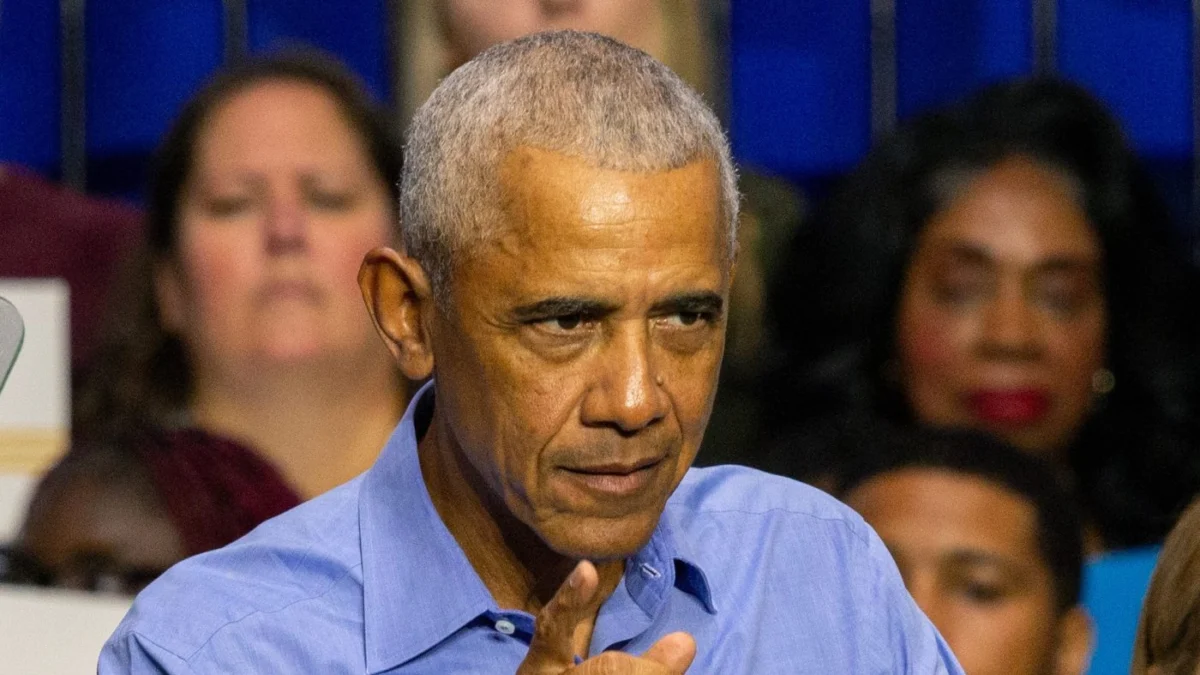
Former President Barack Obama has consciously adopted a selective approach to criticizing President Donald Trump during the latter’s two terms in office, a strategy he recently articulated as essential to preserving his role as a political leader rather than a mere commentator. This measured engagement, detailed in a wide-ranging profile by The New Yorker published in May 2026, underscores Obama’s deliberate effort to maintain gravitas and effectiveness in a highly polarized political landscape. His interventions, though infrequent, carry significant weight, particularly when addressing issues he deems fundamental to democratic principles or human rights.
The former president elaborated on his calculated restraint, stating, "For me to function like Jon Stewart, even once a week, just going off, just ripping what was happening — which, by the way, I’m glad Jon’s doing it — then I’m not a political leader, I’m a commentator." This comparison highlights Obama’s desire to distinguish his post-presidency from that of a media personality or satirist. His perspective suggests that constant criticism, while potentially cathartic, could dilute the impact of his pronouncements and diminish his standing as a figure capable of rallying support or influencing policy when it truly matters. The role of a former president in American politics is a delicate balance, often oscillating between elder statesman and partisan advocate. Obama’s strategy appears to lean towards the former, reserving his public critiques for moments he believes demand his unique voice and moral authority.
Since departing the White House in January 2017, Obama has indeed chosen his moments to challenge the Trump administration. His interventions have focused on specific policies and actions that he views as detrimental to the nation’s values or democratic integrity. These carefully timed criticisms aim to provide a powerful counter-narrative without succumbing to the daily political fray, thereby maximizing their resonance with the public and policymakers alike.
Targeted Interventions: Immigration and Electoral Integrity
One notable instance of Obama’s direct criticism emerged in February 2025, when he sharply condemned the Trump administration’s immigration enforcement tactics. This particular rebuke followed a deeply concerning incident in Minneapolis, where federal officers fatally shot two American citizens, Renee Good and Alex Pretti, during an immigration-related operation. The deaths sparked national outrage and intensified scrutiny of federal agents’ use of force and operational protocols. Speaking to liberal commentator Brian Tyler Cohen, Obama minced no words, declaring, "The rogue behavior of agents of the federal government is deeply concerning and dangerous." This statement transcended typical policy disagreement, touching upon fundamental issues of civil liberties and government accountability. Civil rights organizations and immigrant advocacy groups echoed Obama’s concerns, calling for immediate investigations and reforms to curb what they described as increasingly aggressive and unaccountable federal enforcement practices under the Trump administration. The administration, for its part, likely defended the actions as necessary for national security and border integrity, a consistent stance throughout its tenure.
Beyond immigration, Obama has also been a vocal critic of the nationwide Republican push for partisan redistricting, commonly known as gerrymandering. This practice, which involves manipulating electoral district boundaries to favor one political party, has become a flashpoint in American democracy. Obama articulated his strong belief against this practice, stating, "Redistricting is another good example of where I strongly believe we should not be having politicians draw lines that determine who’s voting for them." His stance aligns with broader calls for independent redistricting commissions and fair maps, arguing that the integrity of representative democracy is undermined when politicians choose their voters rather than voters choosing their representatives.
The battle over redistricting intensified last year, with Republicans in the Texas Legislature redrawing their state’s congressional maps at the explicit urging of President Trump. This move, designed to solidify GOP dominance, was part of a broader national strategy to leverage state legislative power to secure electoral advantages. In response, Democratic-controlled states, including California and Virginia, have engaged in their own efforts to counter these partisan maneuvers. The redistricting fight remains a critical electoral battleground, unfolding roughly six months before the 2026 midterm elections, with profound implications for the balance of power in Congress and state legislatures for the next decade.
Obama’s engagement in this issue was not merely rhetorical. He actively spoke out in support of a successful ballot measure in Virginia, a critical swing state, which allowed for a more independent process to redraw congressional maps there. His public backing provided a significant boost to advocates for fair maps, ultimately contributing to a legislative outcome that empowered Democrats in the commonwealth to influence the redrawing of district lines. This direct intervention demonstrates Obama’s willingness to use his political capital to influence specific electoral reforms he views as essential for a healthy democracy.
Navigating the Modern Media Environment
Obama is acutely aware of the challenges inherent in maintaining a public profile and communicating effectively in the fragmented and often sensationalized modern media environment. As he told The New Yorker, "The media environment is so difficult that people don’t even know all the stuff I am doing, right? And, I think, when they do see me, then the sense is, ‘Well, why isn’t he doing that every day instead of just during a midterm election, or during a referendum campaign around gerrymandering, or what have you?’" This observation speaks to the public’s expectation for constant engagement from high-profile figures, often fueled by the 24/7 news cycle and social media.
However, Obama’s strategy suggests a rejection of this expectation, prioritizing impact over ubiquity. By choosing his moments, he aims to ensure that his voice resonates more powerfully when he does speak, rather than becoming just another soundbite in the cacophony of daily political commentary. This approach requires a delicate balance of visibility and strategic silence, a challenge for any public figure but particularly for a former president whose every word is scrutinized.
Enduring Popularity and Political Capital
Obama’s calculated approach is underpinned by a remarkable and sustained level of public approval, affording him unique political capital. When he left office in January 2017, his approval rating stood at 59 percent, according to the American Presidency Project. This figure tied for the third-highest mark among departing presidents dating back to Harry Truman, trailing only former Presidents Bill Clinton and Ronald Reagan. Such strong approval upon departure is a testament to his lasting appeal and broad acceptance across various demographics.
This popularity has not waned. A Gallup survey conducted in January 2025 indicated that Obama’s approval rating remained at a robust 59 percent. This made him the best-liked among the five living current or former presidents, a significant indicator of his enduring influence. In stark contrast, President Trump’s approval rating stood at 48 percent just after he took the oath of office for his second term in January 2025. As of Friday, President Trump’s mean approval rating had further declined to just 39.7 percent, according to an average of polls calculated by Decision Desk HQ. The significant disparity between Obama’s sustained popularity and Trump’s fluctuating, often lower, approval ratings highlights the former president’s unique position to shape public discourse and lend credibility to specific causes.
This sustained high approval rating empowers Obama to intervene in political debates with a degree of authority and public trust that few others possess. His ability to mobilize support for specific policy initiatives, endorse candidates, or simply articulate a moral position against certain governmental actions is magnified by his continued favorability. When he speaks, he does so not from a position of partisan weakness, but from a foundation of broad public respect, making his criticisms of President Trump particularly potent.
The Evolving Role of a Former President
Obama’s post-presidency has become a fascinating case study in the evolving role of former chief executives in modern American politics. Traditionally, former presidents have often retreated from the political spotlight, embracing an elder statesman role that largely avoids direct criticism of their successors. While some, like Jimmy Carter, have remained active on global humanitarian issues, direct partisan critiques were less common. Bill Clinton, though politically engaged, often focused on foundation work. George W. Bush largely abstained from commenting on his successors.
However, the unprecedented nature of the Trump presidency has arguably compelled a re-evaluation of this tradition. Obama’s decision to engage selectively, rather than remain entirely silent, reflects a judgment that certain actions or policies threaten core democratic norms to a degree that necessitates intervention. His approach sets a precedent for how former leaders might navigate a highly polarized political landscape where the lines between policy and fundamental democratic principles are increasingly blurred. It suggests that while daily commentary may reduce a former president to a pundit, strategic and infrequent interventions can reinforce their status as a guardian of democratic values.
In essence, Barack Obama is meticulously crafting a post-presidency that balances the gravitas of a former head of state with the imperative to defend what he perceives as essential democratic tenets. His selective criticisms of President Trump, focusing on issues like immigration enforcement and electoral integrity, are not impulsive reactions but calculated moves designed to maximize influence while preserving his unique position as a respected political leader in an tumultuous era. His enduring popularity provides the platform; his strategic restraint ensures the message resonates.







Leave a Reply