
The Democratic Congressional Campaign Committee (DCCC) experienced its most robust fundraising period of the year in the immediate aftermath of the Supreme Court’s pivotal ruling, which curtailed the scope of the Voting Rights Act (VRA) and specifically invalidated Louisiana’s existing congressional map. Within approximately 48 hours, from the court’s announcement on a Wednesday to Friday morning at 10 a.m., the House Democrats’ campaign arm successfully amassed over $522,000. This rapid influx of capital underscores the profound political and financial reverberations of the judiciary’s intervention in the contentious realm of redistricting.
Immediate Political and Financial Repercussions
The DCCC’s swift fundraising success highlights the Democratic Party’s strategy to mobilize its base in response to perceived threats to voting rights. DCCC spokesperson Courtney Rice articulated this sentiment, stating, “Republicans — with the help of this conservative Supreme Court — are attempting to rig the midterms so that they can stay in power. But just like their backfiring redistricting scheme, this will also fail.” This statement frames the judicial decision as a politically motivated maneuver, intended to solidify Republican control, and positions the DCCC’s fundraising as a counter-mobilization effort.
Analysis of the contributions revealed a significant engagement from new donors. Approximately 10 percent of the nearly 23,000 contributions received during this short period came from individuals who had not previously donated to the committee, with the average donation standing at $22.75. This indicates a broad-based, grassroots reaction to the Supreme Court’s ruling, suggesting that the issue of voting rights and fair maps resonates deeply with a segment of the Democratic electorate.
Despite this recent surge, the DCCC has been navigating a competitive fundraising environment. Federal filings from the end of March indicated that the DCCC was trailing its Republican counterpart, the National Republican Congressional Committee (NRCC), in available cash reserves. The DCCC reported $70 million banked, compared to the NRCC’s $78 million. While the $522,000 influx represents a substantial short-term boost, the broader financial parity between the two committees underscores the intense resource battle unfolding ahead of critical election cycles. The fundraising dynamic reflects the high stakes involved in controlling the House of Representatives, where even a handful of seats can determine legislative priorities and partisan power.
The Shifting Sands of Southern Redistricting
The Supreme Court’s decision, which directly impacted Louisiana’s congressional districts, has unleashed a torrent of legislative activity and legal challenges across several Southern states. The ruling centered on Section 2 of the Voting Rights Act, which prohibits voting practices or procedures that discriminate on the basis of race, color, or membership in a language minority group. Historically, this section has been a critical tool for ensuring fair representation for minority populations, particularly in states with histories of racial discrimination in voting. The court’s reinterpretation or limitation of its scope has sent shockwaves through the political establishment, forcing states to re-evaluate their current and future electoral maps.
Louisiana’s Contested Path Forward
Louisiana, the immediate focus of the Supreme Court’s ruling, found its congressional map invalidated due to racial gerrymandering that diluted the voting power of its Black population. Following the decision, Governor Jeff Landry sought to postpone the state’s House primaries, originally slated for May 16. This move, aimed at allowing sufficient time for the legislature to redraw the map, has been met with significant resistance and is currently being challenged in court by voters. The legal battle over the primary schedule underscores the urgency and complexity of the situation, as election officials grapple with the logistical challenges of implementing a new map on a truncated timeline while facing potential legal ramifications. The creation of a new, constitutionally compliant map will likely involve contentious debates within the state legislature, where partisan interests often clash with the mandate for fair representation.
Southern States Confront Redraw Mandates
The implications of the Supreme Court’s ruling extend far beyond Louisiana’s borders, prompting other Southern states to take immediate action. Alabama Governor Kay Ivey and Tennessee Governor Bill Lee have both issued calls for special legislative sessions this week, tasking their respective legislatures with the critical responsibility of revisiting and redrawing their congressional maps. These states, like Louisiana, have significant minority populations and have faced prior scrutiny over their redistricting practices under the Voting Rights Act. The decisions by these governors signal a proactive approach to comply with the evolving legal landscape and avoid potential federal court intervention. The special sessions are expected to be highly charged, with intense lobbying from various political groups and civil rights organizations aiming to influence the new district boundaries.
Mississippi Governor Tate Reeves had also announced plans for a special session to reconsider the state’s judicial lines in anticipation of a potential Supreme Court ruling on the VRA. While Mississippi has already conducted its congressional primaries for the current election cycle, meaning any immediate map changes would not affect the 2026 House elections, the state is keenly aware of the need to align its electoral frameworks with the latest judicial interpretations for future cycles.
Background: The Voting Rights Act and Redistricting
To fully grasp the significance of this ruling, it is essential to understand the historical context and legal framework of the Voting Rights Act of 1965. Enacted during the Civil Rights Movement, the VRA is considered one of the most effective pieces of civil rights legislation in U.S. history. Its primary goal was to overcome legal barriers at the state and local levels that prevented African Americans from exercising their right to vote under the Fifteenth Amendment.
Section 2 of the VRA and its Evolution
Section 2 of the VRA specifically prohibits voting practices that result in a denial or abridgement of the right to vote on account of race or color. This includes practices that dilute the voting strength of racial minority groups, such as gerrymandering. For decades, Section 2 has been a cornerstone for challenging electoral maps that intentionally or unintentionally diminish minority representation. The standard for proving a Section 2 violation has largely been guided by the Supreme Court’s 1986 decision in Thornburg v. Gingles, which established a set of factors (the "Gingles factors") to determine if a minority group is sufficiently large and geographically compact to constitute a majority in a single-member district, if it is politically cohesive, and if the majority group votes as a bloc to defeat the minority group’s preferred candidates.
The Supreme Court’s recent decision, while invalidating Louisiana’s map, appears to have introduced a new nuance or limitation to the application of Section 2. While the full legal ramifications are still being analyzed by experts, initial interpretations suggest a tightening of the criteria for proving vote dilution, potentially making it harder for plaintiffs to successfully challenge maps in the future. This ruling follows a trajectory of decisions, such as Shelby County v. Holder (2013), which struck down a key provision of the VRA requiring federal preclearance for changes to voting laws in certain jurisdictions, and Allen v. Milligan (2023), which affirmed a Section 2 violation in Alabama but also sparked ongoing debates about the VRA’s future. The current ruling, by narrowing the scope of Section 2, adds another layer of complexity to an already intricate area of law.
The Mechanics of Redistricting Challenges
Redistricting, the process of redrawing electoral district boundaries, occurs every ten years following the decennial census. It is a highly politicized process, as the party in power often seeks to draw maps that maximize its electoral advantage, a practice known as gerrymandering. When this gerrymandering results in the dilution of minority votes, it can become a target for VRA Section 2 challenges.
The legal arguments in these cases often revolve around whether a state has created districts that intentionally or effectively suppress the voting power of a racial or ethnic minority group. Plaintiffs typically present demographic data, voting patterns, and legislative intent to demonstrate that a map either prevents a minority group from electing its preferred candidates or packs minority voters into a few districts to reduce their influence elsewhere. The Supreme Court’s recent decision appears to adjust the balance in these challenges, potentially requiring a higher bar for plaintiffs to prove that racial considerations, rather than purely political ones, were the predominant factor in drawing district lines in a way that violates Section 2. This shift could empower state legislatures, particularly in states with Republican majorities, to draw maps that, while perhaps not overtly discriminatory, could still have the effect of diminishing minority representation without triggering a VRA violation under the new interpretation.
A Glimpse into the 2028 Electoral Future
While the immediate focus remains on the 2026 midterm elections in the affected Southern states, the Supreme Court’s ruling is also prompting a longer-term strategic realignment for the 2028 elections and beyond. The window for redrawing maps that would impact the 2026 elections is rapidly closing, and in many states, it may already be too late to implement new lines before candidate filing deadlines and primary elections. However, the precedent set by the ruling will undoubtedly influence how states approach redistricting for the next full cycle.
Northern States React to Precedent
The ripple effects of the Supreme Court’s decision are not confined to the South. House Minority Leader Hakeem Jeffries, a prominent Democrat from New York, announced that fellow New York Representative Joseph D. Morelle would engage with state leaders to discuss redrawing New York’s congressional map. While such a redraw would likely not take effect until the 2028 elections, the proactive discussions signal a broader Democratic effort to assess and potentially revise maps in light of the evolving legal interpretations of the VRA. New York, a state with complex demographics and a history of redistricting controversies, understands the importance of crafting maps that withstand legal scrutiny and ensure fair representation.
Similarly, Democrats in Colorado have already initiated efforts to redraw their state’s House map in preparation for the 2028 cycle. Colorado has an independent redistricting commission, which often aims for non-partisan maps, but even these commissions operate within the legal parameters set by federal courts. The proactive stance in these states suggests a recognition that the Supreme Court’s ruling creates a new framework that all states, regardless of their historical context, must consider when designing electoral districts.
Southern States Eye Long-Term Adjustments
On the Republican side, Georgia Governor Brian Kemp has reportedly stated that his state should adopt a new map ahead of the 2028 elections. Georgia, a state that has seen significant demographic shifts and intense political competition in recent years, particularly in its growing suburban areas, has been a focal point for voting rights debates. The prospect of a new map for 2028 suggests that Republican-controlled legislatures in the South may seek to capitalize on the Supreme Court’s ruling to solidify their electoral advantages, potentially by drawing lines that are less vulnerable to VRA challenges under the newly interpreted standards.
The long-term planning for 2028 underscores that redistricting is a continuous, cyclical battle. Every ten years, following the census, states redraw their maps, and these maps often face legal challenges that can take years to resolve. The current Supreme Court ruling is not an endpoint but rather a significant development in this ongoing saga, setting new parameters for how future maps will be drawn and defended in court.
Broader Implications for Congressional Control and Minority Representation
The Supreme Court’s ruling and the ensuing redistricting efforts carry profound implications for the balance of power in the U.S. House of Representatives and for the future of minority representation in Congress. Redistricting is often seen as the most powerful tool for shaping electoral outcomes, as district lines can effectively predetermine which party wins a seat.
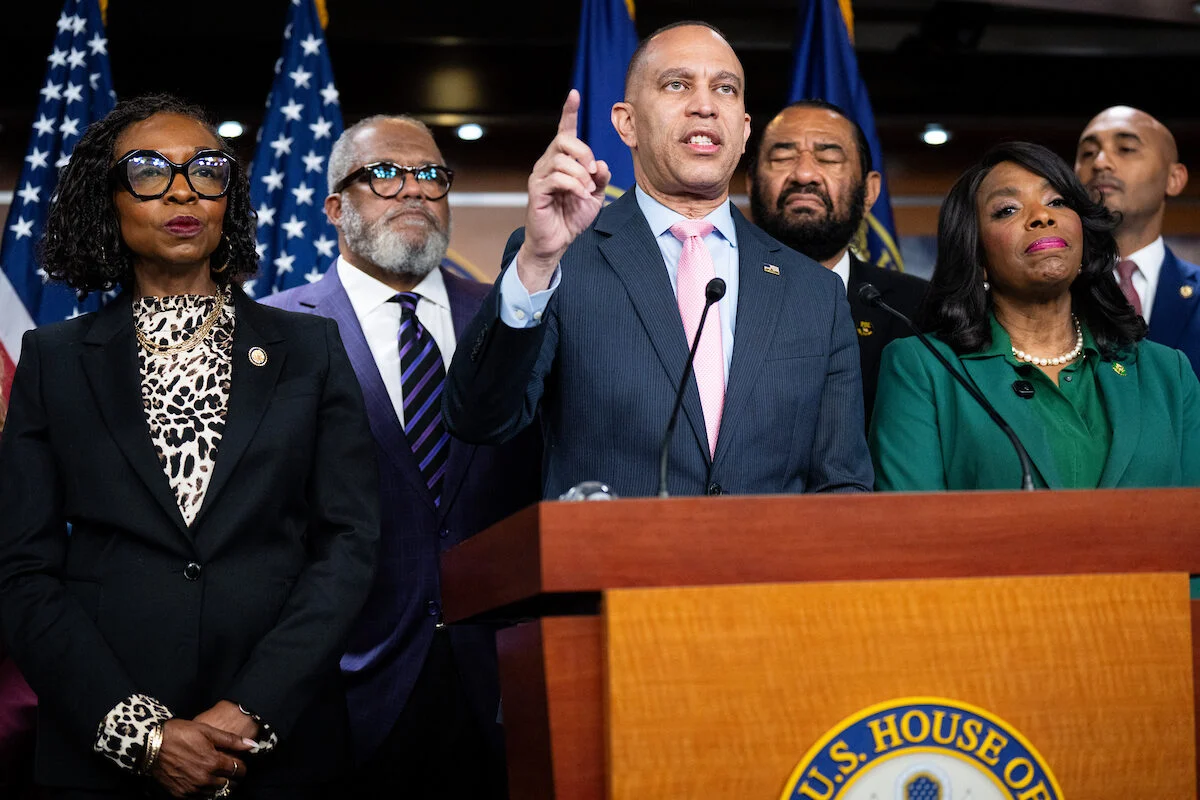
By potentially making it more difficult to prove vote dilution under Section 2 of the VRA, the ruling could empower state legislatures to draw maps that, while technically compliant with the new judicial interpretation, may nonetheless reduce the number of districts where minority voters can elect their preferred candidates. This could lead to a decrease in the overall number of minority representatives in Congress, impacting the diversity of legislative bodies and potentially diminishing the voice of minority communities in national policy debates. The Congressional Black Caucus (CBC), whose members were pictured alongside House Minority Leader Hakeem Jeffries, has historically been a strong advocate for robust enforcement of the VRA and fair maps. Such a ruling likely prompts serious concern among these groups about the future of minority representation.
The battle for control of the House is often decided by a slim margin of seats. In an era of intense partisan polarization, every district redraw, every legal challenge, and every judicial ruling takes on outsized importance. The Supreme Court’s decision introduces a new element of uncertainty and potential advantage for the party that can best navigate the revised legal landscape. Republican-controlled states, particularly in the South, may see this as an opportunity to shore up their majorities, while Democrats will likely redouble their efforts to organize and mobilize against what they perceive as efforts to undermine fair elections.
The Enduring Battle for Fair Representation
The current wave of redistricting activity and legal challenges is a stark reminder that the fight for fair and equitable representation in American democracy is never truly settled. The Voting Rights Act, while foundational, is subject to ongoing interpretation and reinterpretation by the courts, and each new ruling reshapes the parameters within which states must operate.
As states like Alabama, Tennessee, and Louisiana convene special sessions, and others like New York, Colorado, and Georgia plan for 2028, the core tension remains: how to reconcile partisan political interests with the constitutional mandate for equal protection and the VRA’s goal of preventing racial vote dilution. The Supreme Court’s recent decision has undeniably shifted this balance, adding new layers of complexity to an already intricate process. The outcome of these legislative sessions and the subsequent legal challenges will not only determine the electoral maps for the coming cycles but will also cast a long shadow over the future of voting rights and the composition of the U.S. Congress for years to come.










Leave a Reply