
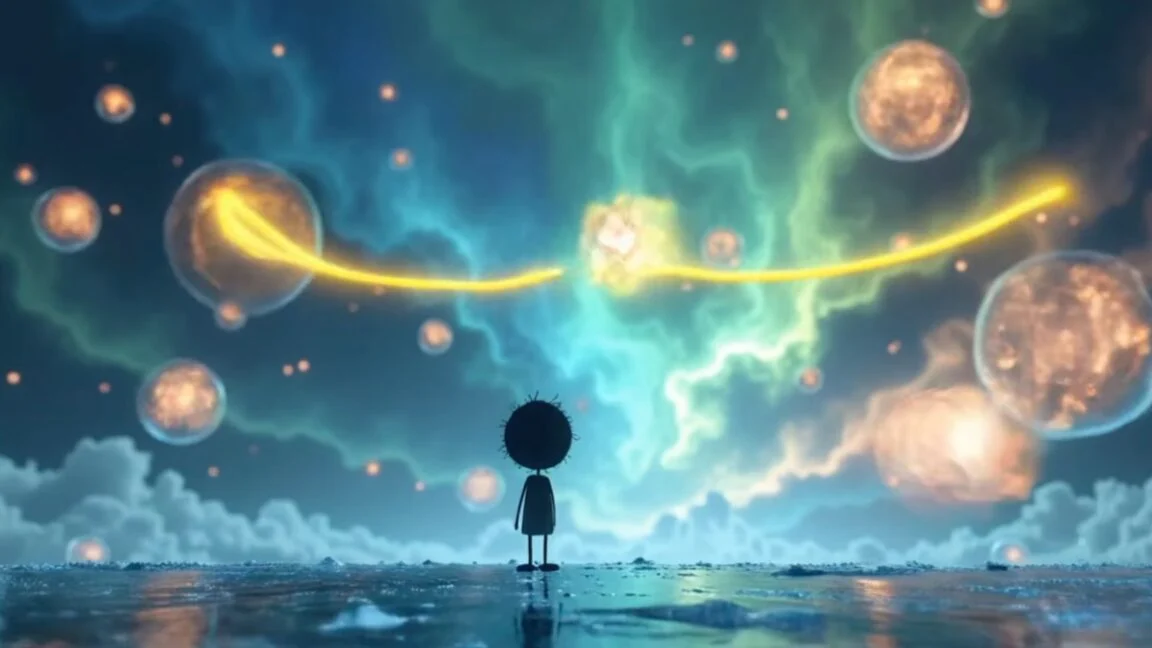
In an era where scientific literacy is increasingly crucial yet often challenged by the complexity of advanced topics, a unique podcast has emerged to demystify one of the most enigmatic fields of modern science: quantum mechanics. "The Quantum Kid podcast," co-hosted by nine-year-old Kai Moskvitch and his mother, theoretical physicist and science communicator Katia Moskvitch, has not only captivated a global audience, recently crossing the significant milestone of 100,000 subscribers, but has also garnered critical acclaim with a nomination for a prestigious Webby Award. This innovative approach to science communication leverages the innate curiosity of a child to unlock the secrets of the universe, proving that even the most intricate scientific concepts can be made accessible. The public voting phase for the Webby Awards, a crucial determinant in some categories, concludes tomorrow, April 15th, 2026, with an opportunity for global participation to support this pioneering educational endeavor.
The Genesis of a Quantum Quest: From Child’s Curiosity to Global Platform
The origins of "The Quantum Kid podcast" can be traced back to the insatiable curiosity of its junior co-host, Kai Moskvitch. From an unusually early age, Kai displayed a profound fascination with scientific principles, spending hours immersed in educational YouTube videos dedicated to various scientific disciplines. His aptitude for technology was equally remarkable, as evidenced by his proficiency in Python programming since the tender age of six. This precocious intellect naturally led Kai to pose profound questions to his mother, Katia, about fundamental aspects of existence: the origins of life, the vastness of the universe, and, perhaps most challenging of all, the perplexing realm of quantum physics.
Katia Moskvitch, a distinguished theoretical physicist with a background deeply rooted in these very subjects, found herself navigating a unique challenge. While her professional expertise equipped her with the answers, translating these complex ideas into terms comprehensible and engaging for a child, especially her own inquisitive son, required a different skill set. It was this daily intellectual sparring that sparked the revolutionary idea for a podcast. Recognizing Kai’s eagerness for deeper understanding and his natural charisma, Katia proposed the creation of his own platform, initially conceived as a YouTube channel, to explore these questions. Kai’s enthusiastic affirmative response set the wheels in motion for what would become a groundbreaking project in science communication.
The duo officially launched "The Quantum Kid podcast" in the summer of 2025, committing to a consistent production schedule of approximately one episode per month. This deliberate pace allowed for thorough research, thoughtful interview preparation, and high-quality production, ensuring that each episode delivered maximum educational value without overwhelming its audience. The podcast quickly distinguished itself by its unique format: a child-led interview with some of the world’s most prominent quantum physicists and technologists, guided and supported by his expert mother.
Demystifying the Indecipherable: The Challenge of Quantum Mechanics
The advice often given to scientists—to explain their work in terms a child can understand—is perhaps nowhere more daunting than in the field of quantum mechanics. This branch of physics deals with phenomena at atomic and subatomic levels, where classical physics breaks down and particles exhibit behaviors that defy intuitive understanding. Concepts such as superposition (a particle existing in multiple states simultaneously), entanglement (two particles linked regardless of distance), and quantum tunneling are not just complex; they are fundamentally counter-intuitive, often described by physicists themselves as strange or even bizarre. Richard Feynman famously remarked, "If you think you understand quantum mechanics, you don’t understand quantum mechanics."
This inherent difficulty has historically limited public engagement with quantum physics, often relegating it to the domain of specialized academics. However, with the accelerating development of quantum technologies—including quantum computing, quantum cryptography, and quantum sensing—the need for broader public understanding has never been more pressing. "The Quantum Kid podcast" directly addresses this communication gap, transforming an intimidating subject into an accessible and engaging narrative. By positioning a child as the primary interviewer, the podcast inherently adopts a pedagogical framework that prioritizes clarity, fundamental questions, and relatable analogies, circumventing the jargon that often alienates general audiences.
A Junior Interviewer Meets Quantum Luminaries
One of the significant advantages "The Quantum Kid podcast" benefits from is Katia Moskvitch’s extensive network within the global quantum physics community. Her background as a theoretical physicist and a seasoned science communicator has opened doors to some of the most influential minds in both academia and industry. This access has allowed Kai to engage in conversations with figures whose contributions have shaped the very landscape of quantum science.
Notably, Kai had the opportunity to interview Professor Peter Shor, a pivotal figure in quantum computing. Shor is renowned for developing Shor’s algorithm in 1994, a quantum algorithm that can efficiently factor large integers, posing a significant threat to widely used public-key cryptography systems like RSA. His work fundamentally demonstrated the potential power of quantum computers to solve problems intractable for classical machines, catalyzing much of the subsequent research and investment in the field. Kai’s interview with Shor provided a rare glimpse into the mind of a pioneer, with the young interviewer adeptly posing questions that sought to simplify the profound implications of Shor’s work.
Another highlight featured University of Texas, Austin, physicist Scott Aaronson, a leading expert in quantum computing and computational complexity theory. Kai’s discussion with Aaronson delved into the captivating, often speculative, topic of time travel. Aaronson, known for his rigorous analysis of the limits of computation and his insightful commentary on the philosophical implications of quantum mechanics, provided a nuanced perspective on the scientific feasibility and paradoxes associated with traversing time. Such interviews not only inform but also inspire, showcasing that even the most complex scientific questions are open for exploration and discussion, regardless of age.
The willingness of such high-profile scientists to participate underscores the perceived value and unique appeal of "The Quantum Kid podcast." It suggests a recognition within the scientific community that innovative methods are needed to foster the next generation of scientists and to bridge the gap between cutting-edge research and public comprehension. Their participation lends significant credibility to the podcast’s educational mission.
Audience Engagement and the Power of Co-Learning
While the podcast is ostensibly hosted by a child, the target audience and its actual demographic composition reveal a fascinating aspect of its impact. Katia Moskvitch observed that the true strength of the podcast lies in its ability to facilitate co-learning within families. As she articulated to Ars, "This is the intended audience. It’s parents watching, ideally with their children. I don’t think many kids are watching it on their own." This insight is further corroborated by YouTube analytics, which indicate that the primary age group engaging with the podcast falls between 25 and 45.
This demographic data highlights the podcast’s success in creating a shared educational experience. Parents, often grappling with their own understanding of complex scientific topics, find "The Quantum Kid" an accessible entry point. The child-led questions and simplified explanations serve as an effective pedagogical tool, allowing adults to grasp concepts alongside their children. Scott Aaronson’s personal experience further validates this model; he reportedly watched his episode with his own two children, who subsequently peppered him with follow-up questions. This anecdotal evidence powerfully illustrates the podcast’s capacity to spark curiosity and deeper engagement within family units, transforming passive consumption into active scientific inquiry.
The podcast thus functions as a multi-generational learning platform, fostering scientific literacy not just in children, but also in their parents. This intergenerational learning model is particularly effective for complex subjects, as it encourages dialogue, shared discovery, and a sustained interest in STEM fields beyond the initial exposure.
The Significance of a Webby Award Nomination
The nomination of "The Quantum Kid podcast" for a Webby Award is a testament to its exceptional quality, innovative approach, and significant cultural impact. Often dubbed the "Oscars of the Internet," the Webby Awards celebrate excellence in digital content across a wide array of categories, including websites, video, advertising, media, and podcasts. A nomination is a highly coveted recognition, placing the podcast among the best digital productions globally.
The specific nomination for "Experimental & Innovation" within the podcast category underscores the groundbreaking nature of "The Quantum Kid." It acknowledges the podcast’s novel format, its success in tackling a notoriously difficult subject, and its ability to create a unique and effective learning experience. Past Webby winners and nominees represent the vanguard of digital creativity and communication, making this recognition a significant endorsement of the Moskvitch duo’s pioneering efforts. For a relatively niche science podcast to achieve such mainstream recognition speaks volumes about its compelling content and broad appeal. The public voting component for the Webby Awards adds another layer of community engagement, empowering the audience to directly support content they value.
Broader Implications for STEM Education and Public Understanding
The success of "The Quantum Kid podcast" carries profound implications for the future of STEM education and public engagement with science.
Firstly, it provides a powerful model for demystifying complex scientific disciplines. By demonstrating that quantum mechanics can be explained and understood by a child, the podcast challenges the perception that such fields are exclusively for an elite few. This accessibility is vital for inspiring a new generation of scientists, engineers, and innovators. When children like Kai actively participate in the discourse, it sends a clear message that science is for everyone.
Secondly, the podcast reinforces the critical role of effective science communication in an increasingly complex world. In an era often characterized by misinformation and a growing skepticism towards expert knowledge, platforms that translate rigorous scientific concepts into understandable narratives are invaluable. "The Quantum Kid" serves as a beacon of clarity, fostering a foundational understanding that can combat scientific illiteracy and promote evidence-based thinking.
Thirdly, the intergenerational learning model championed by the podcast has the potential to strengthen family bonds around educational pursuits. By providing a shared intellectual endeavor, it encourages parents to actively participate in their children’s learning journey, fostering an environment where curiosity is celebrated and scientific inquiry is a collective adventure. This dynamic can cultivate a sustained interest in science and technology from an early age, potentially guiding future career choices and academic paths.
Finally, the podcast’s digital-first approach highlights the power of new media platforms in democratizing knowledge. Podcasts offer an on-demand, flexible format that can reach audiences globally, transcending geographical and socio-economic barriers. "The Quantum Kid" leverages this accessibility to bring cutting-edge scientific discussions directly into homes and classrooms worldwide.
Looking Ahead: The Evolving Landscape of Science Communication
As "The Quantum Kid podcast" continues to grow in influence and reach, its trajectory suggests a promising future for innovative science communication. The ongoing development of quantum technologies ensures that the subject matter will remain highly relevant and continue to evolve, providing a rich source of content for future episodes. The Moskvitch family’s unique collaboration serves as an inspiring example of how passion, expertise, and a fresh perspective can transform seemingly impenetrable subjects into captivating educational experiences.
The podcast’s journey from a mother’s response to her son’s questions to a Webby-nominated global phenomenon underscores a fundamental truth: curiosity is universal, and the human desire to understand the universe knows no age limit. By empowering a nine-year-old to lead the charge, "The Quantum Kid" is not just explaining quantum mechanics; it is actively shaping how the next generation perceives and interacts with the wonders of science.








Leave a Reply