The landscape of American aviation is undergoing a significant strategic pivot as American Airlines (AA) publicly declares its intent to transcend its historical operational models and position itself as the premier global airline based in the United States. This declaration, articulated by Chief Commercial Officer Nat Pieper during the Oneworld Loyalty Summit, signals a calculated move to challenge the current market dominance held by rivals Delta Air Lines and United Airlines. For an airline that has historically oscillated between cost-cutting measures and legacy-carrier aspirations, this formal objective marks a definitive shift toward a premium-focused, experience-driven business model.
The Context of the Strategic Pivot
The comments made by Nat Pieper at the Oneworld summit serve as a rebuttal to the recent posturing of competitors. Earlier this year, Delta Air Lines CEO Ed Bastian suggested that his airline belongs in the same echelon as global leaders like Singapore Airlines and various top-tier Middle Eastern carriers. While such claims are frequently met with skepticism from aviation analysts and seasoned travelers, Pieper’s response was notably more grounded. Rather than reaching for comparisons to international boutique airlines, American Airlines is focusing on its immediate domestic rivals.
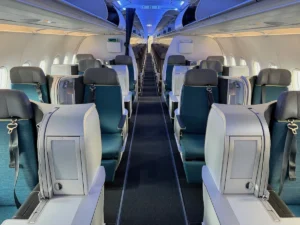
The timing of this announcement aligns with American’s recent push to modernize its fleet and cabin experience. The carrier recently held a high-profile media event showcasing a reconfigured Boeing 777-300ER, featuring 70 business-class suites. While the hardware—which mirrors the seats currently found on the airline’s newer Boeing 787-9 Dreamliners—is a physical manifestation of this strategy, the executive team emphasizes that the transformation is as much about "soft goods" and service culture as it is about seating real estate.
A Chronology of Competitive Evolution
To understand the weight of American’s current mission, one must look at the trajectory of the "Big Three" U.S. carriers over the last decade. Following the wave of consolidations between 2008 and 2013, the primary focus for American, Delta, and United was operational stability and debt reduction.

- 2013–2018: The era of consolidation. American focused heavily on integrating the US Airways merger, often struggling with labor harmony and technology integration, which left the carrier trailing behind Delta’s aggressive focus on operational reliability and premium revenue management.
- 2019–2022: The pandemic reset. As the industry faced an existential threat, American prioritized liquidity and fleet simplification, while Delta and United began to signal their long-term intent to move further upmarket, targeting the "premium traveler" who remained resilient during economic downturns.
- 2023–Present: The premium arms race. American has begun to play catch-up with its interior retrofits, despite facing significant supply chain delays that have hindered the speed of cabin refreshes. The announcement at the Oneworld summit acts as a formalization of this late-stage push.
Analyzing the "Premium" Challenge
American Airlines faces a complex set of variables in its quest to become the premier U.S. carrier. The aviation industry is notoriously capital-intensive, with long lead times for aircraft deliveries and expensive certification processes for new interiors.
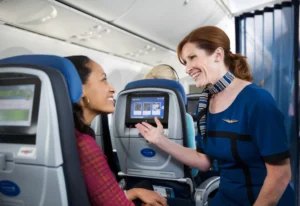
Data indicates that American has struggled with brand perception compared to its peers. While Delta has successfully marketed itself as a premium "lifestyle" brand—often justifying higher ticket prices through superior operational performance and customer service consistency—American has faced criticism for a lack of clarity in its identity. Historically, the airline’s frontline staff—the gate agents and flight attendants who serve as the "last mile" of the brand experience—have struggled to identify whether the carrier was competing with low-cost, budget-focused entities like Spirit Airlines or full-service global giants.
Nat Pieper’s strategy relies heavily on internal alignment. If the message of a "premium, global experience" does not resonate with the employees, the physical investments in business-class suites will fail to yield the desired return on investment. The challenge for management is to move beyond the physical product and address the service-level consistency that has historically plagued the airline.
Supporting Data and Market Implications
The battleground for the premium traveler is increasingly centered on loyalty programs and business-class revenue. American’s AAdvantage program remains a central pillar of its competitive strategy. However, market observers note that while the program is robust, recent adjustments—such as the restriction of award seat availability on partner airlines and the elimination of the traditional upgrade award chart—have created friction with loyal high-frequency travelers.
When comparing the "Big Three," the metrics for success are often evaluated based on:

- Revenue per Available Seat Mile (RASM): A measure of efficiency that Delta has historically led.
- On-Time Performance and Completion Factor: Key indicators of operational reliability, where Delta and United have generally outperformed American in recent years.
- Customer Satisfaction Index (CSI): A subjective but critical metric where American is currently working to close the gap through cabin upgrades and improved lounge access.
The implication of American’s shift is that it is essentially conceding the low-cost, high-volume market to the ultra-low-cost carriers (ULCCs) and focusing its resources on the high-margin business and premium-leisure traveler. This move is statistically sound; the post-pandemic travel market has seen a persistent demand for "premium economy" and "business class" seats, which often subsidize the cost of the rest of the cabin.
The Obstacles Ahead
Despite the ambitious rhetoric, the road to becoming the "premier" carrier is fraught with logistical hurdles. Retrofitting a fleet is a slow, multi-year process that requires planes to be pulled from active service, impacting short-term capacity. Furthermore, the airline industry is currently battling a global supply chain crisis that has slowed the production of seats, galleys, and in-flight entertainment hardware.
Moreover, there is the issue of parity. United Airlines has aggressively marketed its "Polaris" business class and its expansive international route network, while Delta has invested billions into its domestic hub infrastructure. For American to genuinely overtake these competitors, it must demonstrate not just a superior seat, but a superior ecosystem. This includes seamless airport experiences, robust global partner connectivity via the Oneworld alliance, and a level of service that justifies the premium price tag.
Strategic Outlook
The declaration made by the American Airlines leadership team serves as a clear notice to stakeholders: the airline is no longer satisfied with its current market position. Whether this is a realistic goal or a marketing maneuver remains to be seen. Industry analysts are looking for more than just new suites; they are looking for a sustained period of operational excellence and a shift in corporate culture that empowers frontline employees to deliver a consistent, high-end experience.
As American Airlines moves forward, the success of this strategy will be measured by its ability to execute its retrofit program without further delays and, more importantly, by its ability to convince the traveling public that the "American" brand is synonymous with quality rather than just utility. The rivalry between the three major U.S. carriers has entered a new phase—one defined by a race to the top rather than a race to the bottom. For American, the challenge is no longer just about survival; it is about reclaiming a seat at the head of the table in the global aviation market.