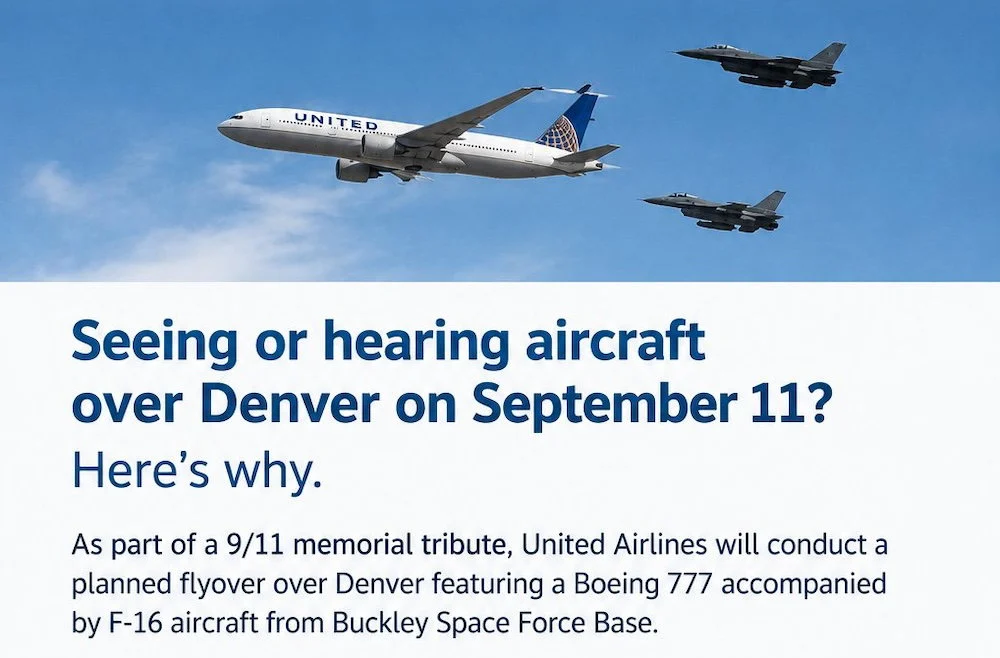
United Airlines has found itself at the center of a mounting public relations crisis following the announcement of an unorthodox and deeply controversial 9/11 memorial demonstration scheduled for Friday. The airline plans to operate a low-altitude flight over the Denver metropolitan area utilizing a Boeing 777 wide-body commercial aircraft, flanked and escorted by military fighter jets. The intended visual display—strikingly reminiscent of the emergency security responses deployed during the terrorist attacks of September 11, 2001—has triggered widespread confusion, sharp criticism from aviation professionals, and extraordinary precautionary measures by local emergency services.
The planned demonstration has laid bare a profound disconnect between corporate remembrance initiatives and public sensitivity. As municipalities, families, and aviation institutions prepare to mark the somber 25th anniversary of the tragedy, critics and community leaders are questioning the judgment of airline leadership in authorizing a display that mirrors the very imagery associated with national trauma.
Chronology and Flight Parameters of the Planned Demonstration
According to official planning documents and operational details released by United Airlines, the controversial tribute is meticulously timed to coincide with historical events of September 11, 2001. The scheduled sequence of operations outlines a tightly managed window of activity across Colorado airspace:
- 8:15 AM: The United Airlines Boeing 777 is scheduled to depart from Denver International Airport (DEN), accompanied by four F-16 fighter jets belonging to the 120th Fighter Squadron of the Colorado Air National Guard.
- 9:03 AM: The formation is slated to execute a low-altitude pass over United Airlines’ flight training center, located approximately 13 miles from the departure airport. This specific minute marks the exact historical timestamp when United Airlines Flight 175, a Boeing 767 hijacked by terrorists, was deliberately flown into the South Tower of the World Trade Center in New York City.
- 9:30 AM: All participating aircraft are scheduled to complete the exercise and land back at the airport within a 75-minute operational window.
Despite the precision of the flight plan, the precise flight path relative to urban high-rise structures remains opaque, with organizers noting that routing adjustments could occur due to meteorological conditions.
Emergency Response and Public Safety Warnings
The potential for psychological distress and widespread public alarm prompted the Denver Office of Emergency Management to take the extraordinary step of issuing advanced warnings to regional emergency dispatchers and first responders.
Authorities recognized that a large commercial airliner flying at low altitudes in close formation with military fighter aircraft—particularly on the anniversary of September 11—would inevitably be perceived by the civilian population as an active hijacking or security emergency. To prevent municipal 911 emergency networks and 311 non-emergency information lines from being overwhelmed by panicked citizens reporting an imminent aviation disaster, municipal authorities deemed proactive communication essential.
Furthermore, the operational approval process itself encountered regulatory hurdles. A spokesperson for the Colorado Air National Guard confirmed that the formal authorization for the military jet escort remained under active review at the state level as the scheduled date approached, highlighting the administrative sensitivity surrounding the deployment of military assets for corporate-led commemorative events.
Corporate Defense and Internal Rationale
When pressed by regional media outlets regarding the psychological impact of the flyover and the obvious parallels to the events of 9/11, representatives for United Airlines defended the initiative by emphasizing its private, internal nature.
Airline officials asserted that the demonstration was conceived at the direct request of United leadership based in Denver, which serves as a major hub and operational center for the carrier. The official stance from corporate communications is that the exercise is intended strictly as a private remembrance ceremony dedicated to the airline’s employees, pilots, flight attendants, and ground personnel, rather than a public spectacle.
When questioned about whether leadership anticipated public anxiety or complaints regarding the optics of a passenger plane escorted by combat aircraft, the airline maintained that because the event is not open to the general public, it should be evaluated through the lens of internal employee closure and solidarity. Company representatives declined to provide specific details regarding minimum altitude restrictions over populated areas, reiterating that flight trajectories are subject to operational discretion and weather variables.
Industry Reaction and Professional Assessment
The aviation community has responded to the announcement with a mixture of incredulity and profound concern. Aviation professionals, safety analysts, and active-duty airline pilots have openly questioned the decision-making process within United Airlines’ upper management.
Critics have pointed out the inherent contradiction of honoring victims of hijacked commercial aircraft by recreating the unsettling visual signatures of those attacks—specifically, large transport category aircraft operating at unconventional altitudes under military interception protocols. Industry observers have drawn unfavorable comparisons to other historical aviation memorials, arguing that standard memorial services, wreath-laying ceremonies, or moments of silence offer solemnity without introducing avoidable public panic or psychological distress.
Internal dissent within the carrier has also surfaced. Active commercial airline captains and long-serving industry personnel have expressed disbelief that such a concept passed through corporate safety, public relations, and legal review boards without being intercepted. The prevailing sentiment among many aviation workers is that the operational risk and potential for public misunderstanding heavily outweigh any intended internal commemorative value.
Broader Implications for Aviation Public Relations
The unfolding situation surrounding United Airlines highlights the delicate balance corporations must maintain when engaging in large-scale public memorials. As institutions increasingly seek high-visibility ways to mark historic anniversaries, the line between meaningful tribute and tone-deaf spectacle requires careful navigation.
The necessity for a major American city to issue emergency directives warning citizens not to report a perceived hijacking serves as a critical indicator of the event’s potential disruption. As the scheduled time approaches, the incident will likely serve as a case study in crisis communications, stakeholder management, and the vital importance of anticipating public perception in the planning of high-profile aviation events.