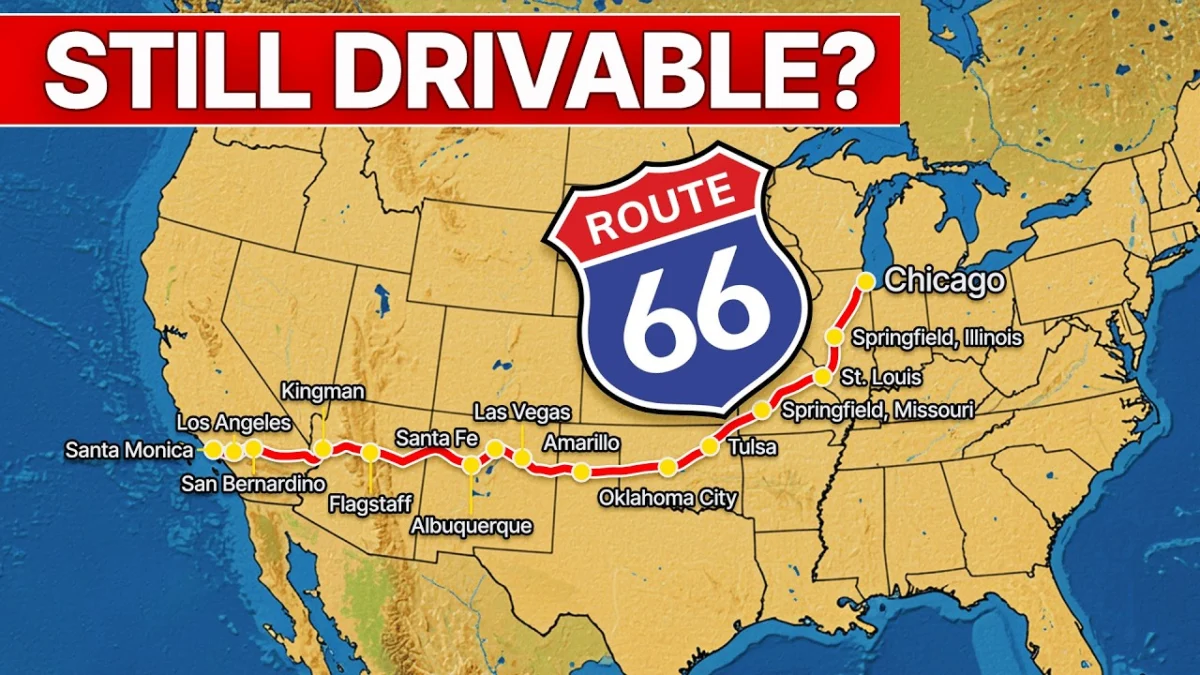
As the United States commemorates 250 years of national independence, travelers and Americana enthusiasts worldwide are turning their attention to another monumental milestone: the centennial anniversary of Route 66. Established officially on November 11, 1926, the legendary thoroughfare dubbed the "Mother Road" by author John Steinbeck has reached its 100th year. Throughout the centennial year, domestic and international tourists alike have taken to the asphalt to complete the 2,448-mile pilgrimage stretching from Chicago’s Grant Park to the Santa Monica Pier. Traversing eight states, major metropolitan hubs, desolate expanses, and an array of eccentric roadside attractions, the highway remains a potent symbol of mid-century mobility, economic transformation, and cultural mythology.
The Genesis and Evolution of the Mother Road
The creation of Route 66 in 1926 was part of a broader federal initiative to standardize and pave the rapidly expanding American highway network. Designed to bridge the Midwest to the Pacific Coast, the route served as a vital economic artery during the Great Depression. It provided a lifeline for hundreds of thousands of Midwestern farmers and families migrating westward, most famously documented by Steinbeck in his 1939 masterpiece, The Grapes of Wrath.
Following World War II, the highway played a pivotal role in the post-war economic boom and the rise of car culture. Small towns along the 2,448-mile stretch transformed rapidly to accommodate motorists, giving birth to a distinct vernacular architecture characterized by neon-lit motels, independent diners, quirky souvenir shops, and larger-than-life fiberglass landmarks like the iconic "Muffler Men" statues.
However, the golden era of the two-lane highway proved finite. The passage of the Federal-Aid Highway Act of 1956, championed by President Dwight D. Eisenhower, initiated the construction of the U.S. Interstate Highway System. Designed for high-speed, long-distance military and commercial transit, the modern interstates systematically bypassed the winding towns and roadside businesses of Route 66. By the late 20th century, traffic dwindled to a fraction of its peak volume, leading to the official decommissioning of the highway in October 1985.
Chronology of Route 66: Key Milestones
- November 11, 1926: Route 66 is officially established as part of the new U.S. Highway System, connecting Chicago, Illinois, to Los Angeles, California.
- 1930s: The Dust Bowl drives a massive migration of displaced agricultural workers westward along the highway, cementing its status in American literature and folklore.
- 1956: President Dwight D. Eisenhower signs the Federal-Aid Highway Act, funding the construction of the Interstate Highway System that would ultimately supersede Route 66.
- October 1985: Route 66 is officially decertified and decertified from the U.S. Highway System, replaced entirely by modern interstates.
- 1990s: State legislatures and grassroots preservation groups establish "Historic Route 66" designations, sparking a concerted effort to restore and protect surviving infrastructure.
- November 11, 2026: Route 66 officially reaches its centennial anniversary, prompting global tourism surges, digital documentation projects, and renewed preservation funding.
Modern Preservation and the Digital Age of Travel
Despite its official removal from federal maps, the legacy of Route 66 refused to fade. In the late 1980s and early 1990s, dedicated preservationists, historical societies, and state governments successfully lobbied to establish "Historic Route 66" markers across significant portions of the remaining roadway. Today, approximately 85 percent of the original alignment remains drivable, drawing millions of domestic and international visitors seeking an authentic slice of mid-century Americana.
In the lead-up to the centennial, content creators and travel vloggers have embraced the highway as a canvas for modern exploration. Documentarians and digital chroniclers—such as Chris Attrell and Josh McNair—have utilized the milestone year to record comprehensive end-to-end journeys. Attrell’s centennial expedition, capturing over 100 stops along the route, highlights both the enduring charm of operating roadside businesses and the poignant reality of rural towns left behind by the interstate bypass.
Travelers navigating the route today encounter a study in contrasts. While bustling segments near major urban centers thrive on tourism, other stretches wind through quiet "semi-ghost towns" like Tucumcari, New Mexico. Once defined by rows of thriving motels and service stations, these locations now function as open-air museums for photographers and historians, capturing a melancholic aesthetic of total desuetude.
Economic and Cultural Implications
The centennial of Route 66 arrives at a time when heritage tourism is experiencing a significant post-pandemic resurgence. Local economies across Illinois, Missouri, Kansas, Oklahoma, Texas, New Mexico, Arizona, and California have leveraged the anniversary to secure federal and state grants aimed at restoring aging neon signs, retro gas stations, and historical roadside landmarks.
Economists and tourism boards note that the highway generates substantial regional revenue, supporting small businesses ranging from family-owned diners—such as the famous Cozy Dog Drive-In in Springfield, Illinois—to niche museums and themed lodging like the iconic Wigwam Motels in Arizona and California. Furthermore, the route serves as a crucial cultural bridge, attracting international travelers from Europe, Asia, and South America for whom Route 66 remains the ultimate embodiment of the romanticized American road trip.
As preservation efforts look toward the future, conservationists face the ongoing challenge of balancing commercial modernization with historical integrity. Ensuring the structural survival of fragile mid-century architecture requires coordinated public-private partnerships and sustained legislative backing. With global attention focused on the centennial celebrations, stakeholders remain optimistic that the Mother Road will continue to endure as a living monument to American mobility well into its second century.