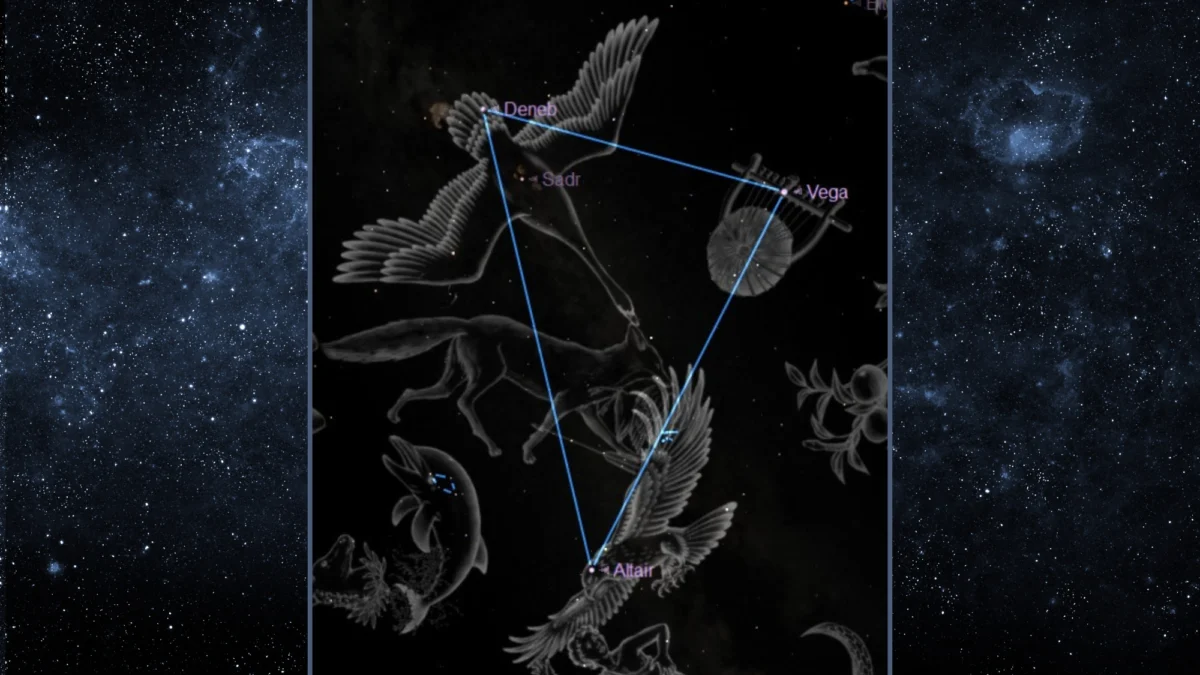
As the transition from the humid warmth of summer to the crisp, cooling air of autumn settles across the Northern Hemisphere, observers of the night sky are often greeted by a familiar celestial anchor. High above, suspended in the darkening dome of the evening, the Summer Triangle continues to command the zenith. Comprised of the three brilliant luminaries—Vega in the constellation Lyra, Altair in Aquila, and Deneb in Cygnus—this asterism persists as a dominant feature of the night long after the summer solstice has faded into memory. While the calendar may shift toward the winter months, the persistence of the Summer Triangle poses a compelling question for both amateur stargazers and professional astronomers alike: why does this celestial formation retain its seasonal moniker despite its prominence well into the autumn, and what does this tell us about the nature of our observation of the cosmos?
The Mechanics of the Summer Triangle’s Longevity
The classification of the Summer Triangle as a "summer" entity is primarily a function of its visibility window during the warmer months of the year. During the height of summer, the triangle is a constant companion from dusk until dawn. In June and July, an observer can witness the formation rising in the east-northeast at nightfall, passing nearly directly overhead at midnight, and finally descending toward the west-northwest as the first light of daybreak begins to pierce the horizon.
As the Earth continues its annual orbit around the sun, the stars appear to shift westward by approximately one degree each day. By the time September and October arrive, the timing of the triangle’s transit has shifted significantly. While it no longer spans the entirety of the night, it remains a fixture of the evening sky. Even in mid-November, the triangle can be spotted hanging in the western sky shortly after sunset. Its label, therefore, is not a statement of its seasonal exclusivity, but rather a reflection of its most convenient and spectacular period of observation.
Stellar Anatomy: A Study in Distance and Luminosity
To understand the Summer Triangle is to understand the vast disparity in the physical nature of its constituent stars. While they appear as a cohesive, roughly equilateral triangle to the naked eye, these three stars are separated by distances that defy human intuition.
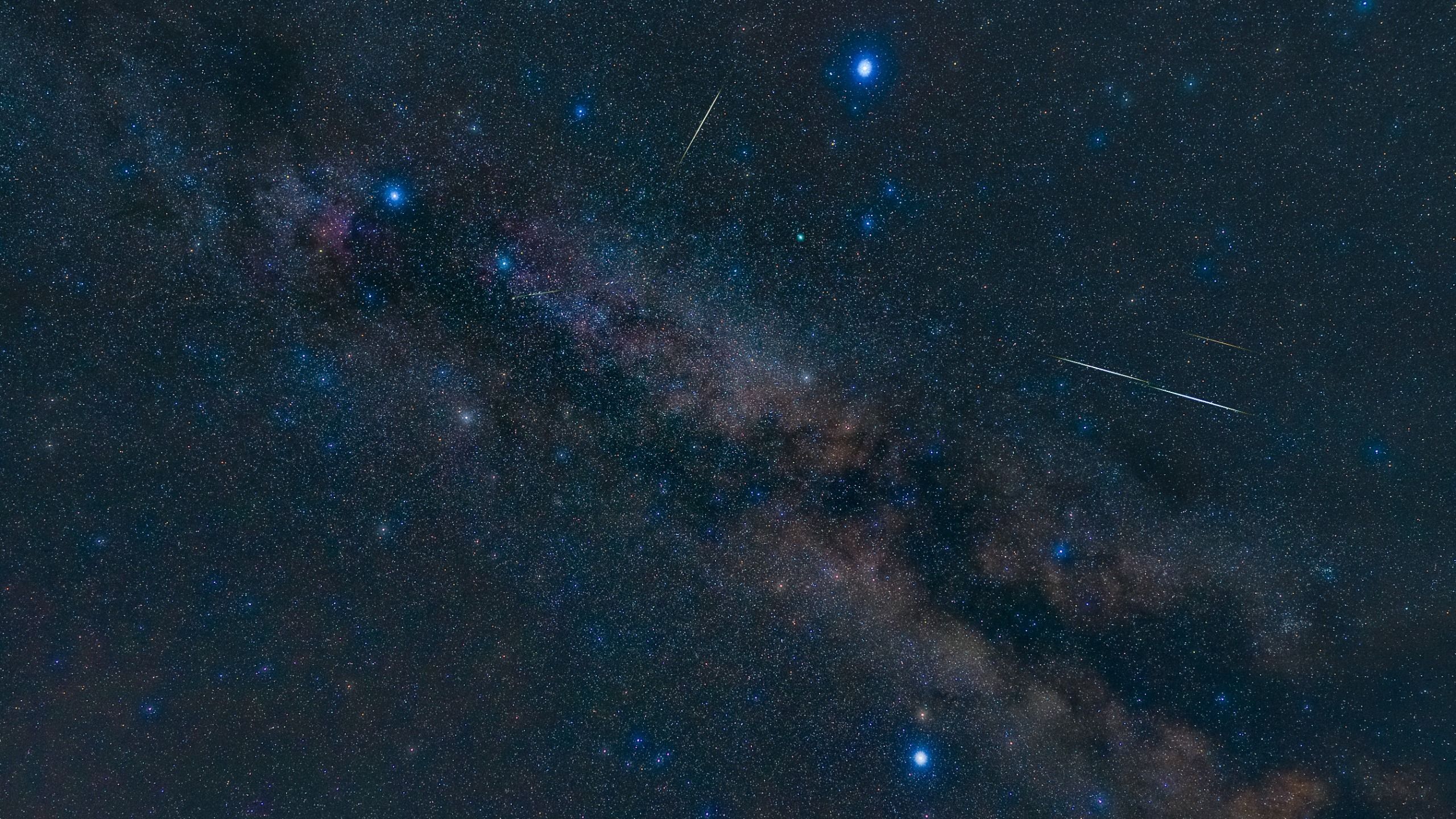
Altair, the southernmost vertex, is the closest to our solar system at a distance of approximately 16.7 light-years. It is a main-sequence star, roughly 1.8 times the mass of our sun. Vega, the brightest of the three, sits at approximately 25 light-years away. It is a blue-white dwarf star that has long served as the baseline for the astronomical magnitude scale, with an apparent magnitude of 0.00.
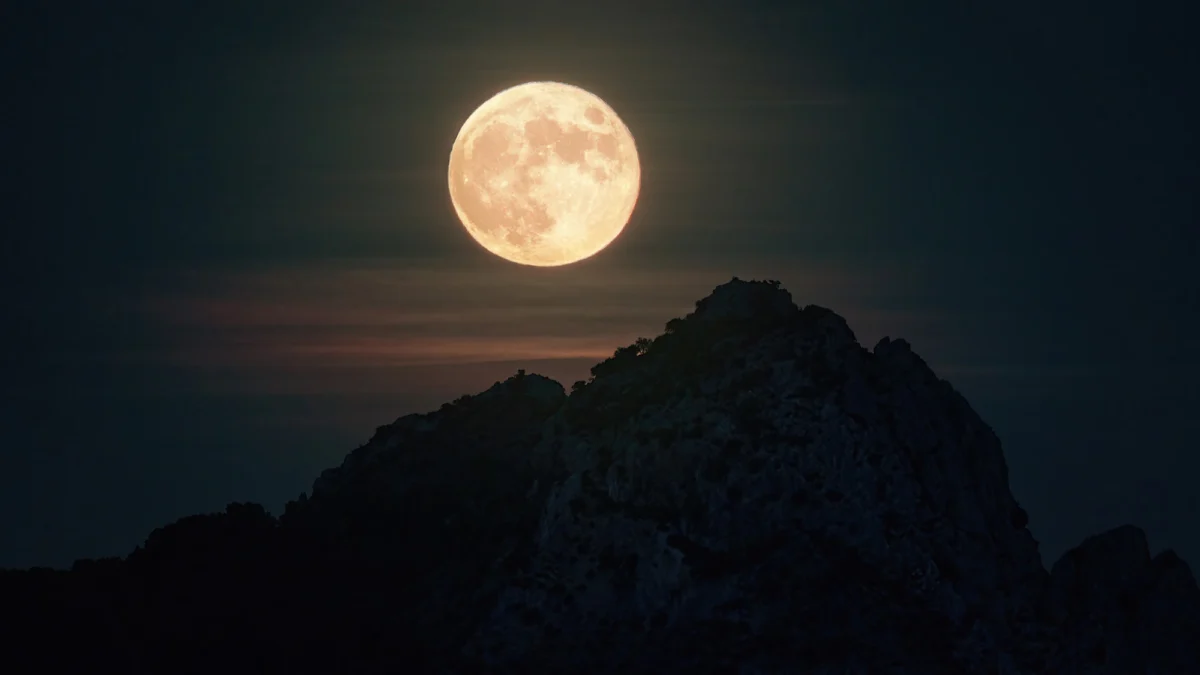
In stark contrast to these relatively close neighbors, Deneb stands as a celestial titan. Located between 1,400 and 2,600 light-years away, its exact distance is difficult to pinpoint due to the limitations of parallax measurements at such extreme ranges. Deneb is a blue-white supergiant of extraordinary luminosity; it is estimated to be at least 55,000 times brighter than our sun. If Deneb were moved to the distance of Altair or Vega, it would cast shadows on the Earth and shine with a brilliance rivaling the full moon. The fact that we see it as a prominent first-magnitude star despite its distance is a testament to its status as one of the most powerful stars in our immediate galactic neighborhood.
The Linguistic Debate: The Naming of a Star Pattern
The origins of the term "Summer Triangle" are subject to historical debate, reflecting the way astronomical nomenclature often evolves through informal use before gaining mainstream acceptance. While some enthusiasts attribute the popularization of the term to the British astronomer Sir Patrick Moore, who famously noted in a 1958 BBC broadcast that he had introduced the nickname, the documentary evidence suggests a more complex lineage.
H.A. Rey, the author and illustrator best known for Curious George, played a significant role in modernizing sky charts. In his 1952 publication, The Stars: A New Way to See Them, Rey highlighted the trio as a "right triangle," and by his 1954 children’s book, Find the Constellations, he had firmly adopted the "Summer Triangle" moniker. Furthermore, European sources suggest the term has deeper roots; Austrian astronomer Oswald Thomas referred to the formation as the "Grosses Dreieck" (Great Triangle) in the 1920s and later as "Sommerliches Dreieck" (Summerly Triangle) in 1934. Evidence also suggests that U.S. military navigation manuals utilized during World War II may have employed the term to help pilots and navigators identify key reference points in the night sky.
The Vega Pronunciation Controversy
Beyond the identity of the formation, the pronunciation of its brightest star, Vega, has become a niche point of contention in the astronomical community. The 1997 film Contact, based on the novel by Carl Sagan, featured a character who consistently pronounced the star as "Vey-gah," a pronunciation that likely drew influence from the Chevrolet Vega, a subcompact car manufactured in the 1970s.
Professional astronomers, however, maintain the traditional pronunciation: "Vee-ga." This distinction, once championed by the late astronomical educator George Lovi, serves as a subtle shibboleth within the community. Lovi’s often-quoted maxim—"Vee-ga is a star, and Vey-gah is a car"—remains the standard by which enthusiasts distinguish between astronomical tradition and popular cultural misconceptions.
Implications for Modern Astronomy and Public Engagement
The enduring popularity of the Summer Triangle illustrates the importance of asterisms in public engagement with the night sky. Unlike official constellations, which are strictly defined by the International Astronomical Union (IAU) as specific regions of the celestial sphere, asterisms are patterns defined by human perception and cultural tradition. They act as "gateways" to deeper astronomical inquiry.
By providing a recognizable, high-contrast target for the novice observer, the Summer Triangle serves a pedagogical function. It allows for the introduction of complex concepts—such as stellar magnitude, light-years, and the life cycles of stars—within an accessible framework. When a student or an amateur stargazer observes the difference between the "penlight" brightness of the nearby Altair and the "lighthouse" intensity of the distant, supergiant Deneb, they are engaging in the same fundamental classification work that defined the early era of astrophysics.
A Chronology of Observation
The observation of the Summer Triangle has transitioned from a practical tool for ancient maritime and terrestrial navigation to an object of scientific study and recreational astronomy.
- 1920s–1930s: Austrian astronomer Oswald Thomas establishes the groundwork for the term in European literature, using descriptive names like "Great Triangle."
- 1940s: During World War II, the pattern is utilized in military navigation training, cementing its utility as a navigational reference.
- 1952–1954: H.A. Rey formalizes the term in his widely distributed educational materials, helping to standardize the name in the English-speaking world.
- 1958: Sir Patrick Moore brings the term to mass media via the BBC, leading to its near-universal adoption by the public.
- 1997: The release of Contact sparks a minor, enduring debate over the pronunciation of Vega, highlighting the tension between popular culture and scientific nomenclature.
Conclusion
As the autumn progresses, the Summer Triangle will inevitably continue its slow, stately migration toward the western horizon, eventually disappearing into the glare of the sun before returning to the eastern skies in the spring. Its persistence in our vocabulary, even when the seasons have clearly shifted, speaks to the human desire to impose order upon the vastness of the universe. The triangle is more than just a cluster of stars; it is a bridge between the observer and the cosmos, a reminder that even as our calendar pages turn, the fundamental mechanics of the galaxy remain in constant, observable motion. Whether one calls it an autumn fixture or a summer relic, the triangle remains one of the most reliable and awe-inspiring sights available to any observer willing to look up after dusk.