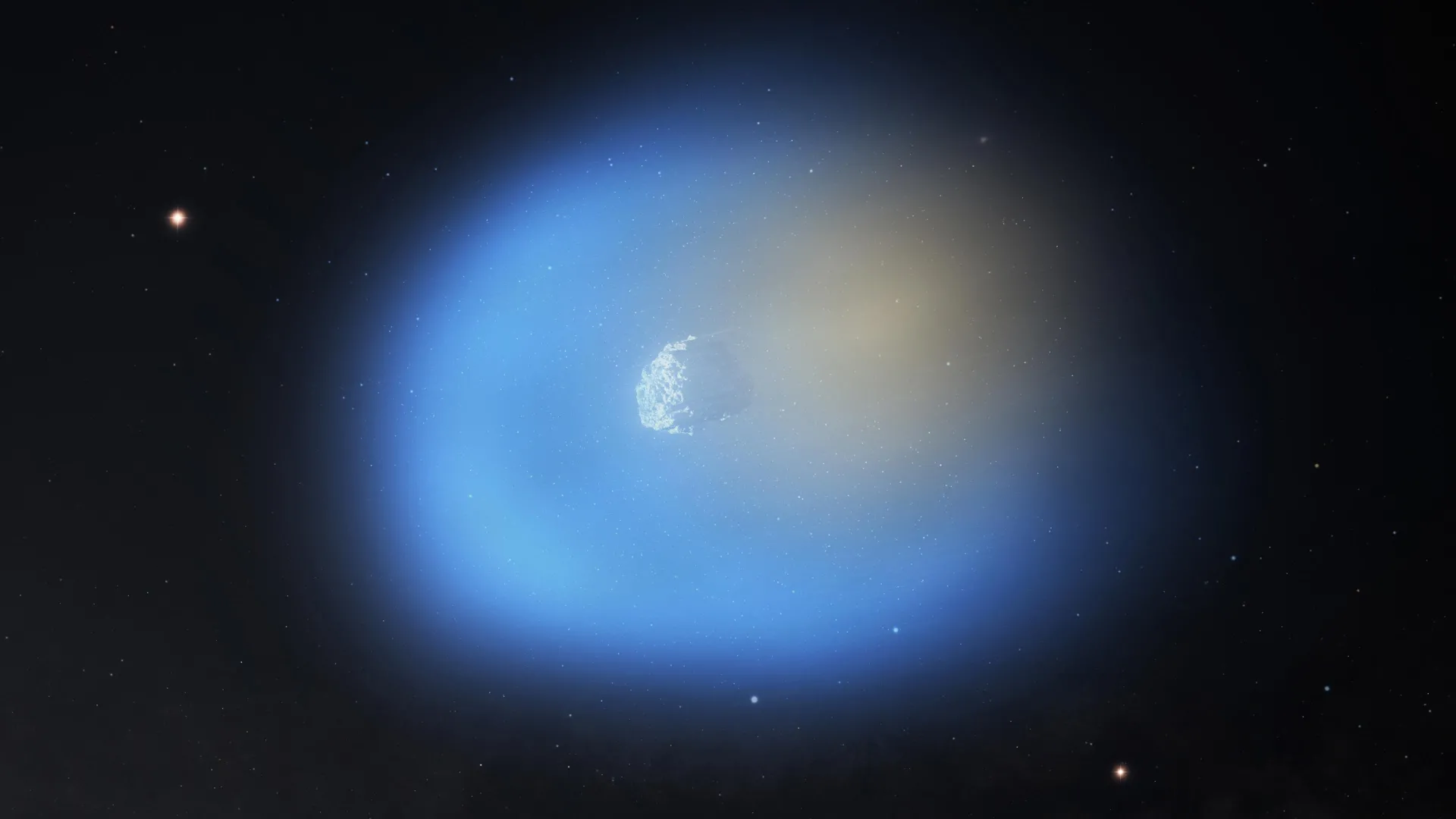
The scientific community is currently grappling with a transformative discovery regarding the nature of planetary system formation, as recent data from the Atacama Large Millimeter/submillimeter Array (ALMA) indicates that the interstellar visitor 3I/ATLAS possesses a chemical signature distinct from any object native to our own solar system. As the comet traverses the inner reaches of our neighborhood, its unique, methanol-rich composition has provided researchers with a rare "fingerprint" of the volatile conditions present in its home system. This interstellar traveler, the third of its kind ever documented, serves as a high-fidelity messenger from a distant, unknown stellar origin, challenging existing models of how icy bodies are constructed in the deep reaches of the galaxy.
The Chronology of an Interstellar Visitor
The detection of 3I/ATLAS followed a string of observational milestones that began in early 2025. Following the initial identification of the object as an interstellar intruder—a status confirmed by its hyperbolic trajectory that precludes a closed orbit around our Sun—astronomers initiated an aggressive campaign of multi-wavelength monitoring. The goal was to leverage the unique opportunity to study the material properties of an object formed in a foreign protoplanetary disk.
In late 2025, as 3I/ATLAS approached perihelion, the point in its orbit closest to the Sun, solar radiation began to sublimate the surface ices of the comet’s nucleus. This process created a vast, glowing coma—an atmosphere of gas and dust that trailing behind the nucleus like a cosmic plume. Astronomers utilized the Atacama Compact Array, a specialized configuration of ALMA in the high-altitude Chilean Andes, to capture the faint submillimeter emissions emanating from this coma. These observations were timed precisely to catch the comet at peak activity levels, allowing the research team to map the chemical distribution of the escaping gases with unprecedented spatial resolution.
Decoding the Chemical Fingerprint
The core of the recent discovery lies in the ratio of specific organic molecules identified within the coma. The research team, led by Professor Nathan Roth of American University, focused their analytical efforts on two primary compounds: hydrogen cyanide (HCN), a standard marker for cometary organic chemistry, and methanol (CH3OH), a complex alcohol.
The data returned by ALMA proved startling. In most comets native to our solar system, the ratio of methanol to HCN is relatively constrained, reflecting the standard chemical evolution of the solar nebula. In 3I/ATLAS, however, the researchers measured ratios of approximately 70 and 120 on different observation dates. These figures place the object in an extreme category of methanol enrichment, far exceeding the typical chemical profiles recorded for comets observed within the Oort Cloud or the Kuiper Belt.
"Observing 3I/ATLAS is like taking a fingerprint from another solar system," stated Nathan Roth. "The details reveal what it’s made of, and it’s bursting with methanol in a way we just don’t usually see in comets in our own solar system. This is a primary indicator that the environmental conditions in the system where 3I/ATLAS formed were fundamentally different from those that governed the early development of our own planetary neighbors."
Comparative Analysis: The Webb Telescope Precedent
Before the ALMA observations provided this detailed chemical breakdown, the James Webb Space Telescope (JWST) had already begun to peel back the layers of 3I/ATLAS. Earlier in 2025, when the comet was still at a greater distance from the Sun, JWST data indicated that the coma was dominated by carbon dioxide. This initial finding hinted at a volatile-rich object, but the addition of the ALMA data regarding methanol has created a more complex and nuanced picture.
The synthesis of JWST’s infrared observations and ALMA’s submillimeter measurements suggests that 3I/ATLAS is not merely a "dirty snowball" but a chemically complex structure. The high resolution of ALMA allowed scientists to differentiate between molecules released directly from the nucleus and those released from smaller, drifting ice grains. While the hydrogen cyanide appeared to emerge exclusively from the central nucleus, the methanol showed a broader distribution, originating from both the nucleus and the sublimation of these microscopic ice particles as they migrated into the coma.
This behavior—where tiny grains act as miniature, independent comets—is a phenomenon rarely observed with such clarity. While a handful of solar system comets have exhibited similar "grain-based" outgassing, 3I/ATLAS represents the first instance where the physics of this process has been traced in an object of confirmed interstellar origin.
Broader Scientific Implications
The significance of this research extends far beyond the chemical makeup of a single comet. The scientific community has long used comets as "time capsules," believing that their composition preserves the conditions of the protoplanetary disks from which they coalesced. By analyzing the chemistry of 3I/ATLAS, astronomers are effectively benchmarking the diversity of planetary systems throughout the galaxy.
The discovery suggests that the chemical "recipes" for forming icy bodies are far more varied than previously thought. If 3I/ATLAS is representative of its home system, it implies that star systems elsewhere may possess different distributions of organic precursors—the building blocks for planetary atmospheres and, potentially, the chemistry necessary for biological development.
Furthermore, this discovery provides a crucial comparative data point alongside the two previous interstellar visitors, 1I/’Oumuamua and 2I/Borisov. While ‘Oumuamua baffled scientists with its unusual shape and lack of a visible coma, and Borisov appeared more similar to our own comets, 3I/ATLAS presents a third, distinct archetype. Each new visitor provides a unique perspective on the "galactic neighborhood," helping to determine whether our solar system is a common occurrence or an outlier in terms of its chemical inventory.
Future Research and Global Collaboration
The research involving ALMA, which is a partnership of the U.S. National Science Foundation (NSF) and international partners including the European Southern Observatory (ESO) and the National Institutes of Natural Sciences (NINS) of Japan, highlights the importance of global cooperation in astronomical discovery. The technical capability required to detect the faint signatures of methanol from an object moving at high velocities across the sky is immense, requiring the high-altitude, stable atmospheric conditions provided by the Atacama desert.
As 3I/ATLAS continues its trajectory, the international astronomical community is shifting its focus to long-term monitoring and data archival. The goal is to compare the recent methanol findings with future observations of other interstellar objects that are expected to be detected as survey telescopes, such as the Vera C. Rubin Observatory, come online in the coming years.
The analysis of 3I/ATLAS serves as a potent reminder of the dynamic nature of our galaxy. With every interstellar object that enters the inner solar system, humanity gains an unprecedented opportunity to conduct "remote sensing" of distant planetary systems without the need for multi-generational space travel. The chemical data harvested from 3I/ATLAS will undoubtedly influence the next decade of theoretical models regarding planet formation, helping to refine the criteria used to identify habitable environments in the vast expanse of the cosmos.
As the comet moves toward its eventual departure from our solar system, the data collected will remain a cornerstone of planetary science. Researchers are now looking to synthesize the findings from JWST, ALMA, and ground-based optical telescopes to construct a comprehensive model of the comet’s life cycle. This effort is not merely about categorizing an icy visitor; it is about mapping the chemical diversity of the universe and understanding the specific conditions that allowed our own solar system to host life, while recognizing that the rest of the galaxy may operate on an entirely different set of chemical rules.