
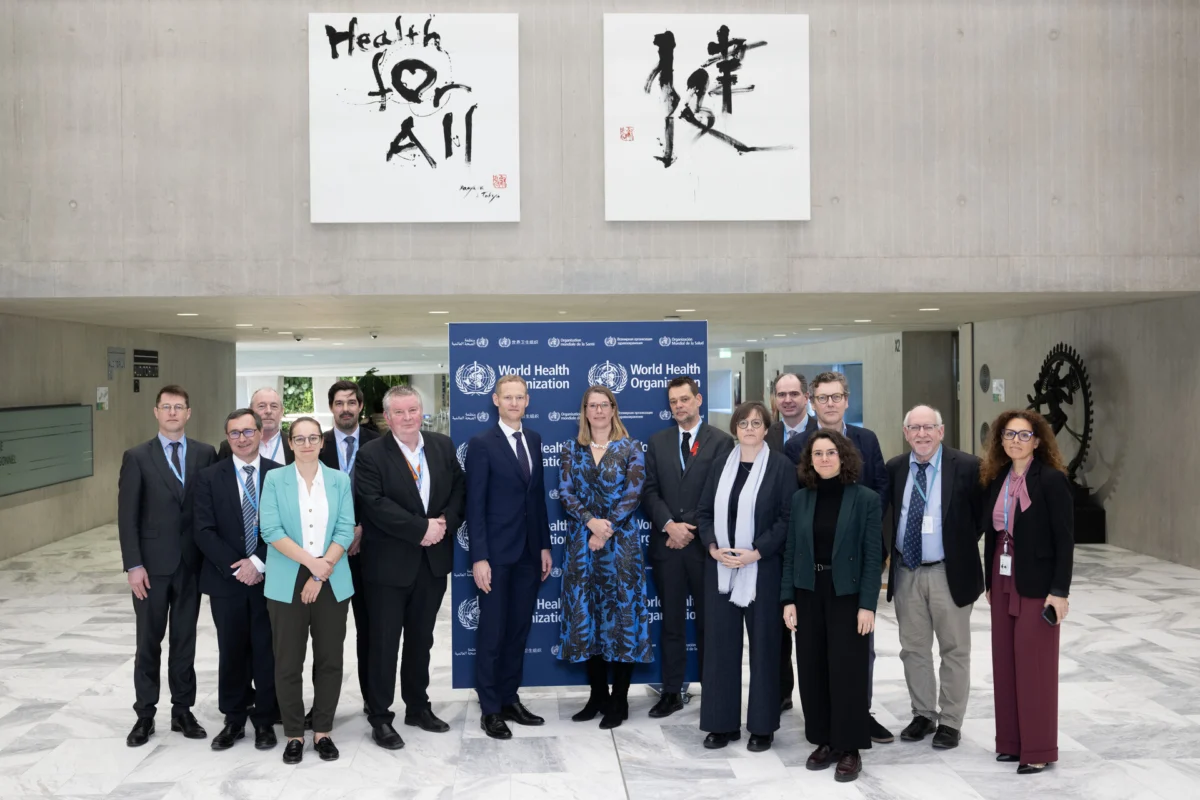
In an era defined by compounding global health challenges, the Kingdom of Belgium and the World Health Organization (WHO) have concluded a comprehensive three-day strategic dialogue in Geneva, charting a forward-looking course for their enduring partnership. The high-level consultations, which convened leadership and technical experts from WHO Headquarters alongside representatives from the Regional Offices for Africa and Europe, culminated in a renewed commitment to accelerate universal health coverage (UHC), bolster fragile health systems, and guarantee equitable global access to life-saving vaccines, medicines, and medical technologies.
The Belgian delegation was led by H.E. Christophe Payot, Ambassador and Permanent Representative of Belgium to the United Nations and other international organizations in Geneva. Significantly, the delegation’s composition reflected a unified national approach, incorporating representatives from the Belgian Federal Government as well as the regional governments of Flanders and Wallonia. This multi-tiered representation underscored Belgium’s whole-of-government dedication to multilateral health governance and international development cooperation.
Chronology and Context of the Strategic Dialogue
The three-day engagement served as a critical milestone in the multi-year partnership between Belgium and the WHO, building directly upon the policy momentum generated during Belgium’s Presidency of the Council of the European Union in 2024. Throughout the EU presidency, global health security, equitable access, and crisis preparedness occupied central positions on the European legislative and diplomatic agenda. The Geneva talks provided a structured framework to review how these European-level priorities translate into tangible, field-level interventions supported by Belgian development assistance.
Opening the dialogue, delegates engaged in rigorous plenary sessions to evaluate the alignment between the WHO’s overarching strategic frameworks—specifically the transition toward the 14th General Programme of Work (GPW14)—and Belgium’s national development cooperation priorities. Against the backdrop of an increasingly complex geopolitical and epidemiological landscape, both parties sought to optimize resource allocation, enhance operational efficiencies, and streamline bilateral-multilateral synergies in partner nations across Africa and beyond.
Koen Van Acoleyen, Minister Counselor at the Permanent Representation of Belgium to the UN, reflected on the depth of the discussions during the proceedings. "After listening to the leaders and experts of WHO, we now better understand how they are navigating these challenging times," Mr. Van Acoleyen stated. "We are honoured that we can walk this road together."
Expanding Equitable Access to Medicines and Health Technologies
A primary focal point of the strategic dialogue was the ongoing evaluation of the Access to Medicines programme, a critical global health initiative funded by Belgium. The program aims to address market failures, reduce financial barriers, and foster sustainable local manufacturing ecosystems for essential therapeutics in low- and middle-income countries.
During the sessions, WHO technical experts presented detailed implementation reports, highlighting both major achievements and persistent structural challenges encountered at the country level. Senegal was highlighted as a prominent case study, illustrating how targeted policy interventions, regulatory strengthening, and supply chain optimizations can improve population-level access to quality-assured medical products.
Furthermore, the discussions addressed the imperative of local production as a cornerstone of long-term health security. Both the Belgian and WHO delegations acknowledged that reducing reliance on centralized global supply chains requires robust capacity-building, technology transfer, and predictable market-shaping mechanisms. Ensuring the financial and operational sustainability of the Access to Medicines initiative emerged as a shared strategic objective for the coming years.
Health Emergencies, Pandemic Preparedness, and the One Health Framework
The dialogue naturally gravitated toward the architecture of global health security, particularly in light of recent post-pandemic reforms. Participants reviewed the WHO’s evolving role in preventing, preparing for, responding to, and recovering from health emergencies. Central to this discussion were the ongoing negotiations surrounding the global pandemic agreement and the operationalization of the One Health approach—a collaborative, multisectoral, and transdisciplinary framework recognizing the interconnection between human, animal, plants, and their shared environment.
To ground these high-level policy debates in operational reality, WHO officials showcased active emergency response operations, drawing particular attention to the complex and hazardous field conditions in Gaza. Experts detailed the logistics of delivering emergency medical aid, coordinating clinical deployments, and maintaining essential health service delivery amidst active conflict.

The agenda also addressed escalating biological threats, including the intensification of zoonotic spillover events driven by climate change, habitat loss, and agricultural expansion. Officials evaluated current risk mitigation strategies and emphasized the necessity of strengthening early warning surveillance systems to detect novel pathogens before they escalate into international public health emergencies.
Advancing Universal Health Coverage and Primary Care
Universal health coverage remains the bedrock of sustainable development and health equity. During dedicated thematic sessions, participants reviewed the achievements of the UHC-Partnership across the 2021–2024 funding cycle, with a specific focus on outcomes realized in Belgium’s priority partner countries.
Field-level insights from the Democratic Republic of Congo (DRC) provided a practical lens through which to examine both systemic achievements and administrative bottlenecks in primary health care delivery. The dialogue explored avenues to deepen integration between WHO country office technical assistance programs and Belgium’s bilateral development cooperation initiatives on the ground.
Particular attention was dedicated to the integration of mental health services into primary health care frameworks—a critical component often neglected in traditional development models. In addition to mental health, the delegations reviewed collaborative progress across other specialized programmatic areas supported by Belgian funding, notably the fight against Neglected Tropical Diseases (NTDs) and the advancement of Sexual and Reproductive Health and Rights (SRHR). Both parties reaffirmed that programmatic decision-making must remain strictly anchored in robust, transparent, empirical evidence.
Official Responses and Multilateral Solidarity
The contributions of the Belgian state were formally acknowledged by the WHO leadership, who praised the consistency, transparency, and political will demonstrated by the Belgian delegation.
"We thank you for your support, honesty, and strong engagement for global health," remarked Dr. Catharina Boehme, WHO Assistant Director-General for External Relations and Governing Bodies. "Your efforts in supporting our work in Mozambique and Senegal are clear examples of the crucial work we accomplish together."
This sentiment was mirrored by senior development officials from Brussels. Dirk Brems, Director of Thematic and Multilateral Cooperation at the Directorate-General for Development Cooperation and Humanitarian Aid, emphasized the intrinsic value of the partnership in an increasingly fragmented global order.
"We recognize WHO as a trustworthy partner in global health. We felt proud hearing how crucial our support is to the Organization and how it is having a positive impact at country, regional, and global levels," Mr. Brems stated. "It’s important we continue these discussions as we tread uncharted territories, and we look forward to working together for strong and sustained multilateralism."
Broader Impact, Implications, and the Road Ahead
As the three-day dialogue concluded, the partners laid the groundwork for the next generation of cooperation frameworks. Discussions initiated during the meetings will directly inform the drafting of a renewed WHO-Belgium Country Cooperation Strategy and a multi-year partnership agreement designed to span the lifecycle of the WHO’s 14th General Programme of Work (GPW14).
The strategic alignment of Belgium’s development assistance with the core tenets of GPW14—which places universal health coverage and health-systems strengthening at the center of international public health ambitions—signals a cohesive approach to global health governance. By prioritizing resilient health systems, equitable medical manufacturing, and robust pandemic preparedness, Belgium and the WHO have reinforced a shared vision: that sustainable global health security is not merely an aspiration, but an achievable outcome rooted in unwavering multilateral solidarity, evidence-based policy, and mutual accountability.








Leave a Reply