
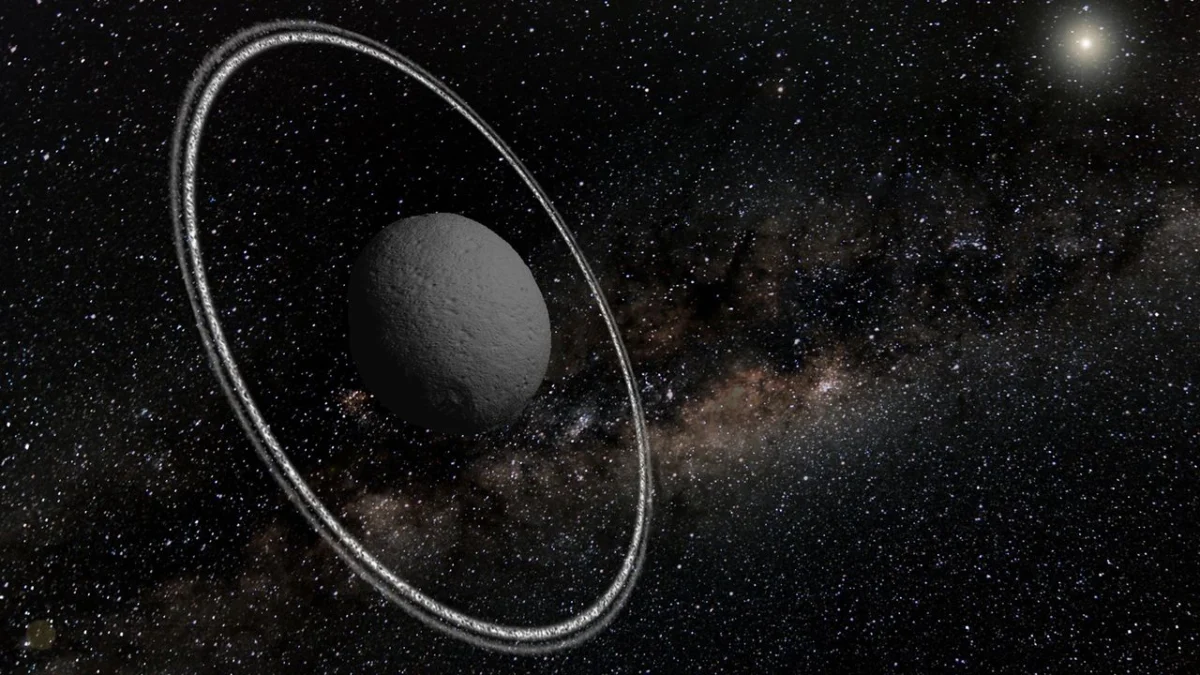
Recent observations captured by the advanced infrared capabilities of the James Webb Space Telescope (JWST) have revealed that the enigmatic rings encircling the distant small body known as Chariklo appear mysteriously different from previous detections. This unexpected finding has prompted astronomers to reevaluate the dynamic behaviors of small, icy bodies residing in the outer reaches of our solar system, shedding new light on the complex physical processes occurring far beyond the orbit of Mars.
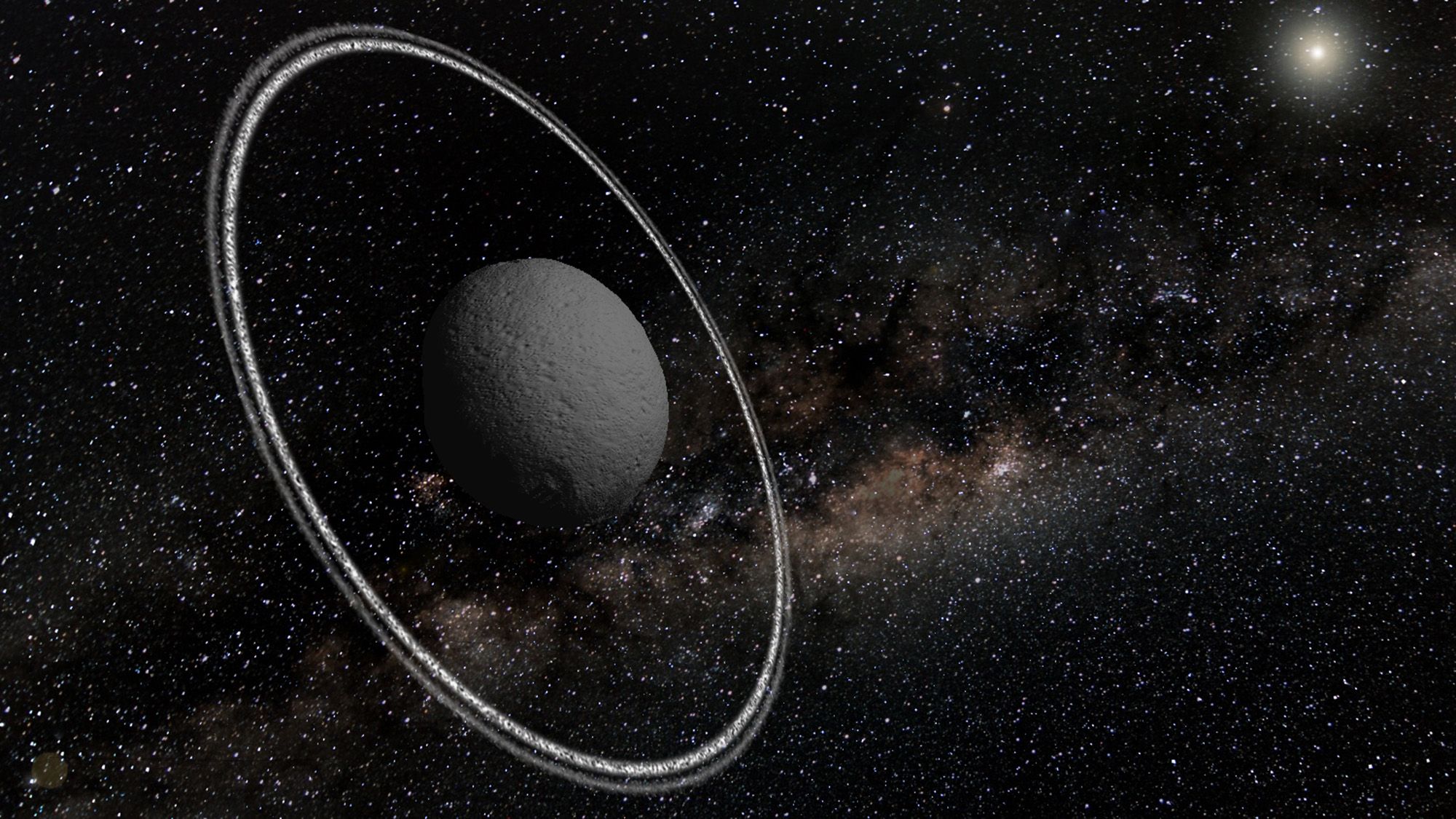
Chariklo, officially designated as 10199 Chariklo, is classified as a centaur—a unique and rare class of small celestial bodies that orbit the sun primarily between Jupiter and Neptune. These objects cross the orbits of the giant planets, experiencing extreme gravitational interactions and volatile temperature fluctuations. Measuring a mere 400 miles (approximately 250 kilometers) in diameter, Chariklo is the largest known centaur in the solar system. Despite its relatively diminutive size, it stunned the astronomical community in 2014 when researchers discovered that it is surrounded by two dense, narrow rings, making it the smallest known object in the solar system to possess a ring system.
The newly processed data from JWST’s Near-Infrared Spectrograph (NIRSpec) and Near-Infrared Camera (NIRCam) instruments indicate that the appearance of these concentric rings has altered significantly since they were first characterized through stellar occultation techniques more than a decade ago. While planetary rings are typically associated with gas giants like Saturn, Uranus, Jupiter, and Neptune, finding a stable ring system around a minor planet-like body fundamentally challenges existing models of orbital dynamics and ring formation.
A History of Discovery: How Chariklo’s Rings Were Found
The discovery of Chariklo’s ring system in 2014 was a milestone in planetary science. It occurred serendipitously when an international team of astronomers tracked the centaur as it passed in front of a distant star, an event known as a stellar occultation. By observing how the background starlight dimmed momentarily before and after the primary eclipse, scientists detected two distinct drops in brightness. These secondary dips revealed the presence of two sharp, narrow rings—designated provisionally as the main ring (1G) and the outer ring (2G)—located roughly 245 miles (391 kilometers) and 252 miles (405 kilometers) from the center of Chariklo, respectively.
Prior to this revelation, planetary rings were thought to be exclusive to massive worlds with immense gravitational fields capable of tearing apart larger moons that ventured too close—a boundary known as the Roche limit. Chariklo’s extremely low mass raised immediate theoretical questions about how such fragile rings could remain stable over millions of years without dissipating into space or accreting into a single, cohesive moonlet.
Subsequent observations over the next several years utilized ground-based telescopes, including the European Southern Observatory’s Very Large Telescope (VLT) in Chile, as well as the Hubble Space Telescope. These follow-up campaigns confirmed the existence of the rings and allowed researchers to calculate their widths and optical depths with increasing precision. However, monitoring a 250-kilometer object billions of miles away presents profound technological hurdles, leaving gaps in our continuous understanding of how the ring system evolves over short temporal scales.
The James Webb Space Telescope Steps In
The deployment and commissioning of the James Webb Space Telescope in 2022 provided astronomers with an unprecedented tool to study the outer solar system in high-resolution infrared light. Because centaurs are cold, distant, and reflect very little visible sunlight, JWST’s infrared sensors are ideally suited to detect their thermal emissions and spectral signatures.
Researchers trained the telescope on Chariklo to analyze the composition of both the central body and the surrounding ring material. The resulting data not only confirmed the presence of crystalline water ice within the rings—a finding consistent with previous ground-based spectroscopy—but also highlighted unexpected structural discrepancies.
When comparing the latest JWST measurements with historical occultation models, scientists observed that the apparent brightness and width profiles of the rings appeared altered. Whether these shifts are due to physical changes in the distribution of ring particles, variations in viewing geometry as Chariklo orbits the sun, or localized disruptive events remains a central puzzle for the research team.
Understanding Centaurs and Their Origins
To contextualize these findings, scientists look closely at the nature of centaurs themselves. These objects originate primarily in the Kuiper Belt, a vast reservoir of icy planetesimals situated beyond the orbit of Neptune. Gravitational nudges from Neptune and other giant planets occasionally dislodge these bodies, sending them spiraling inward toward the inner solar system, where they transition into centaurs.
Because centaurs spend a significant portion of their existence in deep space before transitioning into active comets or fading out, they retain pristine chemical records of the early solar system. Many centaurs exhibit cometary activity, occasionally developing gas and dust comas when warmed by the sun. Chariklo itself has shown signs of minor, sporadic activity, hinting at volatile ice sublimation beneath its dark, carbon-rich crust.
The presence of rings around such an active and dynamically unstable body suggests that ring systems might be far more common among small solar system bodies than previously assumed. Similar rings were subsequently discovered around another centaur, Chiron, and hinted at around trans-Neptunian objects like Haumea and Quaoar. This emerging class of "ringed minor bodies" forces dynamicists to rethink the evolutionary pathways of the outer solar system.
Implications for Orbital Dynamics and Stability
The revelation that Chariklo’s rings may be changing over time opens a critical debate regarding their long-term stability. Standard physical models dictate that narrow rings require shepherd moons—small, embedded satellites whose gravitational influence confines the ring particles and prevents them from spreading out and dispersing into space.
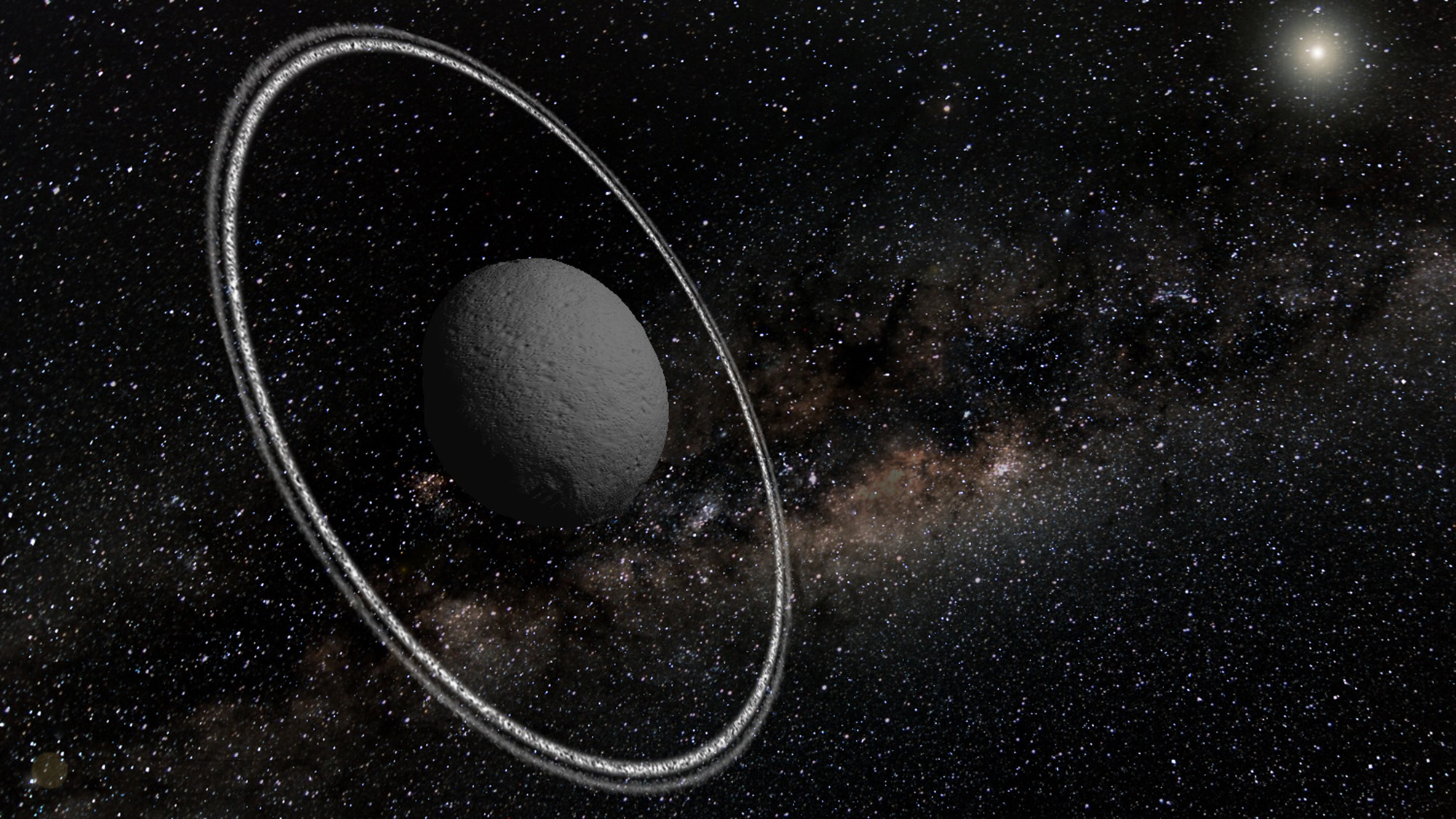
If Chariklo’s rings are indeed shifting, fluctuating in density, or undergoing structural deformation, it could indicate the presence of undiscovered shepherd moons moving within or near the ring system. Alternatively, the changes might reflect ongoing collisional grinding among the ring particles, or seasonal sublimation processes driven by the centaur’s eccentric, 63-year orbit around the sun.
Astrophysicists are currently running complex numerical simulations to test these hypotheses. By modeling the gravitational interactions between Chariklo, its icy rings, and potential unseen moonlets, researchers hope to determine whether the observed differences represent a cyclical seasonal phenomenon or a rare, transient phase in the life of the ring system.
Broader Impact on Solar System Evolution Studies
The ongoing investigation into Chariklo’s rings extends well beyond the centaur itself. Understanding how small bodies maintain or lose ring systems provides crucial insights into the accretion and destruction mechanics of early planetary building blocks. Rings act as natural laboratories for studying particle dynamics, viscosity, and gravitational resonance in micro-gravity environments—conditions that mirror the primordial protoplanetary disk from which the planets formed 4.6 billion years ago.
Furthermore, the success of JWST in capturing detailed data on such a small, distant target underscores the telescope’s expanding role in solar system science. While initially designed to peer deep into the early universe to study the first galaxies, JWST has proven to be an extraordinarily powerful observatory for investigating our own cosmic backyard, from the weather patterns of gas giants to the composition of distant icy debris.
Future Outlook and Upcoming Observations
As the scientific community digests these latest JWST datasets, preparations are already underway for subsequent observation windows. Astronomers plan to schedule additional spectroscopic and imaging campaigns to track Chariklo as it continues along its trajectory. By combining future JWST data with high-precision stellar occultation predictions managed by international observation networks, researchers aim to build a comprehensive, multi-year model of the centaur’s ring dynamics.
The mystery of Chariklo demonstrates that even well-studied targets in our solar system retain the capacity to surprise us. As instruments like the James Webb Space Telescope continue to push the boundaries of remote sensing, our comprehension of the dynamic, ever-changing environment of the outer solar system will undoubtedly continue to deepen, bridging the gap between distant celestial mechanics and our fundamental understanding of planetary origins.









Leave a Reply