
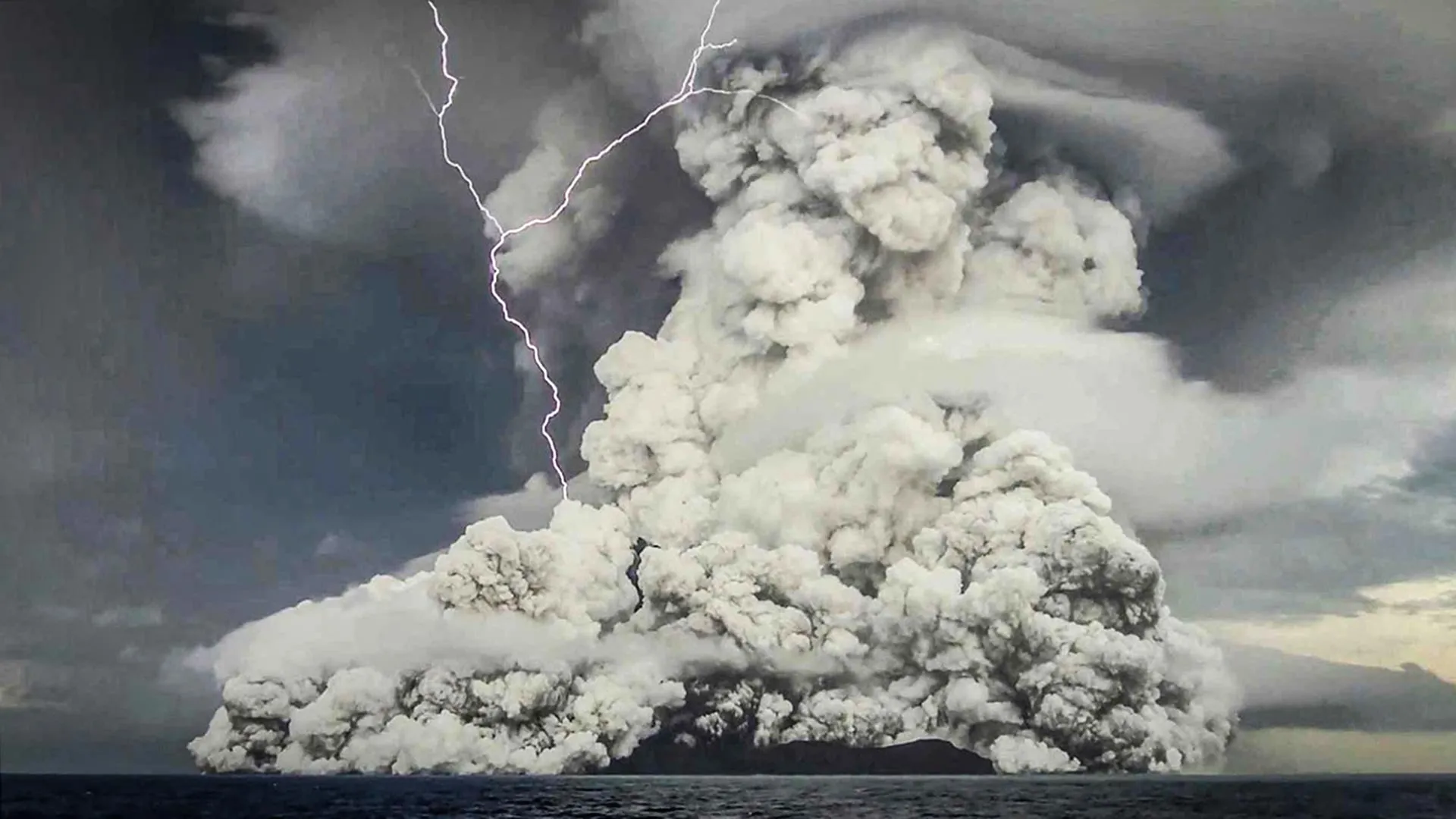
When the Hunga Tonga-Hunga Ha’apai volcano erupted beneath the waves of the South Pacific in January 2022, the resulting cataclysm sent shockwaves around the globe, triggering tsunamis and injecting an unprecedented volume of water vapor into the stratosphere. While the event’s immediate physical devastation was well-documented, scientists have recently uncovered a hidden chemical byproduct of the eruption that may offer a glimmer of hope for climate change mitigation. An international team of researchers, led by Dr. Maarten van Herpen of Acacia Impact Innovation BV, has discovered that the massive volcanic plume acted as a giant, natural atmospheric cleaner, systematically destroying methane—a potent greenhouse gas—within its own cloud.
The findings, published in the journal Nature Communications, suggest that the interaction between volcanic ash, seawater, and sunlight created a unique chemical environment that accelerated the breakdown of methane. This discovery is particularly significant because methane, while shorter-lived than carbon dioxide, is roughly 80 times more effective at trapping heat over a 20-year horizon. By understanding how the Earth naturally removes this gas, researchers may be able to develop new strategies to dampen the "emergency brake" of near-term global warming.
A Chronology of the Hunga Tonga Event
The eruption began in earnest on January 15, 2022, following a series of smaller precursor activities in late 2021. The climax of the event was one of the most powerful volcanic explosions recorded in the modern era, with a blast radius that sent an ash column soaring into the mesosphere, reaching an altitude of approximately 58 kilometers.
Unlike typical terrestrial volcanoes, the Hunga Tonga-Hunga Ha’apai vent was located underwater. As the magma interacted with the surrounding South Pacific seawater, it vaporized vast quantities of liquid, injecting not just ash and sulfur dioxide into the atmosphere, but also an unprecedented amount of water vapor. It was this specific mixture of materials—the salty marine aerosols and volcanic mineral dust—that set the stage for the observed chemical phenomenon. Over the ten days following the eruption, satellite sensors tracked the plume as it drifted across the Pacific toward South America, providing a rare longitudinal view of an atmospheric laboratory in motion.
The Chemical Fingerprint: Formaldehyde as a Catalyst Tracer
The discovery of this methane-destruction process was not the result of direct measurement, but rather a clever interpretation of "chemical fingerprints" detected by the European Space Agency’s Sentinel-5P satellite. The satellite carries an instrument known as TROPOMI, which monitors the composition of the atmosphere on a global scale.
Inside the volcanic plume, researchers observed a record-high concentration of formaldehyde. In atmospheric chemistry, formaldehyde is a fleeting, transient molecule that appears briefly when methane is oxidized or broken down. Because formaldehyde exists for only a few hours before degrading, its persistent presence over a ten-day period served as a definitive indicator that a continuous process of methane destruction was occurring within the cloud.
"When we analyzed the satellite images, we were surprised to see a cloud with a record-high concentration of formaldehyde," explained Dr. van Herpen. "Because formaldehyde only exists for a few hours, this showed that the cloud must have been destroying methane continuously for more than a week."
The Mechanism: Chlorine, Salt, and Sunlight
The science behind this cleanup process involves a mechanism known as "iron salt aerosol" chemistry. Scientists first identified a similar process in 2023, observing how Saharan dust, when mixed with sea salt from ocean spray, could catalyze the release of reactive chlorine in the troposphere.
In the case of the Hunga Tonga eruption, the mechanism was replicated in the stratosphere, a much thinner and colder layer of the atmosphere. The volcanic activity thrust huge amounts of saline water and mineral-rich ash into the high atmosphere. When sunlight hit these suspended particles, it triggered a photochemical reaction that liberated chlorine atoms. Chlorine is highly reactive and acts as a potent oxidant; when it encounters methane, it breaks the hydrocarbon bonds, effectively neutralizing the gas before it can contribute to the long-term greenhouse effect.
Professor Matthew Johnson of the University of Copenhagen, who participated in both the 2023 dust study and the new volcanic research, noted the rarity of the observation. "What is new—and completely surprising—is that the same mechanism appears to occur in a volcanic plume high up in the stratosphere, where the physical conditions are entirely different," Johnson said.
Quantitative Impact: Cows, Volcanoes, and Budgets
The study provides a sobering perspective on the scale of methane emissions. Researchers calculated that the volcano released approximately 300 gigagrams (Gg) of methane during the eruption. To put this into context, that is roughly equivalent to the annual methane output of two million cows.
However, the cleanup mechanism was equally impressive. The plume removed roughly 900 megagrams (Mg) of methane per day. This discovery has forced a re-evaluation of the global methane budget, the accounting system used by climate scientists to track how much methane enters and leaves the atmosphere. Previously, models had not fully accounted for the role of mineral dust and volcanic ash in methane sequestration. According to the research team, these new findings suggest that existing estimates of atmospheric methane flux may require adjustment to include these intermittent but highly effective natural sinks.
Implications for Climate Engineering
The potential to replicate this "volcanic cleanup" is a topic of intense interest, though it is accompanied by significant caution. Scientists are currently exploring ways to accelerate the removal of methane from the atmosphere as a complement to carbon dioxide reduction. While carbon dioxide remains the primary driver of long-term climate change, methane reduction is viewed as the most effective lever to lower temperatures in the next 10 to 20 years.
The difficulty in climate engineering has always been verification—how can one prove that a method is actually removing methane on a meaningful scale? The researchers believe the Hunga Tonga event provides a proof-of-concept. "How do you prove that methane has been removed from the atmosphere? How do you know your method works? It’s very difficult," says Dr. Jos de Laat of the Royal Netherlands Meteorological Institute. "But here we address that problem by showing that methane breakdown can in fact be observed using satellites."
Challenges and Future Research
Despite the excitement surrounding these findings, the path to practical application is fraught with challenges. Any effort to introduce aerosols into the atmosphere to catalyze methane destruction would need to be rigorously tested for safety, as atmospheric manipulation can have unintended consequences for the ozone layer or regional weather patterns.
Furthermore, the TROPOMI instrument used in this study was not originally designed to detect formaldehyde in stratospheric volcanic plumes. Dr. Isabelle De Smedt of the Royal Belgian Institute for Space Aeronomy highlighted the technical rigor required to confirm the data. "Retrieving formaldehyde from TROPOMI in a stratospheric volcanic plume is far outside the instrument’s standard operating conditions," she noted. "We had to carefully correct the satellite’s sensitivity for the unusual altitude of the signal and account for interference from high sulfur dioxide concentrations."
Conclusion: A Natural Blueprint
The Hunga Tonga eruption stands as a singular, violent event, yet it has provided scientists with a rare "natural experiment." By revealing that nature possesses its own mechanisms for mitigating greenhouse gas pollution through mineral-salt-chlorine interactions, the study opens a new frontier in atmospheric science.
While the researchers emphasize that this is not a panacea for climate change—and certainly not a substitute for the urgent need to decarbonize the global economy—it provides a valuable blueprint for future research. As engineers and climatologists look for ways to address the methane crisis, the lessons learned from the South Pacific may prove instrumental in designing safer, more effective atmospheric interventions. As Professor Johnson concluded, the study offers a "new way to help figure out how humans might slow global warming," using the very tools of chemistry that once seemed exclusively the domain of violent geologic phenomena.







Leave a Reply