
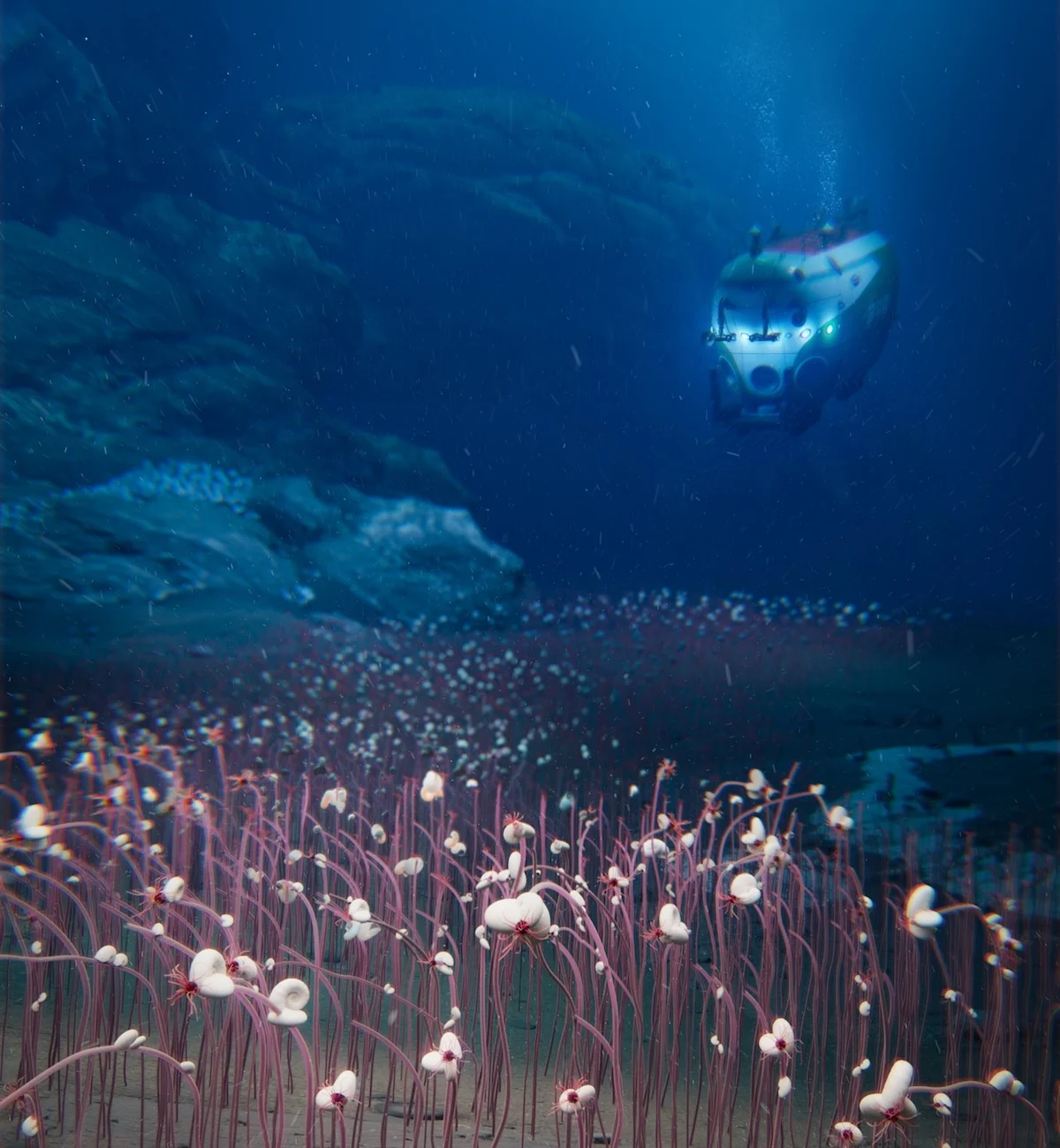
Deep beneath the surface of the western Pacific Ocean, in the crushing darkness of the planet’s deepest abysses, marine researchers have uncovered a sprawling ecosystem that fundamentally challenges our understanding of life’s biological limits. During a series of intensive deep-sea dives utilizing the Chinese manned submersible Fendouzhe, scientists discovered thousands of mollusks, tubeworms, and other complex invertebrates thriving nearly six miles below sea level in the Mariana, Kuril-Kamchatka, and western Aleutian trenches. Published in the prestigious journal Nature, the study documents the deepest and most extensive chemosynthesis-based animal communities ever recorded on Earth, stretching across a vast, interconnected underwater landscape.
The findings overturn long-held assumptions regarding the barren nature of hadal zones—the oceanic regions lying between 3.7 and 6.8 miles deep—and provide compelling evidence that complex animal life can flourish in environments previously thought too hostile, nutrient-poor, and high-pressure to support anything more than microscopic single-celled organisms.
Unveiling the Hadal Oasis: Main Facts and Discoveries
The groundbreaking expedition, led by researchers from the Institute of Deep-sea Science and Engineering at the Chinese Academy of Sciences, focused on the Earth’s hadal trenches. These remote, crescent-shaped tectonic trenches are among the least explored regions on the planet. During 23 separate dives into the Mariana Trench last year—a chasm whose maximum depth exceeds the height of Mount Everest—the Fendouzhe submersible mapped expansive communities of large invertebrates spanning a staggering distance of more than 1,500 miles at depths ranging from 3.6 to 5.92 miles.
Unlike coastal or shallow-water ecosystems that rely on sunlight and photosynthesis, these subterranean oases survive entirely without solar radiation. Instead, the communities are sustained through chemosynthesis, a biological process where organisms convert chemical energy into organic matter. Isotopic analysis of the region revealed that hydrogen sulfide-rich and methane-rich fluids are transported upward along active geological faults traversing deep sediment layers. Methane within these fluids is produced microbially from deposited organic matter, feeding dense mats of bacteria.
Video footage captured by the submersible revealed thriving fields of siboglinid polychaetes—tubeworms growing up to a foot in length—clustering densely around snow-like microbial mats. Interspersed among the tubeworms were massive mounds of bivalves, clams, and various mollusks, alongside free-floating marine worms, spiky crustaceans, sea lilies, and sea cucumbers. According to the research team, these organisms do not merely exist in isolated pockets of survival; rather, they form a vibrant, interconnected oasis thriving within the profound desert of the deep sea.
Chronology of Deep-Sea Exploration and the Fendouzhe Expeditions
To fully grasp the magnitude of the recent discovery, it is essential to examine the historical timeline of human exploration in the deepest oceanic trenches. For decades, the sheer physical barriers of extreme hydrostatic pressure, freezing temperatures, and total darkness kept these abyssal zones hidden from direct human observation.
The chronology of manned exploration in the Mariana Trench highlights the technological leaps required to reach these depths:
- January 23, 1960: Oceanographer Jacques Piccard and U.S. Navy Lieutenant Don Walsh achieved the first historical descent to the bottom of the Challenger Deep in the bathyscaphe Trieste, reaching a depth of approximately 6.9 miles. They reported observing living fish, temporarily challenging the notion that life could not exist under such immense pressure.
- March 25, 2012: Filmmaker and explorer James Cameron completed the first solo dive to the bottom of the Mariana Trench aboard the Deepsea Challenger, descending nearly 6.8 miles. Cameron famously described the barren, silent landscape as desolate and alien.
- 2020–2024: The Chinese Academy of Sciences accelerated its deep-sea exploration initiatives using the newly developed Fendouzhe (Striver) manned submersible. The vessel proved capable of enduring pressures exceeding 1,000 atmospheres, allowing for prolonged scientific observation and sample collection.
- 2024: During an intensive campaign involving 23 dives in the Mariana Trench, the research team mapped the extensive chemosynthetic communities and collected the data that would form the basis of the Nature study.
- July 2025: The findings were formally published in Nature, accompanied by video documentation that captured the global scientific community’s attention.
Supporting Data and Ecological Mechanics
The discovery provides quantitative metrics that redefine oceanographic models of carbon cycling and benthic biology. The identified communities span an estimated 1,553.4 miles along the trench systems, proving that hadal environments are far more biologically active than previously theorized.

The primary energy drivers of this ecosystem are tectonic and microbial. As organic matter drifts down from the upper ocean layers over millennia, it settles into the trench sediments. Microorganisms break down this material, generating vast quantities of methane and hydrogen sulfide. Geological faults act as subterranean plumbing systems, channeling these chemical-rich fluids directly to the seafloor. The sheer abundance of these resources allows large invertebrate populations—such as bivalves and tubeworms—to build dense biomass far removed from the sunlit surface world.
Lead author Xiatong Peng noted that the geological similarities shared by numerous hadal trenches globally suggest that such chemosynthetic communities could be far more widespread than previously anticipated. Mengran Du, a marine geochemist and co-author of the study, emphasized that the true breakthrough lies not merely in the depth of the discovery, but in the sheer density and complexity of the biological communities observed.
Official Responses and Academic Reactions
The publication of the study has sent ripples through the international oceanographic and marine biology communities, drawing praise for its technical achievement while prompting reevaluations of marine carbon models.
Marine scientists not directly involved in the research have pointed out that the study bridges a critical gap in marine ecology. While previous expeditions had identified microbial life and occasional isolated invertebrates near hydrothermal vents in shallower crustal zones—such as those found 1.24 miles below the Pacific floor—documenting large, complex animal colonies sustained by cold-seep chemosynthesis at hadal depths was previously thought improbable due to extreme energy limitations.
Furthermore, institutions tracking deep-sea biodiversity have lauded the multidisciplinary approach of the research, which combined manned submersible operations, high-definition video logging, geochemical sampling, and isotopic analysis. The integration of these methodologies has provided a robust framework for future investigations into the sub-seafloor biosphere.
Broader Impact and Implications: Conservation Versus Commercial Pressures
Beyond its ecological and biological significance, the discovery arrives at a critical geopolitical and environmental crossroads. The announcement coincides with intensifying global debates over the regulation of deep-sea mining. Governments and multinational corporations are increasingly eyeing the ocean floor for valuable mineral deposits, including polymetallic nodules rich in nickel, cobalt, copper, and rare earth elements essential for green technologies and electric vehicle batteries.
Environmental scientists and conservationists have issued stern warnings that opening the deep sea to industrial extraction could inflict irreversible damage on fragile marine ecosystems. Because hadal trenches and abyssal plains operate on extremely slow biological and geological timelines, any disruption caused by heavy machinery, sediment plumes, or toxic spills could devastate newly discovered ecosystems before humanity fully understands their composition or ecological function.
The International Seabed Authority (ISA), charged with regulating mineral-related activities in international waters, has faced mounting pressure to finalize a comprehensive mining code. However, disagreements among member states regarding environmental safeguards, liability, and monitoring enforcement have stalled the adoption of definitive rules.
The revelation that complex, flourishing oases exist in the deepest recesses of the Pacific adds profound moral and scientific weight to arguments for precautionary conservation. As researchers continue to analyze data from the Fendouzhe expeditions, the deep ocean is increasingly revealed not as a uniform, lifeless void, but as a dynamic frontier of biological resilience—one that demands rigorous protection as human reach extends ever deeper into the unknown.









Leave a Reply