
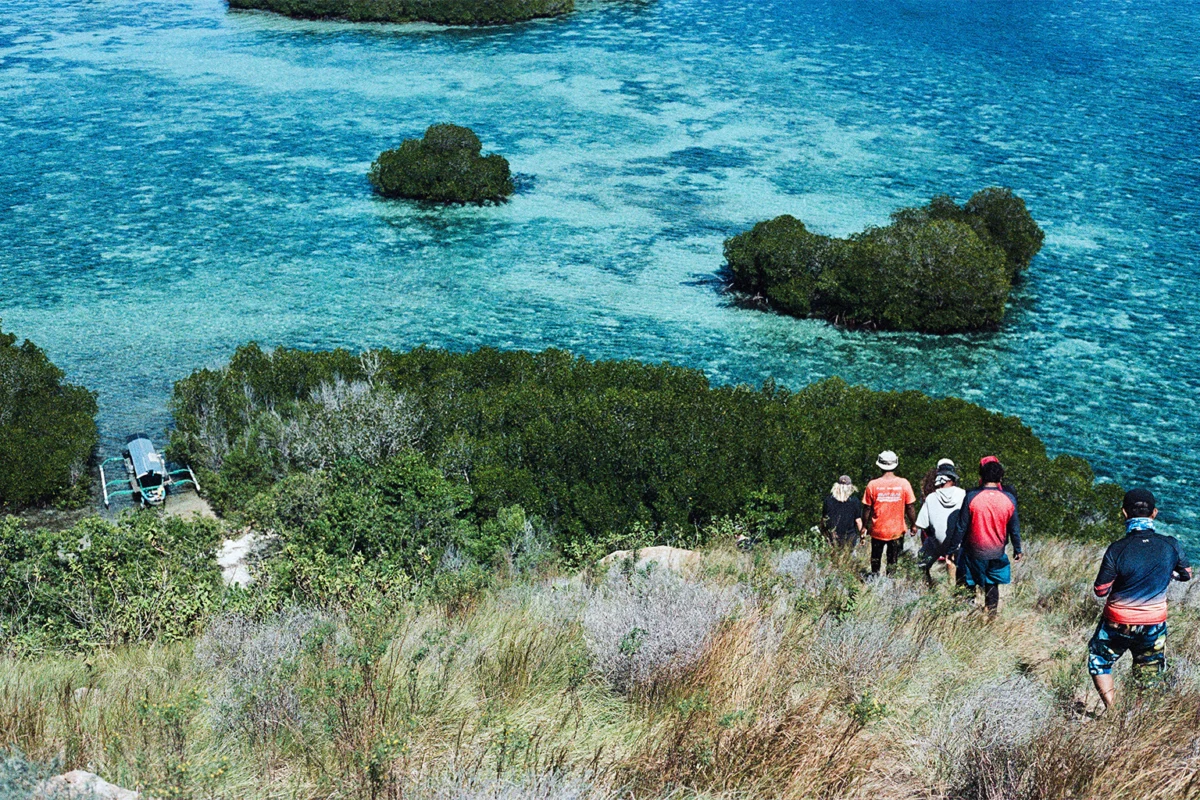
Off the glistening coast of Poto Tano, a small and weathered fishing community on Indonesia’s Sumbawa Island, Mahari sits at the bow of a wooden boat with a cigarette in hand, quietly surveying the shifting swells. As the ketua, or leader, of a localized collective of Bajau octopus fishers, Mahari’s experienced eyes determine the rhythm of the day. He reads the ocean not with modern sonar or GPS coordinates, but through an inherited literacy of stars, wind direction, air pressure, and tidal currents. Once he assesses the water visibility and current strength, he makes a silent, authoritative call that dictates whether his crew will deploy trailing shell hooks or dive directly into the reef using traditional freediving gear.

The Bajau people, widely recognized across Southeast Asia as maritime nomads, are an Indigenous ethnic group whose ancestral domain spans the coastal waters of Indonesia, Malaysia, and the Philippines. For generations, their existence has been inextricably linked to the sea. Historically living entirely on houseboats, the Bajau mastered the art of freediving, harvesting marine resources with minimal impact on fragile coral ecosystems. Today, however, their traditional way of life faces a complex crucible of modern economic pressures, devastating environmental degradation, and shifting regional regulations. In Sumbawa, a newly enforced provincial ban on compressor diving—a perilous technique that supplies divers with continuous surface air—has brought renewed value to ancient freediving wisdom. Through collaborative grassroots initiatives, senior fishers and local conservation groups are racing to ensure this deep ecological knowledge survives into the future.
Ancient Heritage Meets Modern Peril
The physiological adaptations of the Bajau have long fascinated the global scientific community. Renowned for their extraordinary breath-hold capacities, scientific studies have revealed that generations of diving have triggered genetic mutations in the Bajau, resulting in significantly enlarged spleens that store oxygen-rich red blood cells. Infants are introduced to the sea within their first week of life, learning to navigate marine environments with an intuition that bypasses modern navigational tools.

Despite this profound cultural heritage, recent decades have seen many Bajau fishers abandon traditional freediving in favor of compressor diving. Driven by the urgent need to support growing families amid rising living costs, fishers face immense financial incentives to maximize their daily catch. Compressor diving involves using improvised, unmonitored mechanical compressors on boat decks to pump air continuously through a narrow hose to a diver deep below. This allows fishers to descend to depths of 20 to 30 meters and remain submerged for hours, vastly increasing their harvest of high-value marine species like the day octopus (Octopus cyanea).
Yet, the human cost of compressor diving has been catastrophic. Unlike recreational scuba diving managed with strict safety protocols, local compressor diving in Indonesian artisanal fisheries operates entirely without decompression tables, safety checks, or proper training. The physiological consequences are severe and often permanent. Fishers routinely suffer from decompression sickness—commonly known as "the bends"—air embolisms, chronic joint pain, neurological damage, and severe paralysis.

Veteran fishers in Poto Tano bear the physical scars of this dangerous practice. Wandra, a local fisher, notes that many of his peers have been permanently disabled or killed by diving accidents. Another fisher, Well, confesses that he abandoned compressor diving only after suffering paralysis for a month at a time on three separate occasions. Mahari chillingly recounts enduring paralysis roughly 30 times throughout his career, describing a hazardous cycle of seeking emergency hyperbaric treatment only to return to the compressor out of economic desperation. Over time, prolonged exposure to artificial air supplies also degrades a diver’s natural breath-holding stamina, making the physical transition back to traditional freediving exceptionally difficult.
The Art of the Pocong and Sustainable Fisheries
Recognizing the escalating health crisis and the compounding destruction of local coral reefs, regional authorities and grassroots organizations have stepped in to curb illegal diving. In 2020, the West Nusa Tenggara provincial government enacted a formal ban on compressor diving. However, enforcement remains a formidable challenge. Conservationists note that illicit compressor diving frequently occurs under the cover of night, evading coastal patrols and continuing to threaten marine biodiversity.

To bridge the gap between conservation mandates and Indigenous livelihoods, the Jari Foundation—a marine management and ecotourism NGO operating across Lombok and Sumbawa—stepped in. Founded by Hani Nusantari and her husband, Boen, the foundation partnered with local fishers to establish PELITA (Persaudaraan Nelayan Gurita, or Octopus Fishermen Brotherhood). PELITA currently unites approximately 40 octopus fishers, many of whom have voluntarily transitioned away from compressor diving. Named after the traditional oil lamp (pelita) that once illuminated coastal homes, the group acts as a guiding light for sustainable stewardship, community solidarity, and ecological preservation.
Central to PELITA’s mission is the revitalization of traditional, highly selective fishing gear, most notably the pocong—an Indonesian word translating literally to "ghost." The pocong is a meticulously crafted, life-sized decoy resembling an octopus, carved from wood and adorned with fabric or felt strips that mimic the undulating motion of real tentacles.

When water visibility is high and currents are manageable, skilled Bajau freedivers descend 15 to 20 meters (50 to 65 feet) to the edge of the reef, gently jigging the pocong to provoke a territorial or curious response from wild octopuses. Because the live octopus will instantly recognize a fake if physical contact is made, the technique demands exceptional breath-hold control, agility, and precision. Consequently, only about ten fishers in the Poto Tano community possess the mastery required to use the pocong effectively, spearing or grabbing their prey by hand the moment it approaches. For conditions with poor visibility or strong currents, fishers deploy an alternative tool: a weighted shell adorned with hooks trailed behind a moving boat.
Community Stewardship and Rights-Based Management
The transition from destructive extraction to sustainable management extends beyond gear selection; it involves a fundamental shift in governance. Jari and PELITA have championed a rights-based fisheries management model inspired by successful frameworks in nations like Canada and Australia. Rather than imposing top-down restrictions that alienate Indigenous communities, this approach empowers local fishers to act as primary stewards of their marine environment.

In December 2025, persistent advocacy by Jari and local community leaders culminated in the approval of a village-level governance article granting Poto Tano local authority over its marine resources. This regulatory milestone allows fishers to implement traditional conservation practices legally. For instance, PELITA members routinely practice spatial management by closing two to three specific reef zones to fishing for several months at a time, allowing fish stocks and coral ecosystems to regenerate. Furthermore, fishers adhere to strict size limits, immediately releasing undersized octopus back into the water to ensure population sustainability.
Gender inclusivity has also become a cornerstone of this movement. In 2022, Hani Nusantari established Women for Marine Conservation (WMC) to broaden community participation. Today, women in Poto Tano play an active role in environmental education, community organizing, ecotourism operations, and the collection of vital fisheries data to monitor stock health over time.

Implications and the Horizon for the Bajau
While the path toward complete sustainability is fraught with economic uncertainties, the early indicators of community-led conservation are promising. Younger generations, having witnessed the devastating health impacts of compressor diving on their fathers and uncles, are increasingly rejecting the practice. Instead, youth involvement is surging in areas such as marine science, ecotourism guiding, and ecological monitoring. Plans are also underway to establish a dedicated Bajau cultural museum in Poto Tano to safeguard oral histories, storytelling traditions, and Indigenous ecological knowledge for posterity.
Ultimately, the future of the Bajau in Sumbawa hinges on a harmonious synthesis of ancient wisdom and modern scientific insight. By reclaiming their identity as sea nomads who protect rather than plunder the ocean, fishers like Mahari, Well, and Wandra are proving that indigenous ecological management offers a viable blueprint for marine conservation. As Mahari’s niece pursues formal studies in marine science, the community demonstrates that honoring the past and embracing contemporary science can successfully intersect to protect the reefs that sustain them for generations to come.








Leave a Reply