
Navigating the muddy, opaque waters of the Indus River basin requires a specialized set of evolutionary adaptations. Between 11 million and 16 million years ago, during the high sea levels of the middle Miocene epoch, the ancestors of the Indus River dolphin made their home in what is now modern-day Pakistan and northwestern India. Over millennia, these mammals underwent extraordinary biological transformations to survive in an increasingly turbid environment. Most notably, they developed sophisticated echolocation systems to hunt and navigate while gradually losing their eyesight entirely. Today, these "blind river dolphins"—scientifically designated as Platanista minor and locally known as the bhulan—exclusively navigate the river’s shallow, dry-season waters by swimming gracefully on their sides.
Yet, millions of years of evolutionary refinement have provided these aquatic mammals with little defense against the rapid, anthropogenic transformation of their freshwater habitat. The historical range of the Indus River dolphin has been slashed by an estimated 80%, largely due to a vast, complex network of human-made dams, irrigation canals, and water barrages that fragment the river system. Once boasting a robust population of roughly 10,000 individuals in the late 19th century, the species faced a catastrophic decline, plummeting to a fragile low of just 617 individuals by 2001.
However, a combination of dedicated legal protections, community engagement, and rigorous conservation science has sparked a cautious resurgence. A landmark 2025 study published in the journal Endangered Species Research documented a notable rebound, estimating the total metapopulation to have grown to 1,987 individuals. This figure represents a 19.4% increase between 2011 and 2017, proving that decades-old interventions—such as the outlawing of commercial dolphin hunting in the 1970s—have yielded tangible results. Currently, nearly 99% of the surviving global population is concentrated within a 690-kilometer (430-mile) stretch of the river between the Chashma barrage in Punjab and the Sukkur barrage in Sindh province.

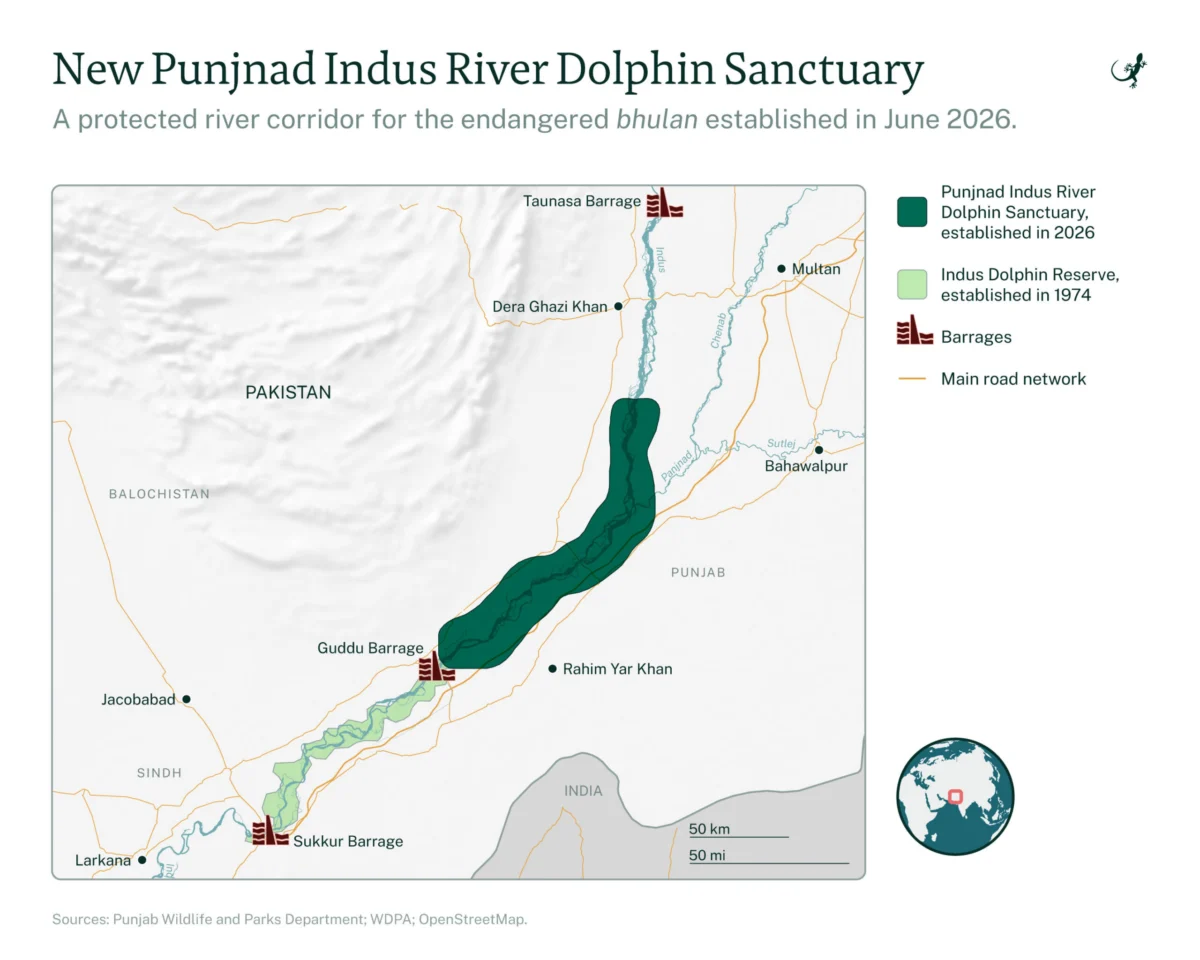
Recognizing the urgent need to secure this fragile momentum, the government of Pakistan officially established the Punjnad Indus River Dolphin Sanctuary in June 2026. This newly designated protected area safeguards nearly 200 kilometers (123 miles) of the Indus River within Punjab province. Crucially, the Punjnad sanctuary connects directly with an existing protected area in southeastern Pakistan’s Sindh province, creating a continuous 400-kilometer (249-mile) stretch of legally protected river habitat. This contiguous sanctuary provides a critical administrative and ecological lifeline to one of the rarest freshwater cetaceans on Earth.
Global Responsibility and Endemic Vulnerability
Conservation biologists emphasize that the survival of the Indus River dolphin rests almost entirely on the shoulders of Pakistan. Hamera Aisha, lead author of the 2025 Endangered Species Research study, underscored the localized nature of the species during an email interview with Mongabay.
"The Indus River dolphin is endemic to the Indus River system, and the overwhelming majority of the remaining global population occurs in Pakistan, with only a very small remnant population now left in the Beas River in India," Aisha noted. "This also means that if these populations were lost from the Indus, there is no comparable population elsewhere that could secure the future of the species. This gives Pakistan a unique global responsibility for the species."

Because the species is listed as endangered on the IUCN Red List, every administrative victory holds profound significance. Javed Mahar, conservator of the Sindh Wildlife Department, pointed out that the bhulan is affectionately known as "the Queen of the Indus River" and has long been protected under Sindh provincial wildlife legislation.
"Earlier, before construction of barrages and dams on rivers, it was found from Attock to the Indus delta, but its habitat shrinkage took place," Mahar explained. "The Government of Sindh during 1970 extended legal protection to this iconic species and declared the Indus Dolphin Reserve between Guddu and Sukkur Barrage. Similar steps were required from the other two provinces, including Khyber Pakhtunkhwa and Punjab."
Mahar views the newly established 123-mile protected stretch in Punjab as a vital and long-overdue continuation of Sindh’s conservation legacy. With experienced organizations like the World Wide Fund for Nature (WWF-Pakistan) maintaining an active presence and partnering with provincial authorities, wildlife officials expect more concrete, synchronized steps toward long-term population procreation.
Mitigating Fisheries Interactions and Commercial Pressures

Despite the encouraging population growth documented in recent years, conservationists warn that hard-won gains remain exceptionally fragile. Confined to a mere fraction of their historical range, the dolphins face a multifaceted matrix of modern threats, with commercial fishing practices presenting an immediate and lethal danger.
Data compiled between 2008 and 2023 reveals that gillnet entanglement accounts for 52% of all documented dolphin mortalities within the Indus Basin. Uzma Khan, a freshwater biologist with the World Wildlife Fund and co-author of the 2025 study, highlighted the unique regulatory challenges present in Punjab’s river sections.
"The river section in Punjab holds the second largest population of the Indus river dolphin," Khan explained. "Punjab auctions fishing contracts for commercial fishing, which means that a contractor would take as much fish as possible to make the contract economically feasible. This is detrimental to dolphins as mortality due to entanglements in fishing gear is one of the leading threats to river dolphins globally."
By establishing the Punjnad Indus River Dolphin Sanctuary, authorities hope to close a major regulatory loophole. While the older Guddu-Sukkur reserve in Sindh successfully curbed unregulated pressures, the upstream waters in Punjab lacked equivalent oversight. Aisha explained that the new sanctuary directly addresses these vulnerabilities by establishing a firmer legal foundation for monitoring human activities, regulating fisheries interactions, and coordinating emergency conservation responses.

Physical Fragmentation and the Canal Stranding Crisis
While administrative boundaries and legal decrees provide essential frameworks for law enforcement, the physical realities of the working Indus River present ongoing environmental management challenges. The riverine habitat remains severely fractured by an extensive system of water barrages constructed primarily to supply agricultural irrigation canals across the region.
These massive concrete barriers frequently trap dolphins in isolated subpopulations. Even more dangerously, shifting water levels often lure or sweep the animals out of the main river channel and into narrow, fast-flowing human-made irrigation canals.
For more than two decades, specialized rescue units operated by WWF and provincial wildlife departments have rushed to save dolphins stranded in these shallow irrigation channels. Rescuing these highly stressed, panic-stricken mammals typically requires physically restraining them, loading them onto transport vehicles, and driving them over rough, unpaved roads back to the safety of the main river.

While the new sanctuary connects 400 kilometers of river habitat under a unified legal banner, Aisha draws a sharp conceptual line between "continuity of protection and ecological connectivity." The sanctuary designation does not physically dismantle or alter the barrage infrastructure that fractures the ecosystem. Consequently, stranding incidents remain a persistent threat, particularly further downstream near Sukkur.
To counter this, the Punjab Wildlife and Parks Department plans to deploy additional field staff within the newly protected zone. Increased personnel will allow for more rigorous monitoring of dolphin movements, quicker response times to strandings, and safer river operations. Experts suggest that while removing the massive barrages is economically and logistically unfeasible, their daily operations could increasingly incorporate ecological flow considerations to minimize the risk of animals entering dangerous canals.
Broader Environmental Pressures: Pollution and Climate Change
Beyond the immediate hazards of fishing nets and concrete barriers, the wider Indus River ecosystem is under severe environmental strain from industrial contamination and global climate change.

Gold mining operations operating along segments of the river frequently utilize highly toxic chemicals, including mercury and cyanide. These pollutants leach directly into the water, poisoning the aquatic food web and accumulating in the tissues of fish and mammals alike. Furthermore, unmitigated climate change is aggressively altering regional precipitation patterns and accelerating the melting of Himalayan glaciers. This disruption threatens to destabilize the natural hydrological cycles, seasonal flooding pulses, and overall health of the Indus River system.
"Maintaining sufficient river flows and habitat quality is critical," Aisha stated. "Dolphins depend on adequate water depth, connected channels and deep pools, and healthy fish populations. Water abstraction and altered flow regimes are therefore directly relevant to dolphin conservation. Pollution from agricultural, municipal and industrial sources and now the plastic pollution also needs greater attention because it affects both dolphins and their prey."
The Path Forward: Community-Based Conservation
Securing a sustainable future for the bhulan requires more than top-down government mandates and legal enforcement; it demands the active, willing participation of the local river-dependent communities who share the ecosystem for their daily livelihoods.

"Communities are pivotal to the success of any conservation initiative," Khan emphasized. "Over years we have seen that traditional fishers have taken other jobs and sustenance fishing has been replaced by commercial fishing. This new protected area intends to encourage community based sustainable fishing and we will see new rules gradually shape up to ensure community involvement to provide that livelihood support."
To achieve this balance, conservationists advocate for science-based management plans that integrate local fishers through international frameworks such as the Conservation Assured | River Dolphin Standards (CA|RDS). In a working river where human populations, agricultural irrigation, commercial fisheries, and fragile biodiversity must all draw from the same finite water source, relying solely on punitive enforcement is insufficient.
The official notification and establishment of the Punjnad Indus River Dolphin Sanctuary stands as a monumental milestone, reflecting decades of tireless collaboration between provincial wildlife agencies, the federal Ministry of Climate Change, and conservation organizations such as WWF-Pakistan. Yet, as experts emphasize, this legal milestone marks a new chapter in conservation stewardship rather than a final destination.
"This notification is a welcoming development and will help in protecting the species," Khan concluded. "Hence, the responsibility of protecting the species lies on us!"









Leave a Reply