
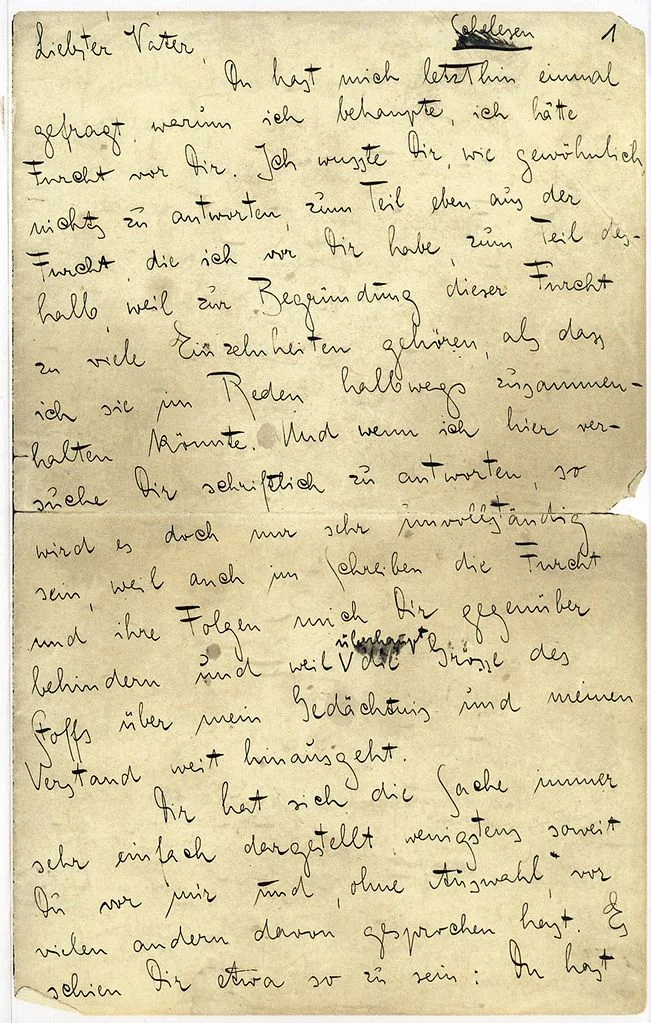
Franz Kafka, the iconic Prague-born novelist, remains one of the most profound chroniclers of existential anxiety and the human condition. While his literary legacy is defined by surreal masterpieces such as The Metamorphosis and The Trial, his personal correspondence—specifically a 47-page missive addressed to his father, Hermann Kafka, in November 1919—offers an unparalleled window into the psychological forces that shaped his work. This document, never delivered to the man for whom it was intended, stands today as a seminal case study in familial trauma, the mechanics of narcissistic power dynamics, and the long-term impacts of early-childhood emotional neglect.
Chronology of a Fractured Relationship
The genesis of the 1919 letter was not an isolated event but the culmination of three decades of mounting friction. Franz Kafka, born in 1883, grew up in a household dominated by his father, a self-made businessman who emerged from humble beginnings to establish a successful dry goods enterprise. Hermann Kafka’s worldview was anchored in the values of nineteenth-century patriarchs: physical strength, professional dominance, and a rigid, meritocratic belief that life’s hardships were merely obstacles to be overcome by willpower.

By 1919, the thirty-six-year-old author was at a breaking point. The primary catalyst for the letter was the dissolution of his engagement to Felice Bauer. Hermann Kafka had voiced intense, active disapproval of the union, viewing the relationship as a distraction from the family business and a threat to his son’s perceived stability. This intervention, compounded by years of subtle and overt criticisms, led to an estrangement that prompted Kafka to attempt a final, desperate act of communication. He wrote the letter in the hopes of bridging the chasm between them, though he simultaneously harbored the cynical awareness that the attempt was likely futile.
The Anatomy of Emotional Tyranny
In the text, Kafka deconstructs his father’s "intellectual domination" with surgical precision. He describes a childhood defined by an inescapable double standard: Hermann, as the absolute authority, felt entitled to judge, criticize, and dictate the terms of existence, while Franz, as the child, was stripped of agency.
One of the most harrowing anecdotes involves a night when a young Franz cried for water. Rather than offering comfort, Hermann dragged the boy from his bed, carried him to a balcony, and left him isolated in the cold. Kafka notes that while the physical act was brief, the psychological impact was permanent. It signaled to the child that he was a "mere nothing" in the eyes of his father. This incident serves as a primary example of how the "limbic contact" between parent and child—as understood by modern psychology—establishes the "wiring" for future emotional regulation. When that contact is characterized by erratic, aggressive, or dismissive behavior, the child often internalizes a chronic sense of guilt and fundamental wrongness.

Data and Psychological Implications
Contemporary psychological research into childhood trauma, particularly regarding parental narcissism, supports many of the observations Kafka made intuitively. The symptoms Kafka describes—a paralyzing fear of authority, the development of deep-seated self-doubt, and the manifestation of psychosomatic illnesses (such as the digestive issues and hypochondria that eventually accompanied his tuberculosis)—align with clinical patterns observed in individuals raised by authoritarian, narcissistic parents.
Sociological data on "self-made" patriarchs of the late 19th and early 20th centuries suggests that such figures often conflated their own professional success with an absolute, objective moral correctness. Kafka noted that for his father, "every opinion other than his own was mad, wild, meshugge, not normal." This environment created a "fun-house maze of mirrors" for the child, where reality was constantly distorted by the parent’s ego. The result, as Kafka articulated, was the destruction of the child’s capacity for independent thought and the stifling of his creative voice.
The Role of the Passive Parent
Kafka’s analysis extends to his mother, Julie Kafka, whom he characterizes as the "beater during a hunt." While she provided occasional warmth and respite, her unconditional devotion to Hermann rendered her an accomplice in the emotional environment. She lacked the independence to validate Franz’s suffering or to serve as a counterweight to the father’s influence. This dynamic is a frequent subject of study in family systems therapy, where the "enabling" parent is recognized as a crucial component in maintaining the toxic status quo, as they often inadvertently force the child back into the orbit of the abuser to maintain domestic harmony.

The Fate of the Missive and Its Literary Significance
Despite the letter’s profound depth and the meticulousness with which it was crafted, it never reached Hermann Kafka. Max Brod, Kafka’s lifelong friend and literary executor, recorded that the author handed the manuscript to his mother, hoping she would deliver it. Julie Kafka, perhaps recognizing that the letter would not change her husband but would only deepen the rift, returned it to her son.
The failure to deliver the letter underscores the inherent tragedy of the dynamic Kafka described: the child’s persistent, almost desperate need for paternal validation, juxtaposed against the parent’s inability to comprehend the child’s perspective. It remains a poignant example of the "compulsive effort" that victims of emotional abuse often undertake—the attempt to explain their reality to someone who is structurally and psychologically incapable of acknowledging it.
Broader Impact and Historical Legacy
Published posthumously in 1966, the Letter to His Father has since become a foundational text for understanding the intersection of biography and literature. It is not merely a record of personal grievance; it is a profound exploration of the power imbalance inherent in the patriarchal nuclear family structure of the Austro-Hungarian era.

The letter highlights the "Impostor Syndrome" that Kafka faced throughout his academic and professional life, born from the fear that his accomplishments were illegitimate and that he would eventually be exposed as a fraud. This internal conflict between the desire for independence and the weight of inherited guilt is a central theme in the literature of the twentieth century.
From a historical perspective, the document serves as an invaluable ethnographic record of the middle-class Jewish family experience in Prague during the turn of the century. It documents the transition from traditional, restrictive structures toward a more individualistic, albeit deeply conflicted, modern identity.
Conclusion: A Legacy of Resonance
The enduring power of the letter lies in its universality. Readers who have navigated similar dynamics with parental figures find in Kafka’s words a form of "shared reality" that provides validation for their own experiences. While the literary world celebrates Kafka for the nightmarish landscapes of The Castle or the alienation of The Trial, the Letter to His Father provides the essential, grounded truth of his life.

In his final reflections, Kafka noted that life is "more than a game of patience," suggesting that while his letter could not solve the puzzle of his relationship with his father, it served as an act of truth-seeking. By attempting to articulate the silence and the shame that had defined his youth, Kafka achieved a measure of clarity that allowed him to exist as a separate, albeit scarred, individual. Today, the document remains a testament to the necessity of finding one’s own voice, even when that voice is developed in the shadow of a dominant and disapproving authority.







Leave a Reply