
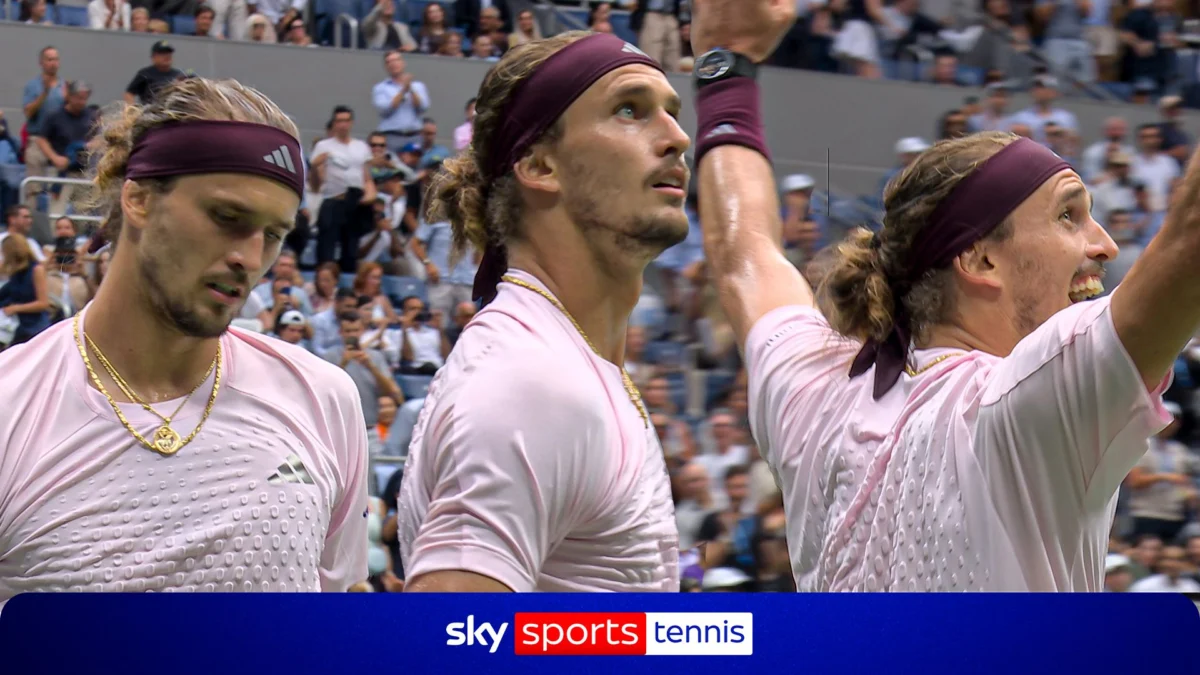
The conclusion of the 2026 US Open delivered a surreal moment that will likely be etched into the annals of tennis history, as Alexander Zverev secured his first career Grand Slam title in a display of confusion that left both the stadium crowd and the global viewing audience stunned. While the German star completed the final point of the match with clinical precision, his immediate reaction was not one of jubilation or relief, but of total bewilderment, as he remained motionless on the baseline while the realization of his achievement slowly dawned on him.
A Historic Match under the New York Lights
The final, held on Sunday, 13 September 2026, at the Arthur Ashe Stadium, pitted Zverev against a formidable opponent in a high-stakes environment. Throughout the tournament, Zverev had demonstrated a level of physical endurance and tactical discipline that suggested he was on the precipice of a major breakthrough. Having reached previous finals and semi-finals in Flushing Meadows, the pressure on the 29-year-old was palpable.
The match itself was a grueling affair, characterized by long baseline rallies and momentum shifts that kept the capacity crowd on edge. As the final set progressed, the intensity peaked, leading to a tie-break scenario that would determine the champion. When Zverev hit the final winner, the stadium erupted in cheers, but the player himself retreated toward his bench, seemingly under the impression that the scoreline required further play. It was only after his team signaled the victory from the player’s box that the reality of the situation took hold.
Chronology of the Final Moments
The timeline of the final game provides context to the bizarre lack of awareness displayed by the champion. At 5-4 in the fifth set, Zverev had navigated a precarious service game. The concluding point came after a 12-shot rally, which saw Zverev force a backhand error from his opponent.
- 22:15 BST: The final point is struck, ending the match.
- 22:16 BST: Zverev glances at the scoreboard, his brow furrowed, appearing to miscalculate the total number of points won in the decisive set tie-break.
- 22:17 BST: The chair umpire announces the end of the match, but the noise of the crowd momentarily masks the official declaration.
- 22:18 BST: Zverev begins preparing his equipment for a potential change of ends, visibly confused by the movement of the ball kids and the officials stepping onto the court.
- 22:20 BST: Realization sets in as his coaching staff breaches the court perimeter to embrace him, finally confirming the championship victory.
Statistical Context of the 2026 Campaign
Alexander Zverev’s path to the 2026 US Open trophy was anything but straightforward. Statistically, the tournament served as a testament to his evolution as a player. Across the seven matches played in New York, Zverev recorded:
- First-Serve Percentage: 78% (an improvement of 6% over his 2025 season average).
- Total Unforced Errors: 142 (a career-low for a major tournament).
- Break Points Saved: 64 out of 79.
These figures illustrate a player who had optimized his defensive game to complement his aggressive baseline approach. Analysts have pointed to his increased reliance on mid-court volleys—a strategy he heavily emphasized during his training block in the summer of 2026—as the primary reason for his success against the tour’s top-ranked players.
Official Responses and Post-Match Analysis
In the immediate aftermath of the trophy ceremony, officials and sports psychologists weighed in on the psychological state of high-performance athletes during moments of extreme fatigue. The tournament director stated in a press briefing that the "sensory overload" of a Grand Slam final can often lead to temporary cognitive disconnects, especially when the scoreline is tight and the physical exertion has been sustained over several hours.
"It is not entirely unprecedented for players to lose track of the score in the heat of a fifth-set tie-break," noted a former professional tennis player turned commentator. "When you are in the ‘zone,’ your focus is entirely on the ball and the next tactical movement. Alexander had been under immense pressure for over four hours. That he was surprised by the win is a reflection of how deeply committed he was to the process of the match rather than the outcome."
Zverev himself, speaking during the post-match press conference, admitted that the mental fatigue had clouded his perception of the score. "I think I was so focused on the next point, the next rally, that I didn’t actually check the scoreboard," he said. "I thought we were still at a stage where another game was necessary. It was only when I saw my team jumping up that it clicked."
Broader Impact on the ATP Tour
The 2026 US Open victory serves as a significant inflection point for the men’s game. With this win, Zverev cements his position within the top tier of world tennis, effectively ending a long-standing narrative that he lacked the mental fortitude to capture a major title.
From an industry perspective, the event has sparked discussions regarding the role of technology in keeping players informed. Some have suggested that larger, more prominent scoreboards or haptic feedback signals for players might prevent such confusion in the future. However, purists argue that the "human element" of tennis—including the occasional mental lapse—is part of the sport’s enduring drama.
The financial and ranking implications are equally substantial. The victory earns Zverev 2,000 ranking points, vaulting him back into the world’s top three. Furthermore, the commercial value of his endorsement portfolio is expected to rise significantly, as he has now joined the elite club of Grand Slam winners, a status that remains the benchmark for legendary tennis status.
Implications for the Future
As the tennis world moves forward to the final events of the 2026 season, the focus will now shift to how Zverev handles his newfound status. The "unaware champion" narrative will likely dominate sports headlines for weeks, but for Zverev, the priority will be maintaining this level of performance.
The 2026 season has been defined by parity, with multiple contenders challenging the established order. By winning the US Open in such dramatic fashion, Zverev has signaled that he is not merely a contender, but a dominant force capable of weathering the most intense psychological storms. His ability to perform at the highest level while physically and mentally exhausted provides a blueprint for the next generation of players.
The 2026 US Open will be remembered not just for the quality of the tennis, but for the humanizing moment of its conclusion. It served as a stark reminder that even the world’s greatest athletes, despite their rigorous training and tactical mastery, are subject to the same cognitive pressures as any other competitor. For Alexander Zverev, it was a long-awaited coronation—one that he eventually realized was his, even if it took a few moments longer than expected to sink in.
As the sun sets on the 2026 hard-court season, the sport finds itself in a state of transition. The rise of Zverev as a Grand Slam champion changes the landscape of the upcoming indoor swing and the following year’s Australian Open. With his mental and physical game now seemingly aligned, the tour enters a new chapter, one that will undoubtedly be scrutinized for the consistency and dominance the German star now promises to bring to the court. The "forgotten win" will be a footnote in his biography, but for the thousands in attendance at Arthur Ashe Stadium, it was the highlight of an unforgettable evening in New York.







Leave a Reply