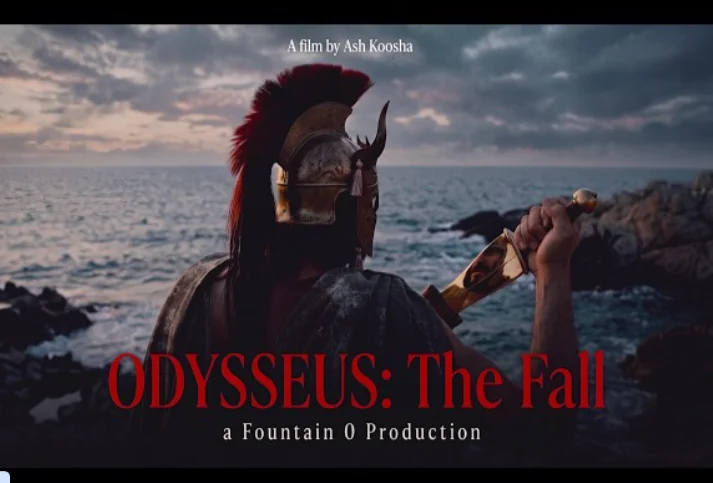
The film industry, often perceived as a bastion of tradition and meticulously crafted artistry, was recently jolted by an announcement that resonated with both awe and apprehension. Ash Koosha, an Iran-born, England-raised engineer, revealed his creation of a 135-minute AI-generated film titled Odysseus: The Fall. This ambitious project, inspired by Homer’s timeless epic The Odyssey, a work in the public domain, was met with immediate scrutiny, particularly as it emerged during a summer where Christopher Nolan’s own ambitious cinematic endeavor, also drawing from The Odyssey and reportedly costing $250 million, was generating significant buzz. The stark contrast in production scale – Koosha’s film produced for a fraction of Nolan’s budget and without human actors – immediately ignited a debate about the future of filmmaking and the role of artificial intelligence within it.
The revelation sent ripples through Hollywood and beyond, prompting questions about Koosha’s intentions and the broader implications of AI-driven content creation. The timing of the announcement was particularly poignant, occurring amidst a public discussion between Christopher Nolan and his frequent collaborator, actor Matt Damon, regarding the future of large-scale, analog filmmaking. Damon expressed a sentiment that this might be "the last chance I was going to have to do something like this," to which Nolan, ever the advocate for traditional cinematic practices, countered that Damon was being "defeatist." Koosha’s project, in this context, was perceived by some as not merely an alternative interpretation but an active acceleration of the very "end-of-cinema" moment Damon seemed to lament, using the very source material that was being championed as a bulwark against such a future.
This perceived provocation led The Hollywood Reporter to engage directly with Ash Koosha, his brother and collaborator Pooya Koosha, and their producer Tom Rogers, founder of CNBC and a co-founder of the AI-centric film production banner Fountain 0. Their aim was to elucidate their vision, which they acknowledge is both forward-thinking and, to some, undoubtedly unsettling.
A New World of Cinema: Koosha’s Perspective
Ash Koosha, when asked about the intense reaction since his announcement, described the period as one filled with "excitement, and a lot of questions, and a lot of confusion." He was quick to address the perception that his project was a direct challenge to Christopher Nolan’s work. "We’re not going against Christopher Nolan," Koosha stated. "He’s doing what he’s doing in the old world of cinema. And he does it brilliantly. But there’s room for something in the new world."
Koosha revealed a long-standing admiration for The Odyssey, stemming from his childhood. His initial encounter with the news of Nolan’s film came through a Reddit community dedicated to Homer. "I’ve been immersed in all the questions about all the details, like Agamemnon’s outfits and everything else," he explained. "My goal is not to make a movie that is the same as his. It’s to use the tools to make my own version of the story."
Dreams of Violet and Deeper Questions
The comparison to Koosha’s previous AI-driven film, Dreams of Violet, which debuted at Tribeca and garnered sympathy due to its subject matter – the recent Iranian democracy protests – was a natural one. Viewers found that film more palatable, perhaps due to the humanitarian urgency and the practical impossibility of filming in Tehran safely. However, Koosha sees a clear connection between the two projects, viewing Odysseus: The Fall not as a departure but as a progression.
"I see them as related," Ash Koosha explained. "Dreams of Violet raised questions and this raises deeper questions – questions that are important for the industry." He elaborated on these core inquiries: "’Can we have stories at the speed of news?’ ‘Can other people paint with tools besides people like Christopher Nolan?’ ‘What can be created if they can?’" These questions, for Koosha, are central to understanding the potential of AI in storytelling.
Tangential Filmmaking: A New Discourse Vehicle
The notion that Odysseus: The Fall might be a derivative work, akin to the "knockoff direct-to-video movies" that have proliferated in the blockbuster age, was firmly rejected by Koosha. He prefers to frame his approach as "tangential filmmaking."
"Not at all," Koosha asserted. "I see more as part of a larger news conversation. Before these AI tools if I had a theory about Odysseus I could write a Substack about him. And some people would read it but how many? Now I can put my take into a film. I can paint my opinion with images and sound and light. And a lot more people can see it."
This concept of "tangential filmmaking" was further elaborated upon by producer Tom Rogers. "Obviously it’s hard to be in the same arena as Christopher Nolan; everyone agrees his Odyssey is the superior film. And we want people to see that film. But hopefully they see ours too," Rogers said. He drew a clear distinction: "Christopher Nolan is the ultimate in physical filmmaking and what we’re trying to do is be the ultimate in AI filmmaking."
Ash Koosha echoed this sentiment, emphasizing the nascent stage of AI filmmaking. "You can’t judge them on the same terms. They’re at 125 years and we’re in our infancy. So of course there are going to be bumps in the road. But it’s what you can achieve by trying. To me the risk is low and the reward is high: a whole new kind of cinema."
Rogers highlighted the financial liberation offered by AI tools: "We’re just trying to show what’s possible when you don’t have to worry about budgets. We want people to see it’s not all slop."
Koosha’s Interpretation of Odysseus
When pressed on his specific take on Odysseus that his film aims to clarify, Ash Koosha offered a personal connection. "I don’t think he’s well-understood," he stated. "I don’t want to say too much but I think as someone who came from Iran and moved to the West as a child I can understand something about his story, about what it means to be far from home. How it wasn’t just about ego motivating him." This suggests a focus on the emotional and psychological journey of displacement and longing, perhaps a more nuanced portrayal than traditional interpretations.
A Deliberate Release Strategy
The Koosha brothers and Rogers indicated a strategic delay in the public release of Odysseus: The Fall. Pooya Koosha explained, "We want to wait a while, at least until late summer. We don’t want people to feel overloaded and confused. That’s important to us." Tom Rogers added, "We could have released it now but we’re not trying to trick people. We want them to be able to clearly compare." This approach underscores their intention to foster dialogue and allow for a thoughtful reception, rather than a hasty reaction.
The Democratization of Cinema: Echoes of the Early Web
The concept of "tangential filmmaking" drew parallels to the early days of the internet, when the advent of blogging challenged the dominance of established media outlets. "It’s a novel view and almost calls to mind the early days of the Web, when everyone started blogging and people said ‘but why would you want to read anything that isn’t from these big media outlets.’ And of course we did, and they co-exist," the interviewer noted.
Ash Koosha readily agreed with this analogy. "Yes, exactly. There is room for all kinds of cinema and AI finally makes that possible. We’ve had so many years when making cinema was dependent on having enough money, and unless you’re Christopher Nolan you couldn’t make a movie of a certain scale, and even he couldn’t sometimes. The concentration of revenue became a barrier to entry. All of that is going to go away. That’s what we’re trying to bring about."
Pooya Koosha expressed a hope for widespread adoption: "We hope a lot of other people come in and do this. This is about something very broad and democratic." Tom Rogers reiterated the mission of Fountain 0: "Yes, that’s the whole goal of Fountain 0 – to look for the best use of the tools."
The Future of Actors in an AI-Driven Landscape
A significant implication of AI filmmaking, particularly in projects that eschew human actors, is the potential impact on the acting profession. When asked about this, Tom Rogers offered a perspective that emphasized value enhancement rather than displacement. "I think this will make actors more valuable, whether it’s in an old-world movie or live theater. People will want to see them too, maybe even more than they do now."
This vision suggests a bifurcated future for cinematic content: one that continues to rely on traditional methods and the allure of human performance, and another that explores new frontiers of expression through AI, potentially freeing up human actors to focus on roles where their unique talents are indispensable.
A Vision of Co-existence
Ultimately, the Koosha brothers and Tom Rogers are not advocating for the eradication of traditional filmmaking but for its expansion and diversification. "That’s all we’re trying to do. To show you can make great films in the manner that Christopher Nolan does. But you can make gorgeous films using AI models too," Ash Koosha concluded. Their project, Odysseus: The Fall, is presented not as a replacement, but as a provocative and innovative addition to the evolving tapestry of cinematic storytelling, one that challenges established norms and opens the door to a future where the boundaries of creativity are increasingly defined by algorithms and imagination, rather than solely by budget and logistics. The dialogue initiated by their AI-generated "Odyssey" is likely to resonate for years to come, shaping conversations about art, technology, and the very definition of filmmaking in the 21st century.