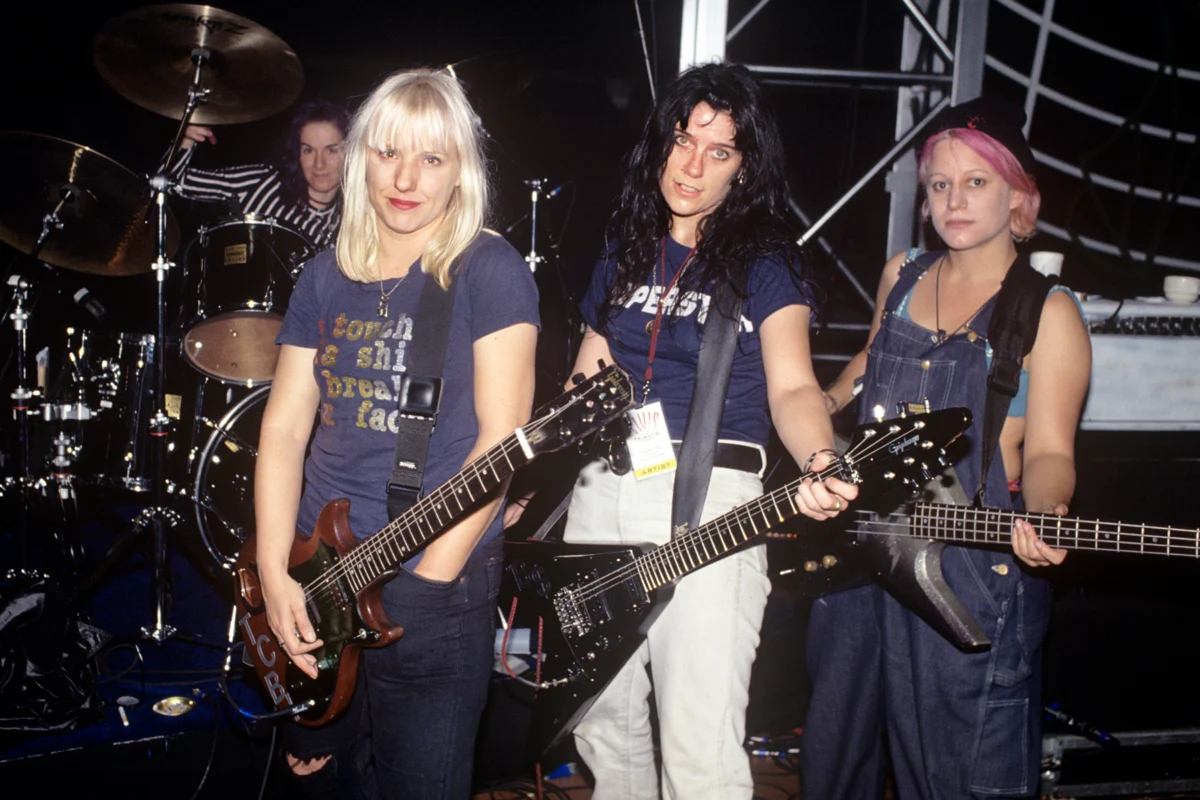
This story was originally published in the August 11, 1994 issue of Rolling Stone.
The Santa Monica beachfront at Gladstone’s, a legendary Los Angeles seafood institution, was the unlikely stage for a culinary and philosophical exchange with L7. The band, known for its raw, unapologetic punk ethos and potent feminist message, was in a celebratory mood, indulging in what vocalist Donita Sparks affectionately termed "Godzilla food" – platters overflowing with lobster, clams, mussels, and shrimp. "Ever since we signed to a major label, whenever we have any kind of meeting, we make them take us out for lobster," Sparks explained, her cheerful demeanor a stark contrast to the band’s ferocious stage presence.
The choice of Gladstone’s, a place often frequented by Hollywood’s elite, underscored L7’s unique position within the burgeoning alternative music scene of the mid-1990s. While grunge had exploded into the mainstream and the "riot grrrl" movement was gaining momentum, L7 remained firmly rooted in the DIY, fuck-you spirit of old-school punk rock. Their influences were clear: the Ramones, the Sex Pistols, and X, all channeling an inspired, insanely energetic sloppiness. This foundation fueled their sound, characterized by mean, squealing, subversive guitars wielded by Sparks and guitarist Suzi Gardner like potent weapons. Their lyrics, tough and uncompromising, championed a ferocious, Thelma & Louise-esque feminism, a sentiment encapsulated in the anthemic refrain of "Shirley," from their then-new album, Hungry for Stink.
"How many times must you be told/There’s nowhere we don’t go," the song proclaimed, a defiant declaration of their unyielding presence. The track sampled drag racer Shirley Muldowney’s iconic retort from the film Heart Like a Wheel: "Winning." L7 repeated the word, "Winning," over and over, a mantra that resonated with their own journey.
"It was so ironic, because in the beginning, we used to get a lot of questions like that," bassist Jennifer Finch recalled, referencing the implicit and explicit challenges women faced in male-dominated industries. "Woman in a man’s world, all that kind of crap." L7, however, was adamant about avoiding categorization. They weren’t "foxcore," nor were they simply "riot grrrls." Finch elaborated, "To create genre out of gender is just horrible to me. I think journalism perpetuates that. I hope the story angles for L7 will eventually be the same as for Nirvana or Cracker. There’s a uniqueness in being a woman, but not that much."
Despite their desire to transcend gender-based labels, L7 was not averse to using their gender as a tool of provocation. A notorious incident at England’s Reading Festival in 1992 saw Sparks remove her tampon onstage and toss it into the stunned audience. While Tampax never capitalized on the unconventional endorsement opportunity, pharmaceutical company Midol, whose cramp-relief products were listed on L7’s concert rider, did once send them a substantial box of free merchandise.
The band’s strength lay not just in their provocative actions or their fiercely independent music, but in their unwavering camaraderie. L7 operated as a cohesive unit, a professional sports team in spirit, united by cigarettes, politics, and a shared vision. There were no individual stars within the band; they eschewed solo interviews and photo shoots, communicating as a unified front, often finishing each other’s sentences and sharing an intricate web of inside jokes.
"Being misquoted happens to us a lot," Finch admitted, her tone tinged with suspicion as she questioned the origins of the interview. "Did you pitch this story, or were you assigned to it? Did you come out from New York just for this?" This protective stance was characteristic of a band that had fought hard for its autonomy and identity.
A History Forged in Punk Rock and Patronage
L7’s journey began in the mid-1980s, a period marked by a vibrant underground music scene in Los Angeles. They honed their craft practicing at the home of Maxine Nazworthy, the benevolent and free-spirited Max Factor heiress. Nazworthy acted as a crucial patroness, a "Medici" for a generation of L.A. punks, including bands like the Chemical People, Redd Kross, and Down by Law.
"It was funny driving to Beverly Hills to rehearse," Finch mused, highlighting the ironic juxtaposition of their punk sensibilities with their privileged rehearsal space. While Finch was the sole native Angeleno, Sparks and Plakas hailed from Chicago, and Gardner grew up in Sacramento. Gardner’s dissatisfaction with the local music scene in her hometown was a driving force behind her relocation. "All these losers that were in my hometown playing rock & roll, they didn’t have a clue," she stated. "I knew I had to get out."
Gardner’s past was also touched by a darker, more unsettling chapter of California youth culture, an experience that would later be immortalized in film. "Suzi was involved in the River’s Edge scandal," Sparks offered, referencing the 1987 film based on a true crime case. Gardner elaborated, " River’s Edge [the film based on a real case wherein a teenager murders his girlfriend, then takes his buddies to see the body] epitomizes that whole area and the kids I hung out with." The gravity of her proximity to such events was palpable when Gardner confessed, "I nearly was that body. I swear to God, I came, like, this close."
Fortunately, Gardner found a more constructive path, connecting with Sparks and eventually forming L7. After enduring a period of less-than-ideal bandmates, they found their final configuration with Finch and Plakas. The band’s early releases, including their 1988 self-titled debut on Epitaph and the 1990 Sub Pop EP Smell the Magic, built a loyal following. However, it was the 1992 album Bricks Are Heavy and its surprisingly commercial single, "Pretend We’re Dead," that propelled them into the mainstream, selling over 250,000 copies and marking a significant commercial breakthrough.
Their burgeoning success also led to an appearance in John Waters’ 1994 cult film Serial Mom, where they played the fictional band the Camel Lips. "Babes in Toyland couldn’t do it," Finch quipped, emphasizing their honor in participating. "We were honored to do it, ’cause we’ve been John Waters fans for a long time."
Hungry for Stink and Rock for Choice
As L7 prepared for a summer tour as part of Lollapalooza, the anticipation for Hungry for Stink was palpable. The album was lauded as a triumph of stripped-down energy over fleeting trends, a testament to the band’s enduring commitment to their raw sound. While the album featured occasional introspective tracks like "Andres," where Sparks showcased her remarkably expressive vocal range, from squealing to growling, it was the album’s pervasive defiance that truly resonated. "People like you just fuel my fire!" Sparks declared on "Fuel My Fire," backed by a rhythm section that was both assaultive and joyous.
The sentiment of "People Like You" extended beyond personal grievances, targeting what L7 perceived as oppressive political forces. Their primary political focus remained Rock for Choice, the pro-choice organization they co-founded in 1991. The band expressed hope that Rock for Choice would have a presence at the Lollapalooza festival, providing a platform for their activism.
"When we started Rock for Choice," Sparks explained, "one of the things that concerned us the most was that Bush was in office representing a huge contingent to take away women’s rights. Since then, we’ve moved on to other issues, more grassroots: Right now, Rock for Choice money is buying surveillance equipment and bulletproof vests for clinic workers, which run around $2,500 apiece."
Rock for Choice benefits had demonstrably raised significant funds for the Fund for the Feminist Majority. Sparks recalled a particularly impactful event in Pensacola, Florida, where a large show featuring Pearl Jam, despite its considerable production costs and heavy security demands insisted upon by local law enforcement in what she described as "good-old-boy territory," ultimately raised less money than anticipated. The threat of cancellation loomed if security requirements weren’t met.
Even with their growing fame, L7 remained unfazed by occasional hecklers at their shows. "There will be an occasional something like, ‘Show us your tits,’" Finch mimicked in a Beavis and Butt-head-esque tone, before adding with a wry smile, "But we’re the ones with a microphone. To battle us is ridiculous."
The Realities of Rock Stardom
Back at Gladstone’s, even the formidable pile of lobster leftovers met a pragmatic end. The band’s finances, while improved, hadn’t drastically altered their habits. Gardner lamented the extensive repairs needed for her 1973 Cadillac, while Plakas drove a bumper-sticker-adorned clunker. "My dad still drives us to the airport," Finch revealed. "He’s the band dad in a way, because he’s from here. But when we go to these guys’ towns, Suzi’s mom takes us to a buffet, and Dee’s mom cooks for us. Donita’s mom cooks for us."
Their international tours, particularly in support of Bricks Are Heavy in Brazil and Japan, offered a glimpse into their evolving public image. While initially novel, the intense adoration of fans, characterized by mobbing customs, proved to be a double-edged sword. "At first, it’s novel, and then it’s a pain in the ass," Gardner admitted. Brazilian fans, she noted, were particularly aggressive, a stark contrast to the more reserved Japanese fans who would patiently wait outside hotels. "In Brazil, they’ll rip your hair out," Plakas added, though Finch maintained that a calm request would usually suffice, a strategy that proved ineffective in Brazil due to language barriers. The pursuit by fans, even chasing their bus down the street for discarded cigarette butts, underscored the intensity of their global appeal.
Despite these challenges, L7’s newfound celebrity status had an unexpected side effect: increased confidence in interacting with other public figures. Finch recounted a peculiar encounter with Angelyne, the iconic Los Angeles billboard personality. Finch asked for an autograph and a message for Lollapalooza, only for Angelyne to claim she had just done an interview for "a Lollapalooza." The exchange, characterized by Angelyne’s obliviousness and Finch’s bemused reaction, highlighted the surreal nature of their celebrity encounters. Finch, reflecting on the interaction, found a strange kinship with Angelyne, humorously envisioning a future where L7, in 20 years, might resemble Angelyne and her pink Corvette.
L7’s journey, from their DIY punk roots and patronage by a wealthy heiress to their current status as a major label act playing Lollapalooza, was a testament to their resilience, unwavering commitment to their ideals, and their enduring ability to connect with audiences through raw, powerful music. They were, and remained, a force to be reckoned with, still hungry for stink and still fueling the fire of rebellion and empowerment.