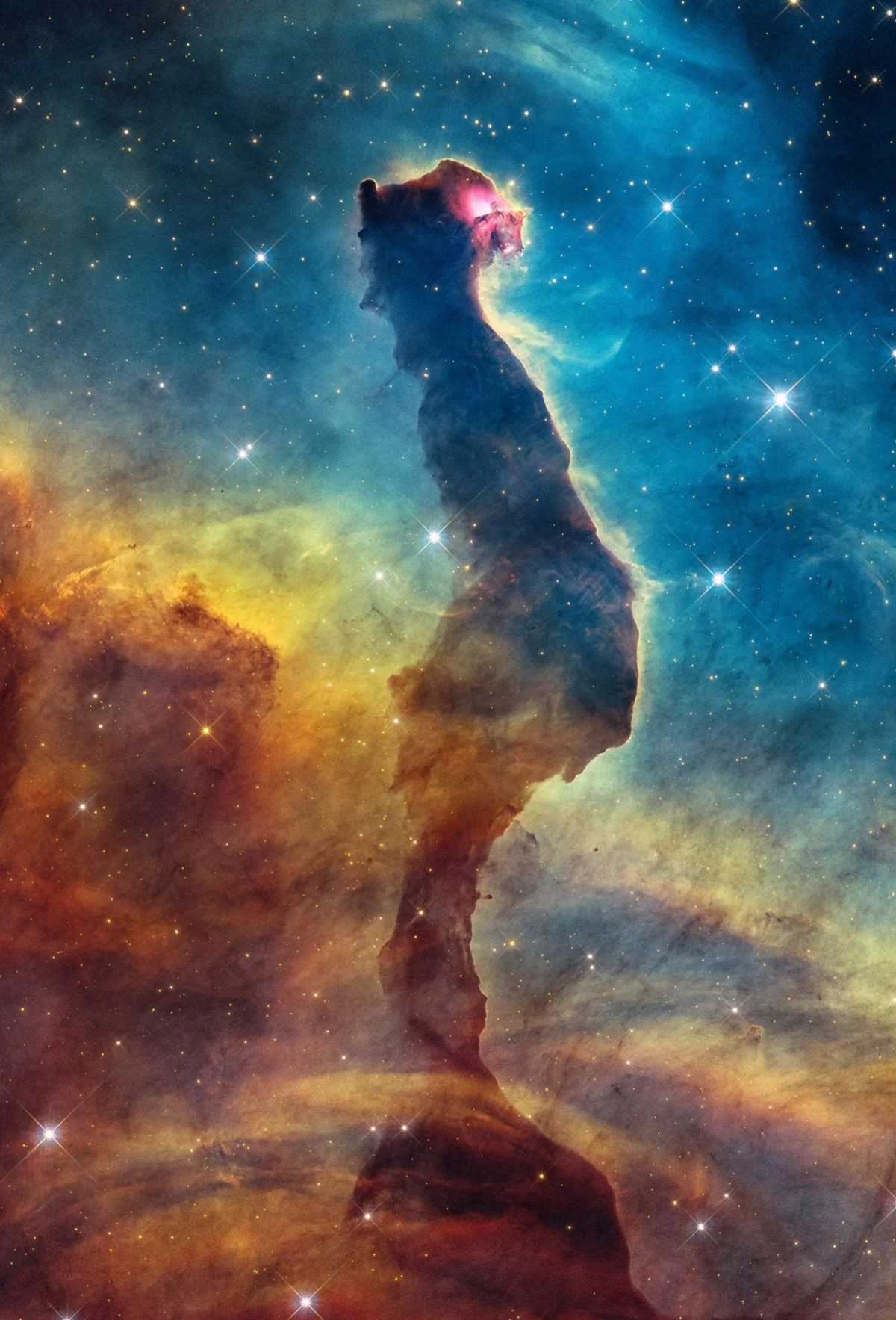
Deep within the luminous expanse of the Carina Nebula, located approximately 7,500 light-years from Earth, humanity’s most powerful space observatories have captured a celestial feature that bridges the gap between interstellar physics and terrestrial pop culture. Designated formally as a massive pillar of star-forming gas and dust, the structure has earned the affectionate moniker of the "Cat’s Head Nebula" due to an uncanny resemblance to a feline glancing backward over its shoulder. Newly released composite imagery from the Hubble Space Telescope and the James Webb Space Telescope (JWST) has provided astronomers and the public with an unprecedented, high-resolution look at this stellar nursery, revealing intricate details of ongoing star formation, cosmic dust dynamics, and the violent forces that sculpt our universe.
While the vast vacuum of space is famously silent—rendering the cosmic adage about screams and meows scientifically accurate—the processes occurring within this stellar cloud are remarkably dynamic. The Cat’s Head Nebula is not merely a static optical illusion; it is an active laboratory of stellar genesis. The formation of massive stars within such pillars represents one of the most fundamental chapters in galactic evolution, and the combined observational power of Hubble and Webb is allowing astrophysicists to peer through dense veils of dust that have historically remained hidden from optical instruments.
Main Facts and Observational Breakthroughs
The newly published images are the result of multi-wavelength observations coordinated between Hubble, which primarily captures ultraviolet, visible, and near-infrared light, and the James Webb Space Telescope, which specializes in high-resolution infrared astronomy. This technological synergy allows scientists to look past the superficial outer layers of the cosmic cloud.
The "feline" silhouette is defined by towering columns of cold molecular hydrogen gas and interstellar dust. At the heart of what appears to be the creature’s single, glowing red eye lies a young protostar, heavily embedded within its natal cocoon. This infant stellar object is currently gathering mass from the surrounding cloud while simultaneously emitting powerful stellar winds and radiation. These energetic outflows carve out cavities in the dust, creating the striking shapes that observers from Earth interpret as familiar anatomical features.
The Carina Nebula itself, within which the Cat’s Head resides, is one of the most extensive and active star-forming regions in our Milky Way galaxy. Spanning hundreds of light-years, it contains a multitude of massive stars—many of them several times more massive than our Sun—along with dense globuls of dust where new stellar systems are continually being born. The discovery and detailed imaging of structures like the Cat’s Head offer critical data points for understanding how these stellar giants influence their local environments through a process known as feedback.
Historical Context and Feline Legacies in Space
The informal naming of celestial objects after animals has a long tradition in astronomy, ranging from the Crab Nebula and the Horsehead Nebula to the Butterfly and Pelican nebulae. These monikers serve a dual purpose: they provide an accessible shorthand for complex coordinates while capturing the public imagination.
However, the intersection of felines and space exploration extends beyond stellar nomenclature into the annals of aerospace history. The most famous precursor to the Cat’s Head Nebula’s cultural resonance is Félicette, a stray Parisian tuxedo cat who, in October 1963, became the first and only feline to survive a suborbital space flight. Launched aboard a French Veronique sounding rocket, Félicette reached an altitude of approximately 100 miles (160 kilometers) before safely parachuting back to Earth. Her mission provided crucial neurological data regarding the effects of microgravity on mammalian vestibular systems during the space race era.
While Félicette paved the way for biological research in microgravity, modern astronomical tools like Hubble and Webb explore the cosmos on a grander, galactic scale. The juxtaposition of a cat’s journey to the edge of space six decades ago with the high-tech imaging of a cat-shaped nebula today underscores humanity’s enduring fascination with both the terrestrial animals that share our homes and the vast, mysterious cosmos that surrounds us.
Chronology of Discovery and Telescope Integration
The imaging of the Cat’s Head Nebula represents the culmination of decades of astronomical observation and engineering achievement.
- 1990: The deployment of the Hubble Space Telescope initiates a revolution in optical astronomy, providing the first ultra-sharp views of the Carina Nebula free from atmospheric distortion.
- 2000s–2010s: Hubble repeatedly targets the Carina region, capturing iconic images of the Mystic Mountain pillars and laying the groundwork for targeted studies of specific dust columns within the complex.
- December 2021: The successful launch of the James Webb Space Telescope marks the dawn of a new era in infrared astronomy, designed specifically to peer through the obscuring dust that blocks visible light.
- 2022–2024: As JWST completes its commissioning phase and begins routine science operations, researchers target complex star-forming regions to compare near-infrared and mid-infrared data with legacy Hubble archives.
- Present: The release of integrated composite images from both telescopes provides the scientific community with comprehensive datasets of the Cat’s Head Nebula, enabling detailed mapping of protostellar outflows and dust temperature distributions.
Supporting Data and Astrophysical Significance
To understand the scale of the Cat’s Head Nebula, one must examine the physical dimensions and environmental conditions of the Carina complex. Situated roughly 7,500 light-years away in the southern constellation Carina, the region is a hotbed of ultraviolet radiation and stellar winds.
The pillars of dust that form the nebula are composed primarily of molecular hydrogen ($H_2$) and silicate-based dust grains. These structures are remarkably resilient, acting as shields that protect the gas inside them from being instantly vaporized by the intense radiation fields of nearby massive stars, such as Eta Carinae. However, this protective environment is also temporary. Over millions of years, photoevaporation—the process by which ultraviolet light strips away and heats the outer layers of a gas cloud—will completely erode the pillar, dispersing the raw materials that would otherwise form future generations of stars.
Data from the James Webb Space Telescope’s Near-Infrared Camera (NIRCam) and Mid-Infrared Instrument (MIRI) have allowed astronomers to measure the temperature gradients within the Cat’s Head. By analyzing the infrared emissions of dust grains heated by embedded protostars, researchers can estimate the mass accretion rates of these infant stars. Initial findings suggest that the star acting as the nebula’s "red eye" is actively accumulating matter at rates significantly higher than average for stars of its class, making it a prime candidate for ongoing monitoring.
Official Responses and Expert Analysis
Astrophysicists and space agency representatives have highlighted the importance of multi-telescope collaborations in modern space science. Dr. Jennifer Wiseman, a senior project scientist for Hubble, noted in related mission briefings that combining the optical clarity of Hubble with the infrared capabilities of Webb is akin to giving astronomers both a magnifying glass and night-vision goggles.
"When we look at regions like the Carina Nebula through these two distinct lenses, we aren’t just taking pretty pictures," explained Dr. Marcus Vance, a stellar formation researcher unaffiliated with the direct imaging team. "We are mapping the life cycle of matter on a galactic scale. The structures we see—like this so-called Cat’s Head—represent the delicate equilibrium between gravitational collapse, which builds stars, and stellar feedback, which ultimately destroys the nursery."
The data extracted from these observations feeds directly into computational models designed to simulate star formation across the universe. By comparing the observed densities and temperatures in the Cat’s Head Nebula with theoretical predictions, scientists can refine their understanding of how molecular clouds collapse under their own weight.
Broader Impact and Implications for Future Research
The public release of the Cat’s Head Nebula imagery serves multiple functions within the broader scientific ecosystem. Beyond its immediate value to astrophysicists studying stellar feedback and protostellar evolution, it plays a vital role in public engagement and science communication. Engaging visuals anchored by relatable concepts—such as a cosmic feline—help demystify complex astronomical processes for audiences worldwide, fostering broader support for publicly funded space exploration.
Looking forward, the insights gained from studying localized star-forming regions like the Carina Nebula provide a baseline for interpreting observations of more distant galaxies. As the James Webb Space Telescope continues to peer deeper into the early universe, detecting the signatures of star formation in the primordial cosmos, understanding the microphysics of local pillars of gas and dust remains essential.
Ultimately, the Cat’s Head Nebula stands as a reminder of the universe’s capacity for both immense violence and delicate beauty. As observatories continue to scan the heavens, mapping the intricate architectures carved by gravity and starlight, humanity gains a clearer picture of its own cosmic origins—proving that whether we look back six decades to a stray cat in orbit or out across 7,500 light-years of interstellar space, our curiosity remains boundless.