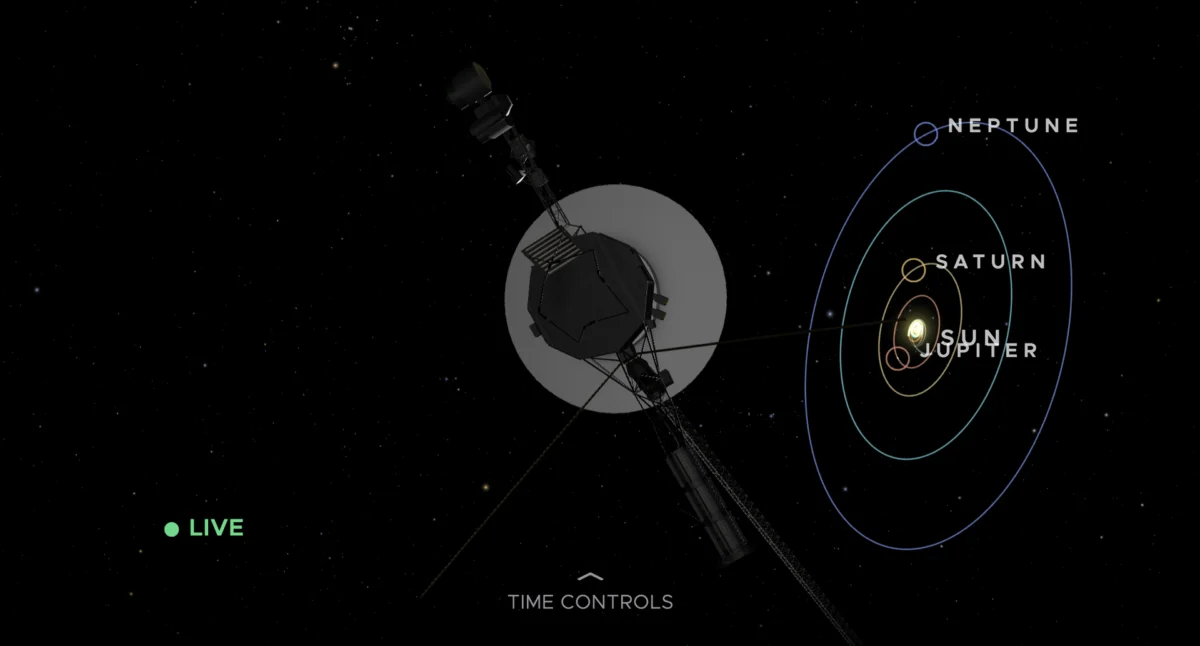
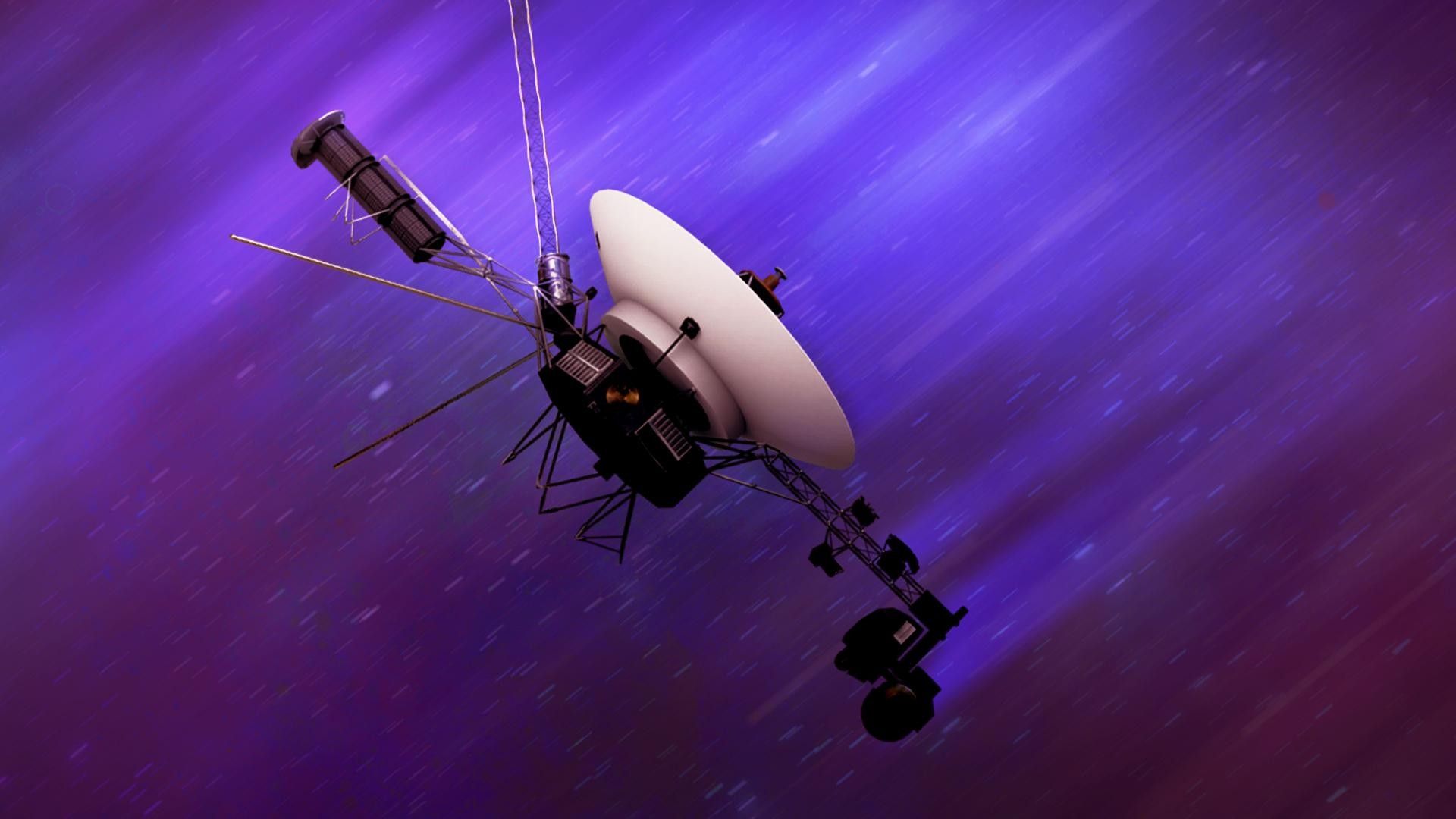
NASA’s Voyager 1 spacecraft is on the threshold of a profound astronomical milestone, cementing its status as the most distant human-made object in history. On November 18, the iconic probe will cross a boundary where the distance between it and our home planet will equal a full light-day. This means that a signal traveling at the absolute speed limit of the universe—approximately 186,282 miles per second (299,792 kilometers per second)—will require 24 hours to bridge the vast abyss separating the spacecraft from the ground stations of NASA’s Deep Space Network.
As the twin Voyager missions approach nearly half a century of continuous operation, this impending distance record serves as a powerful testament to the triumph of mid-20th-century aerospace engineering. Long after completing their primary planetary assignments, Voyager 1 and its sibling, Voyager 2, continue to function in the harsh environment of interstellar space, returning invaluable scientific telemetry that redefines humanity’s understanding of the heliosphere and its cosmic neighborhood.
Anatomy of an Interstellar Journey
Launched on September 5, 1977, just weeks after its twin Voyager 2, Voyager 1 was designed to take advantage of a rare geometric alignment of the outer planets. This planetary grand tour allowed the spacecraft to use gravity-assist maneuvers, swinging past Jupiter in 1979 and Saturn in 1980. These monumental flybys revolutionized planetary science, providing the first detailed, close-up imagery and atmospheric data of the gas giants, their complex ring systems, and their diverse moons.
Following its encounter with Saturn and Saturn’s massive moon Titan, Voyager 1 was deflected on a trajectory northward out of the plane of the planets. While Voyager 2 continued onward to explore Uranus and Neptune, Voyager 1 headed outward toward the boundary of the solar system.
In August 2012, analysis of plasma data confirmed that Voyager 1 had officially crossed the heliopause—the invisible boundary where the solar wind pressure from our sun is overpowered by the pressure of the interstellar medium. This monumental transition marked the moment humanity’s first emissary stepped out of the sun’s protective magnetic bubble and entered the pristine, uncharted waters of interstellar space.
The Chronicle of Communication at the Edge
Operating a spacecraft that is one light-day away introduces staggering engineering and operational hurdles. Communication with Voyager 1 is no longer a matter of real-time troubleshooting; it is a slow, methodical interstellar dialogue.
Because radio waves take a full 24 hours to travel outward to the spacecraft, mission controllers at NASA’s Jet Propulsion Laboratory (JPL) in Pasadena, California, must wait 48 hours for a complete round-trip confirmation of any command sent. If an anomaly occurs, engineers cannot intervene instantly. They must diagnose the issue from yesterday’s telemetry, calculate a fix, transmit the commands, and wait another full day to see if the spacecraft successfully executed the instructions.
Power management is another compounding challenge. Both Voyager probes are powered by radioisotope thermoelectric generators (RTGs), which generate electricity from the natural radioactive decay of plutonium-238. As the decades have passed, the output of these plutonium heat sources has steadily decreased—dropping by roughly four watts every year.
To compensate for this dwindling energy supply, mission engineers have systematically turned off non-essential systems, including heaters, scientific instruments that are no longer useful in interstellar space, and engineering monitors. Despite these stringent power-saving measures, both spacecraft continue to operate select scientific instruments, measuring magnetic fields, plasma densities, and cosmic rays at the very edge of the solar bubble.
Scientific Implications of Deep Space Telemetry
The ongoing survival of Voyager 1 provides researchers with an unprecedented, in-situ laboratory to study the interstellar medium. Before the Voyager probes crossed the heliopause, scientists relied entirely on indirect observations to theorize the nature of space between the stars.
Data transmitted across billions of miles has revealed unexpected characteristics of the local interstellar medium. For instance, instruments aboard Voyager 1 have measured the density of interstellar plasma, discovering that it is significantly denser than previously predicted. Furthermore, the spacecraft has provided crucial insights into how the heliosphere interacts with the galactic wind, shielding the inner solar system from hazardous galactic cosmic rays.
Space scientists emphasize that the value of the Voyager mission lies not only in its groundbreaking discoveries, but in its longevity. No other spacecraft has ever sampled this region of space over such a prolonged period. The continuity of the data allows researchers to observe long-term solar cycles and how they propagate far beyond the orbits of the outermost planets.
Official Perspectives and Heritage
For the generations of scientists, engineers, and space enthusiasts who have dedicated their lives to the Voyager program, the upcoming one-light-day milestone is deeply emotional. Many of the original designers and builders have passed away, leaving the stewardship of the probes to a younger cohort of scientists who were born long after the spacecraft left Earth.
"The Voyagers represent a golden era of exploration and a masterclass in spacecraft durability," noted a representative tracking the mission’s telemetry operations. "When these probes were launched, computing power was minuscule compared to modern standards, yet the hardware was built with such rigorous redundancy and robust engineering that it continues to outlive its creators’ highest expectations."
NASA officials and mission operators continue to monitor the health of the aging spacecraft closely. Every successful transmission received from Voyager 1 is viewed as an extraordinary bonus, stretching the boundaries of what humanity ever thought possible for a machine.
The Broader Impact and Future Outlook
As Voyager 1 continues its lonely voyage through the galaxy, its speed—traveling at roughly 38,000 miles per hour (61,000 kilometers per hour) relative to the sun—carries it steadily deeper into the cosmos. While the spacecraft will eventually run out of electrical power entirely, likely sometime in the 2030s, its journey will not end with the cessation of its radio signals.
Long after its instruments fall silent and its transmitters go dark, Voyager 1 will continue to drift through the Milky Way for millions, if not billions, of years. Aboard the spacecraft is the famous Voyager Golden Record—a 12-inch gold-plated copper phonograph disk designed to communicate the story of our world to any extraterrestrial intelligence that might intercept it. Containing spoken greetings in 55 languages, musical selections ranging from Bach to Chuck Berry, and natural sounds of Earth, the record serves as a time capsule of human civilization.
Reaching the one-light-day milestone on November 18 is more than a numerical curiosity; it is a physical manifestation of humanity’s reach. It stands as an enduring monument to curiosity, perseverance, and the relentless human drive to explore the unknown reaches of the universe.