
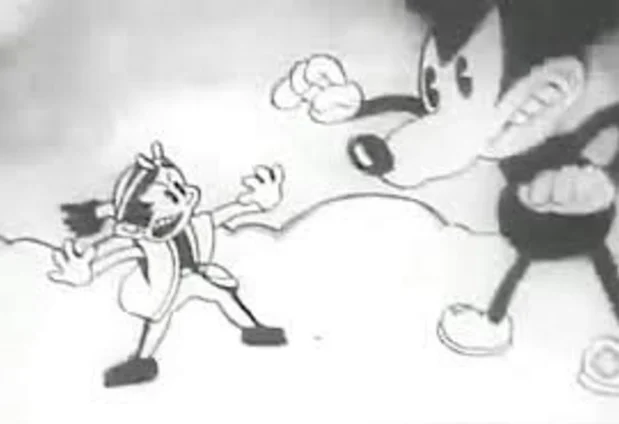
Long before modern Japanese culture embraced Disney’s iconic characters, Mickey Mouse was depicted in Japanese media not as a beloved icon of entertainment, but as a symbol of American imperialist aggression. This striking historical irony is captured in a 1934 animated propaganda short titled Omochabako series dai san wa: Ehon senkyahyakusanju-rokunen, which translates to Toybox Series 3: Picture Book 1936. Created by pioneering animator Komatsuzawa Hajime, the short film offers a fascinating window into the escalating geopolitical tensions of the interwar period, using early animation as an ideological battleground between Western cultural influence and traditional Japanese folklore.
Main Facts and Narrative Overview
The plot of Komatsuzawa’s animated short is deceptively simple yet laden with political symbolism. The story begins on a peaceful island inhabited by various cute, defenseless creatures, including a character closely resembling Felix the Cat. This tranquil setting is suddenly shattered by an aerial invasion led by an army of Mickey Mice riding on the backs of bats. The invading horde is further reinforced by crocodiles and snakes that function crudely as military machine guns, wreaking havoc on the idyllic landscape.
Faced with overwhelming force, the frightened island inhabitants turn for salvation to the legendary heroes of Japanese storybooks and folk tradition. Iconic figures spring to life to defend their realm, including Momotaro (the "Peach Boy"), Kintaro (the "Golden Boy"), Issun-boshi (the "One Inch Boy"), and Benkei, the legendary warrior monk. Together, these cultural champions successfully rout the Mickey Mouse army, sending the American icon packing.
The underlying subtext of the cartoon is unmistakable: while America might view Mickey Mouse as a triumphant modern hero, Japanese folklore offers a pantheon of characters that are older, more numerous, and deeply embedded in a rich cultural heritage. Through this narrative, the animation asserts the profound depth and longevity of Japanese popular culture against the perceived encroaching tide of Western commercialism and hegemony.
Chronology and Geopolitical Context
To fully understand the creation of Toybox Series 3, one must examine the geopolitical climate of the mid-1930s. Although the animated short was produced in 1934, its narrative is specifically set in the year 1936. Historians and film analysts suggest this specific year choice is directly tied to the scheduled expiration of major naval disarmament treaties between the United States and Japan, namely the Washington Naval Treaty and the London Naval Treaty.
As these treaties approached their expiration dates, the global diplomatic framework governing naval power in the Pacific began to collapse. Japan sought regional hegemony in Asia, while Western powers, particularly the United States, viewed Japanese territorial expansion with increasing alarm. Although the catastrophic military confrontation at Pearl Harbor was still seven years away, cultural and political friction between the two nations was already intensifying significantly. Animation and popular media frequently served as early indicators of hardening national sentiments.
Artistic Tropes and Animation Evolution
Beyond its obvious political messaging, the film utilizes several notable artistic tropes that highlight the cross-cultural exchange of animation techniques during the 1930s. The premise of characters stepping out of the pages of a storybook to interact with the real world was a popular storytelling device of the era. Similar motifs would be embraced by American animation studios, most notably Warner Bros., in various cartoons released later in the decade.
Furthermore, the resolution of the conflict in Komatsuzawa’s film reflects traditional folkloric motifs rather than conventional martial victory. Mickey Mouse is ultimately dealt with not through brute physical force, but through a combination of magic, folklore, and derisive laughter. The climax features a character modeled after Rip Van Winkle—a figure who, in Japanese folklore, is aged prematurely by opening a forbidden box. Following this magical intervention, the characters conclude the conflict with song and mockery. In the grim reality of geopolitics, however, international conflicts would not resolve with such whimsical ease.
Broader Impact and Historical Implications
The existence of Toybox Series 3 challenges modern assumptions about global cultural diffusion. Today, Tokyo Disney Resort and extensive consumer affinity for Disney properties highlight a deeply integrated cultural relationship between Japan and the United States. However, the 1930s represent a transitional phase where the global spread of American mass media was met with fierce nationalist resistance in countries positioning themselves as rival imperial powers.
Animation historians view works like Komatsuzawa’s short as precursors to the heavily state-sponsored wartime propaganda films that would emerge across the globe during World War II. Just as American studios later mobilized characters like Donald Duck and commercial icons for Allied war bonds and anti-fascist messaging—exemplified by works such as Der Fuehrer’s Face—Japanese studios during the 1930s and 1940s utilized domestic folklore to fortify national identity against foreign cultural and military threats.
Ultimately, Toybox Series 3 stands as a remarkable artifact of early animation history. It captures a fleeting moment when the world’s most famous cartoon mouse was cast not as a harbinger of global joy, but as the vanguard of an encroaching foreign empire, stopped only by the timeless guardians of Japanese myth.










Leave a Reply