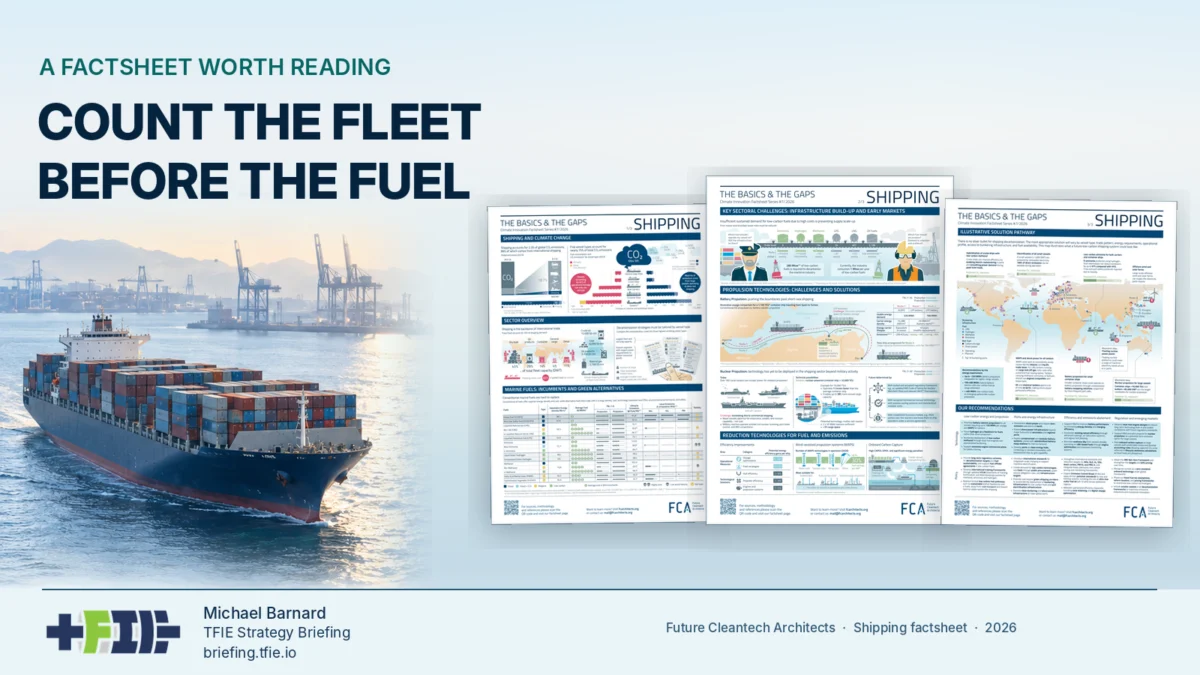
Future Cleantech Architects (FCA), a German-based nonprofit think tank, has addressed this information vacuum with its October 2026 shipping factsheet. Designed as part of the "The Basics & The Gaps" series, the document provides a distilled, high-density overview of the marine energy landscape, aiming to assist policymakers in navigating a transition that is as much about infrastructure as it is about engine technology.
The Complexity of Maritime Decarbonization
The maritime sector does not face a "silver bullet" solution. Unlike the automotive industry, which has seen a relatively rapid pivot toward battery electric vehicles, shipping must contend with immense variations in vessel size, route length, and operational requirements. A short-sea ferry operating in European waters has vastly different power density and refueling needs compared to an Ultra Large Container Vessel (ULCV) traversing the Pacific.
FCA’s new guidance highlights the primary contenders for the future fuel mix:
- Biofuels and Synthetic Fuels: These are often viewed as "drop-in" replacements, yet they face significant constraints regarding production scalability and feedstock availability.
- Ammonia and Hydrogen: While promising zero-carbon tailpipe emissions, both present significant safety challenges—ammonia is highly toxic, and hydrogen requires massive storage volume due to its low energy density.
- Methanol: Increasingly favored by early adopters for its relative ease of handling, though its climate credentials depend entirely on whether it is produced via green hydrogen or fossil-based feedstocks.
- Wind and Battery Assistance: Technologies that provide efficiency gains but cannot, on their own, power the long-haul voyages that define global trade.
Chronology of the Factsheet Development
The development of this resource reflects a growing trend toward rigorous, peer-reviewed transparency in the cleantech sector. In July 2026, FCA circulated a draft of the factsheet to industry stakeholders and independent analysts. To ensure the highest level of technical accuracy, the organization commissioned TFIE Strategy to conduct an independent peer review.

The review process identified critical areas for improvement, specifically regarding how readers might interpret data across different system boundaries. For instance, the original draft struggled to adequately compare technologies at vastly different maturity levels—such as the difference between a mature, conventional engine and an experimental carbon capture system. By the time of the October 2026 publication, these nuances had been integrated, providing a more balanced view that differentiates between theoretical capability and commercial viability.
Supporting Data and Technical Nuances
A significant portion of the FCA report focuses on the lifecycle emissions of various fuels. The report distinguishes between LNG (Liquefied Natural Gas) and LPG (Liquefied Petroleum Gas) as fossil-derived fuels, challenging the notion that they serve as long-term decarbonization solutions. By highlighting the risks of methane leakage—a potent greenhouse gas—FCA provides policymakers with the evidence needed to distinguish between bridge fuels and true zero-emission alternatives.
Perhaps most notably, the report challenges the industry’s reliance on "short-haul" electrification examples. By modeling a 1,100 TEU container ship on a route between Spain and North Africa, FCA moves beyond the "ferry-only" narrative for batteries. This case study demonstrates that while battery-electric or hybrid solutions are gaining ground in regional shipping, the infrastructure requirements—such as high-capacity shore power and modular battery swap stations—remain a significant barrier to entry.
Official Perspectives and Industry Implications
The publication of this factsheet comes at a time when shipping companies are facing a "wait and see" dilemma. With massive capital investments in vessels lasting 20 to 30 years, owners are hesitant to commit to a specific fuel pathway for fear of choosing a stranded asset.
Industry analysts suggest that the FCA approach provides a much-needed framework for capital allocation. By standardizing the metrics for toxicity, lifecycle emissions, and cost, the factsheet allows stakeholders to compare disparate technologies on a level playing field. "Policymakers considering infrastructure subsidies need to understand these differences before treating a nominally alternative fuel as a climate solution," noted one analyst associated with the review.

Furthermore, the FCA website introduces a forward-looking question that is poised to dominate the discourse in 2027 and beyond: How much fuel will the fleet actually require in a decarbonized future? This question moves beyond the simple substitution of fuel and into the realm of system efficiency. If the global fleet adopts wind-assisted propulsion, slows down to increase fuel efficiency, or utilizes more efficient port operations, the total demand for liquid alternative fuels may be lower than current "drop-in" projections suggest.
Broader Impacts and Policy Guidance
The implications of this research are twofold. First, for national and regional governments, the factsheet serves as a diagnostic tool. It helps prioritize public spending on port infrastructure—such as bunkering for ammonia versus charging stations for electricity—based on the specific geographic needs of the region.
Second, for the private sector, the document underscores the difference between demonstrated emissions reductions and theoretical potential. As shipping companies report their ESG (Environmental, Social, and Governance) targets, they are increasingly being held accountable for the source of their energy. The FCA report provides the necessary transparency to ensure that firms are not inadvertently "greenwashing" by utilizing fuels that, when accounting for full lifecycle emissions and methane slip, offer negligible benefits.
Conclusion
The maritime transition is moving from an era of vague promises to an era of technical implementation. As the shipping industry approaches the 2030 milestones set by the IMO, the need for high-quality, synthesized data becomes paramount. Future Cleantech Architects has successfully bridged the gap between complex engineering research and the pragmatic needs of policy and investment. By focusing on the "basics and gaps" of marine propulsion, the organization has provided a roadmap that emphasizes caution, efficiency, and the necessity of distinguishing between true zero-carbon solutions and transitional fossil-fuel-based alternatives. As the industry continues to evolve, resources of this nature will be essential for ensuring that the massive capital shifts required to decarbonize the global supply chain are directed toward sustainable, long-term technological success.