

Global health ministers gathered in Rio de Janeiro for a pivotal G20 meeting chaired by Brazil, delivering a unified endorsement of the World Health Organization’s (WHO) landmark Investment Round. As the international community grapples with compounding health crises, climate-induced epidemiological shifts, and post-pandemic economic recovery, the ministerial assembly underscored the critical need for sustainable, predictable, and flexible financing. The meeting served as a vital stepping stone toward the upcoming G20 Leaders Summit, where final financial pledges are anticipated to shape the trajectory of global health security for the next four years.
The push for financial sustainability comes at a time when the WHO is operationalizing its Fourteenth General Programme of Work (GPW 14), a comprehensive strategic blueprint designed to address emerging health threats, reinforce primary healthcare systems, and drastically reduce preventable mortality on a global scale. By rallying international stakeholders, the G20 health track aims to bridge the perennial gap between the organization’s expansive mandate and its historically fragmented funding structure.
Main Facts and Core Developments
During the high-level convening in Rio de Janeiro, health ministers from the world’s leading economies addressed the systemic vulnerabilities that have historically plagued international health governance. The central agenda item was the WHO Investment Round—a novel financing mechanism intended to mobilize resources for the 2025–2028 strategy cycle.
The primary objectives of this financial mobilization are ambitious yet quantifiable: to improve the health and well-being of billions of people globally and to save an estimated 40 million lives over the strategy period. To achieve these targets, the WHO is seeking predictable voluntary contributions that complement assessed contributions (member state dues), allowing the agency to respond rapidly to disease outbreaks, maintain routine immunization schedules, and support fragile health systems without being hamstrung by earmarked donor preferences.
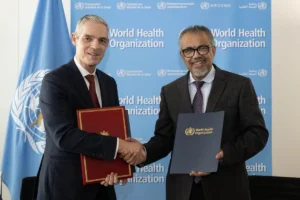
The urgency of the meeting was underscored by WHO Director-General Dr. Tedros Adhanom Ghebreyesus, who updated delegates on the progress of the fundraising campaign. Dr. Tedros announced that the organization has secured 63 distinct pledges amounting to more than one billion US dollars. Significantly, more than half of these commitments originate from first-time voluntary contributors, demonstrating a broadening base of international ownership. These include notable contributions from nations across the African, Western Pacific, and South-East Asian regions.
“Every contribution counts,” Dr. Tedros stated during the proceedings. “Some of the world’s poorest countries have pledged, because they see first-time and first-hand the difference that WHO makes on the ground.”
Among the prominent nations and institutions that have formally announced contributions prior to or during the Rio de Janeiro meeting are Germany, Norway, Singapore, South Africa, Türkiye, the European Union, and the Wellcome Trust. These early commitments are viewed by international relations experts as a critical anchor, providing momentum as the diplomatic focus shifts toward the Leaders Summit.
Chronology and the Path to the G20 Leaders Summit
The endorsement in Rio de Janeiro is the culmination of months of diplomatic groundwork and structural reform within the global health architecture. The timeline leading up to the November summit highlights a deliberate effort by successive G20 presidencies to institutionalize health security as an economic and geopolitical imperative.
- May 2024: The Seventy-seventh World Health Assembly formally supports the operationalization of the Investment Round, establishing the framework for mobilizing resources for GPW 14.
- July 2024: Preparatory technical meetings under the Brazilian G20 presidency begin mapping out sustainable financing mechanisms for multilateral health institutions.
- September 2024: Regional consultations scale up, encouraging low- and middle-income countries to participate in the funding round according to their respective means.
- October 2024: The G20 Health Ministers Meeting in Rio de Janeiro convenes, resulting in explicit political commitments to back the Investment Round.
- November 18–19, 2024: The G20 Leaders Summit, chaired by Brazilian President Luiz Inácio Lula da Silva, is scheduled to take place in Rio de Janeiro, where heads of state are expected to finalize their national pledges.
- 2025–2028: The implementation phase of the WHO’s Fourteenth General Programme of Work, backed by funds secured during the Investment Round.
This chronological progression reflects a strategic shift from crisis-driven emergency fundraising to proactive, long-term fiscal planning. The transition is designed to insulate the WHO against sudden geopolitical shifts and donor fatigue, ensuring continuous operational capacity.
Supporting Data and the Mechanics of WHO Financing
To understand the significance of the G20 ministerial backing, one must examine the unique financial architecture of the World Health Organization. Historically, the WHO has operated under a model where assessed contributions—the mandatory dues paid by member states based on their wealth and population—account for a shrinking percentage of the overall budget. For decades, assessed contributions have hovered around less than 20% of the total budget, forcing the organization to rely heavily on voluntary contributions.
The vast majority of these voluntary funds have traditionally been "tightly earmarked," meaning donors specify precisely how, where, and on what projects the money must be spent. While this funding is vital, it creates severe administrative inefficiencies, distorts programmatic priorities, and leaves the organization vulnerable during sudden health emergencies where flexible capital is required immediately.
The Investment Round was conceived to counteract these structural flaws. By encouraging donors to provide flexible, predictable, and multi-year funding, the WHO can allocate resources based on epidemiological evidence and global need rather than donor preference.
Data from the ongoing campaign indicate a healthy diversification of the donor base. While traditional Western donors continue to provide the bulk of absolute financial volume, the inclusion of first-time contributors from the Global South marks a psychological and diplomatic turning point. The participation of nations in Africa, South-East Asia, and the Western Pacific underscores a shared commitment to regional health sovereignty and multilateral cooperation.
Official Responses and Ministerial Perspectives
The ministerial statements delivered in Rio de Janeiro reflected a high degree of consensus regarding the necessity of multilateralism and fiscal reform.
Brazil’s Minister of Health, Nísia Trindade, emphasized the domestic and international stakes involved in the financial sustainability of the agency. “We need a strong WHO to accomplish its mandate, and we call on everyone to contribute to the financial sustainability of the WHO, including by pledging at the G20 Leaders Summit,” Trindade remarked, reinforcing Brazil’s leadership role in bridging the interests of developed and developing economies during its G20 presidency.
Germany’s Federal Minister of Health, Dr. Karl Lauterbach, brought a European perspective rooted in pandemic-era lessons, stressing that financial commitments must match political rhetoric. “A strong WHO is essential for the world. Resilient sustainable financing is essential for WHO. Financing WHO means investing in a healthier future,” Dr. Lauterbach stated. He issued a direct call to action to his G20 counterparts: “We call on all G20 partners to stand by their political commitments for WHO. To walk the talk and to increase their predictable and flexible financial support to WHO.”
In a demonstration of institutional continuity, South Africa’s Minister of Health, Dr. Pakishe Aaron Motsoaledi, made a warmly received announcement regarding the future leadership of the G20. Dr. Motsoaledi declared that South Africa is fully dedicated to carrying forward the sustainable financing journey of the World Health Organization as it assumes the G20 presidency in the coming year.
“We are carrying forward the baton from Brazil,” Dr. Motsoaledi stated, assuring international partners that health equity and sustainable multilateral financing will remain central to the G20 agenda throughout South Africa’s tenure.
Broader Impact, Geopolitical Implications, and Future Outlook
The outcome of the G20 health ministerial meeting and the impending commitments at the Leaders Summit carry profound implications for global geopolitics and public health infrastructure. In an era marked by rising protectionism, economic fragmentation, and competing superpower interests, global health has frequently served as both a battleground and a rare bridge for international cooperation.
The success of the WHO Investment Round is widely viewed by international relations analysts as a litmus test for the future of multilateralism. If the international community can successfully transition the WHO to a model of predictable, sustainable financing, it will validate the post-World War II institutional architecture’s ability to adapt to twenty-first-century challenges. Conversely, a failure to meet funding targets could leave the global health body structurally underprepared for the next pandemic, antimicrobial resistance escalation, or climate-driven humanitarian crises.
Furthermore, the active participation of emerging economies and developing nations in the funding round signals a democratization of global health governance. By contributing according to their means, countries in the Global South are asserting their stake in international priority-setting, moving past the historical paradigm of passive aid recipients to active financial stakeholders.
As world leaders prepare to convene for the G20 Leaders Summit under the gavel of President Luiz Inácio Lula da Silva, all eyes will be on the final tally of financial pledges. The decisions made in Rio de Janeiro over the coming days will determine whether the international community can successfully translate the hard-earned lessons of recent health emergencies into a resilient, fully funded global health defense system capable of safeguarding billions of lives in the decades to come.





Leave a Reply