A sweeping, decade-long genetic study of howler monkeys has fundamentally altered the scientific understanding of Neotropical primate taxonomy, uncovering two previously unrecognized species tucked deep within the Amazon rainforest and identifying a potentially distinct Caribbean lineage. The exhaustive research, published in the journal Nature Communications, evaluated the genus Alouatta by synthesizing massive genomic datasets, granular physical characteristics, and historical museum specimens.
The findings officially introduce two new Amazonian red howler monkey species to science: the Pantepui red howler monkey (Alouatta iroi), localized in northwestern Amazonia, and the Mato Grosso red howler monkey (Alouatta matogrossensis), found in the southern reaches of the Brazilian Amazon. Furthermore, the study urges the taxonomic elevation of the Trinidad and Tobago howler monkey population—previously classified as a subspecies (A. seniculus insulanus)—to a distinct full species (A. insulanus).
These revelations arrive at a critical juncture for Amazonian conservation. With several of these newly defined lineages facing immediate threats from agricultural expansion and infrastructure projects, conservationists are scrambling to update formal IUCN classifications to secure urgent protections for populations that may already be hurtling toward extinction.
Unlocking the Secrets of the Genus Alouatta Through Big Data
The research initiative was spearheaded by lead author Romina Batista, a evolutionary biologist jointly affiliated with the University of Salford in the United Kingdom and Brazil’s National Institute of Amazonian Research (INPA). The project represents the culmination of more than ten years of arduous fieldwork, widespread sample collection, and meticulous laboratory analysis.
To pierce through historical taxonomic ambiguities, Batista analyzed more than 2 terabytes of raw genomic data. This unprecedented computational scale allowed the research team to detect subtle evolutionary divergences that previous, morphologically focused studies had completely overlooked.
The turning point in the research occurred when Batista was examining genetic lineages across northern Brazil. She noticed a distinct evolutionary split between monkey populations residing on opposite sides of the Branco River. A closer examination of physical traits confirmed the genomic data: Alouatta iroi, found on one side of the river barrier, exhibited measurably lighter, more yellowish fur compared to its taxonomic neighbors.
"When I saw that, I literally called Jean and I said, ‘Jean, there is something different here,’" Batista recalled, referencing co-author and renowned Amazon researcher Jean Boubli.

The Irreplaceable Value of Natural History Museums
While cutting-edge genomic sequencing provided the computational backbone of the discovery, the researchers emphasize that the breakthroughs would have been impossible without historical natural history collections.
By visiting museums housing older specimens collected decades prior, the research team was able to extract DNA and compare historical phenotypes with modern field samples. This cross-referencing provided the physical validation needed to anchor the genetic data into recognized zoological descriptions.
Batista underscored the vital role that museum archives play in modern conservation science. In an era where funding for natural history institutions often faces severe cuts, the study serves as a stark reminder that archival specimens are dynamic scientific resources, capable of revealing entirely new chapters of biodiversity when paired with modern sequencing tools.
"If it was not for the natural history museums holding all this information, I think we also wouldn’t be able to find this," Batista noted.
Alarming Conservation Implications in the Arc of Deforestation
While the discovery of two new mammal species is a monumental achievement for evolutionary biology, it carries severe and immediate conservation implications—most notably for the Mato Grosso red howler monkey (Alouatta matogrossensis).
The geographic range of A. matogrossensis places it squarely within Brazil’s notorious "arc of deforestation." This heavily impacted region has experienced decades of aggressive agricultural conversion, rampant cattle ranching, and unchecked logging. These industrial pressures have heavily fragmented the southern Amazonian canopy, isolating primate populations into vulnerable, non-communicable forest patches.
Although a formal IUCN red list assessment has not yet been finalized, the study’s authors warn that A. matogrossensis meets the preliminary criteria for a "Critically Endangered" designation. Because the species’ natural habitat is shrinking at an alarming rate, researchers are racing against the clock to alert the international scientific community and environmental authorities.
"We want to make the scientific community aware, and we need to evaluate it urgently," Batista stressed.

Infrastructure Threats in the Northern Amazon
The newly circumscribed Pantepui red howler monkey (A. iroi) and its close relative, A. macconnelli, face a different, albeit equally severe, anthropogenic threat in the northwestern Amazon. Plans for the proposed Bem Querer hydroelectric dam on the Branco River threaten to permanently alter the hydrology and ecology of the region.
Large-scale dam projects in the Amazon basin routinely inundate vast tracts of primary rainforest, displacing resident wildlife and fragmenting riverine ecosystems. If constructed, the Bem Querer dam could disrupt the fragile habitats of A. iroi, inundating critical feeding grounds and accelerating population declines before the species has even been fully cataloged by conservation frameworks.
Proactive Mitigation: Canopy Bridges and Open Data Sharing
In response to these mounting pressures, researchers and local conservation groups are implementing targeted mitigation strategies to protect the newly defined species.
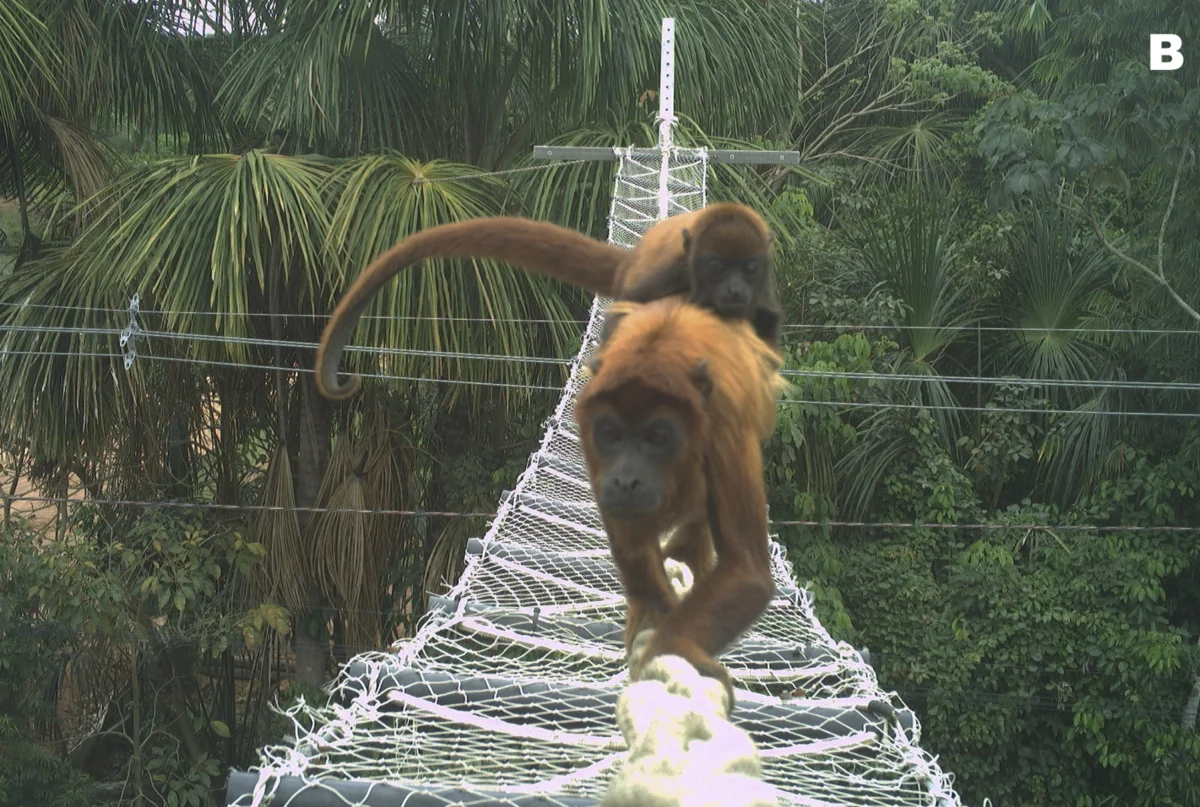
In Mato Grosso, conservationists are utilizing the infrastructure of the Reconecta project to combat one of the most insidious threats to Amazonian wildlife: vehicular roadkill and forest fragmentation. The initiative has successfully installed artificial canopy bridges spanning roadways in high-risk zones, allowing arboreal mammals to safely cross fragmented landscapes. Field monitoring has already documented A. matogrossensis making active use of these structures, including a heartwarming observation of a female successfully navigating the bridge while carrying an infant.
Concurrently, the study’s authors are distributing their granular distribution data to international colleagues, policymakers, and public databases. By supplying open-access genomic and geographic data, the team aims to fast-track official IUCN status evaluations for A. iroi, A. matogrossensis, and the newly proposed Caribbean species, A. insulanus.
A Vital Piece of the Amazonian Puzzle
The formal description of Alouatta iroi and Alouatta matogrossensis underscores a humbling reality about the Neotropical rainforest: despite centuries of scientific exploration, the Amazon continues to harbor hidden layers of biodiversity that remain entirely unknown to formal science.
As climate change, industrial expansion, and deforestation continue to reshape the South American landscape, identifying who is out there—and precisely where they live—is the foundational first step toward keeping them alive. For Romina Batista and her colleagues, these newly minted species are much more than taxonomic classifications; they are crucial, irreplaceable pieces of a complex evolutionary puzzle that humanity is only just beginning to understand.