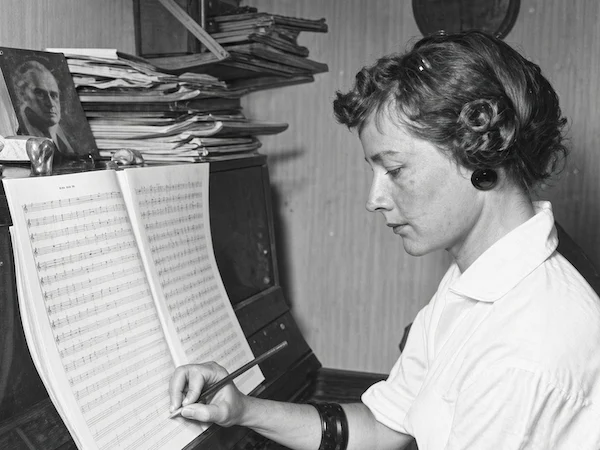
The intersection of political oppression and avant-garde artistic innovation rarely manifests as clearly as it does in the life and career of Else Marie Pade. Long before she established herself as a pioneering figure in electronic music, Pade’s world was defined by sickness, confinement, and the geopolitical upheavals of twentieth-century Europe. Born in Denmark, her trajectory from a bedridden child listening to the ambient sounds of her environment to a member of the Danish Resistance, a political prisoner, and ultimately Denmark’s first female electronic composer remains one of the most compelling narratives in modern music history. Her journey illuminates how trauma, resilience, and technological evolution can converge to forge entirely new aesthetic paradigms.
Early Life and Confinement: The Genesis of a Sonic Imagination
Else Marie Pade’s relationship with sound began not in a concert hall, but in the isolation of a sickbed. Frequent bouts of kidney inflammation during her childhood consigned her to extended periods of bed rest. Deprived of the typical physical freedoms of youth, Pade turned her attention inward and outward toward the auditory world. She became an acute listener, finding profound comfort and stimulation in the ambient noises of her immediate environment—the rhythmic dripping of sponges, the whistling of kettles, the singing of birds, and the trotting of horses on cobblestone streets.
These early auditory experiences formed the bedrock of her sonic imagination. While other children engaged with traditional music education through conventional means, Pade internalized the sounds of daily life as a legitimate musical vocabulary. However, these childhood illnesses constituted neither her last nor her harshest experience of confinement. As she grew into adolescence, the geopolitical landscape of Europe darkened with the advance of Nazi Germany, culminating in the occupation of Denmark in April 1940.
The Danish Resistance and Gestapo Imprisonment
As a young woman living under foreign occupation, Pade’s opposition to the regime was both visceral and active. In a stark demonstration of youthful defiance, she committed an act that could easily have cost her life on the spot: she spat on a column of marching German soldiers. Escaping immediate capture, she fled straight into the arms of the burgeoning Danish Resistance movement.
Her involvement with the resistance was neither symbolic nor peripheral. Pade took on dangerous operational duties, including the distribution of underground newspapers that countered Nazi propaganda. Furthermore, she underwent tactical training in the use of explosives, specifically tasked with learning how to sabotage and cut off enemy telephone lines in the event of an Allied invasion.
The clandestine nature of resistance work carried immense risks. In 1944, her operations were abruptly halted when she was arrested by the Gestapo, the secret police of Nazi Germany. She was subsequently subjected to interrogation and imprisonment, ultimately being transferred to the Frøslevlejren internment camp. Though she never got to execute her sabotage plans against the telephone infrastructure, her arrest marked the catalyst for a profound psychological and artistic transformation.
The Prison Cell Epiphany and the Birth of a Vow
The psychological trauma of solitary confinement under Gestapo interrogation left an indelible mark on Pade. Years later, she detailed the harrowing nature of that experience in an essay published by the cultural magazine The Wire.
"I screamed out loud in fear and helplessness in my solitary cell – but no one came," Pade wrote. "It was then I promised myself that if I survived this I would work with music for the rest of life. And then I felt a strange calm: light, warmth and love were all around me. I was no longer alone. This was the turning point in my life."
The very next day, driven by an urgent need to externalize the musical compositions forming in her mind, Pade improvised a writing tool. Using the metal fastener of her garter belt, she began scratching musical staves directly onto the prison wall, transcribing a theme inspired by a nocturnal vision.
Initially, the prison commandant was infuriated by the defacement of the facility’s infrastructure. However, recognizing the psychological desperation behind the act, the commandant made a pragmatic concession. He informed Pade that he would arrange for the Red Cross to supply her with legitimate music paper and writing utensils, provided she ceased her violent outbursts of despair and stopped defacing the cell walls.
Collaboration in the Internment Camp
Following her transfer to the Frøslev internment camp, Pade’s circumstances shifted slightly, allowing for collaborative artistic output. Remarkably, she was reunited within the camp walls with Karen Brieg, the very piano teacher who had initially introduced her to the Danish Resistance.
The camp environment, though restrictive, became an incubator for resilience. Brieg transcribed traditional Danish songs for a three-part women’s choir, while Pade turned her hand to writing schlagers—popular, sentimental ballad-style songs. Pade’s pragmatic motivation for writing these accessible tunes was financial; she intended to use the earnings from these commercial compositions to fund formal music studies once she and her fellow prisoners were liberated. Her compatriots in the women’s barracks validated this ambition, promising to support her entry into the Royal Danish Academy of Music once the war ended. True to their word, the post-war period opened the doors to formal academic training for the young survivor.
The Discovery of Musique Concrète
Pade entered the Royal Danish Academy of Music with the conventional intention of establishing herself as a pianist. However, the trajectory of her artistic life was permanently altered in 1952 through a broadcast on Danmarks Radio. The program introduced Danish audiences to the radical French compositional movement known as musique concrète, pioneered by Pierre Schaeffer.
Schaeffer’s revolutionary technique involved recording everyday physical sounds—such as railway noises, machinery, and urban clamor—onto magnetic tape, and then manipulating, looping, and collaging them into structured musical compositions. For Pade, these sound-collage experiments struck a profound chord. They instantly connected back to the auditory observations of her bedridden childhood, where she had found symphonic richness in domestic and natural noises.
Inspired by Schaeffer’s methodology, Pade created A Day at Dyrehavsbakken, widely recognized as the first work of electronic musique concrète composed in Denmark. The piece captured the sonic atmosphere of the world’s oldest operating amusement park, transforming screams, laughter, roller-coaster mechanics, and crowd noise into an avant-garde acoustic tapestry.
Integration into the European Avant-Garde
Building upon her initial breakthrough, Pade sought out further education among the leading lights of post-war European modernism. She traveled to study with international pioneers of electronic and serial music, including Karlheinz Stockhausen, György Ligeti, and Pierre Boulez.
The austere, highly intellectualized soundscapes championed by these figures could hardly have been further removed from the sentimental schlager ballads she had composed to maintain morale in the prison barracks. Yet, Pade seamlessly integrated their rigorous structural techniques with her own deeply intuitive, phenomenological approach to sound. The sonic imagination that had once perceived an ambient symphony in dripping sponges and whistling kettles now possessed the technical apparatus of the electronic studio to bring those internal worlds to life.
Broader Impact and Historical Implications
Else Marie Pade’s legacy extends far beyond her status as a geographical anomaly as Denmark’s first female electronic composer. Her career intersects with a broader historical narrative regarding the marginalization and eventual rediscovery of women in early electronic music. Alongside contemporaries such as Daphne Oram and Delia Derbyshire at the BBC Radiophonic Workshop, and Pauline Oliveros in the United States, Pade helped lay the foundational syntax of electronic composition before the advent of commercial synthesizers.
Historians and musicologists frequently analyze Pade’s work as a testament to the therapeutic and redemptive power of art. The psychological arc of her life—moving from the claustrophobia of childhood illness to the terror of Nazi imprisonment, and finally to the expansive freedom of electronic sound manipulation—demonstrates how trauma can occasionally serve as the crucible for radical innovation.
Today, archival projects, retrospectives, and academic studies continue to reevaluate the contributions of mid-century female electronic pioneers. Recordings of Pade’s masterworks, spanning decades of sonic exploration, reveal an artist who remained tirelessly curious, bridging the gap between concrete environmental reality and abstract electronic futures. Her life stands as an enduring reminder that even within the most rigid systems of confinement, the human imagination retains the capacity to invent entirely new ways of listening to the world.