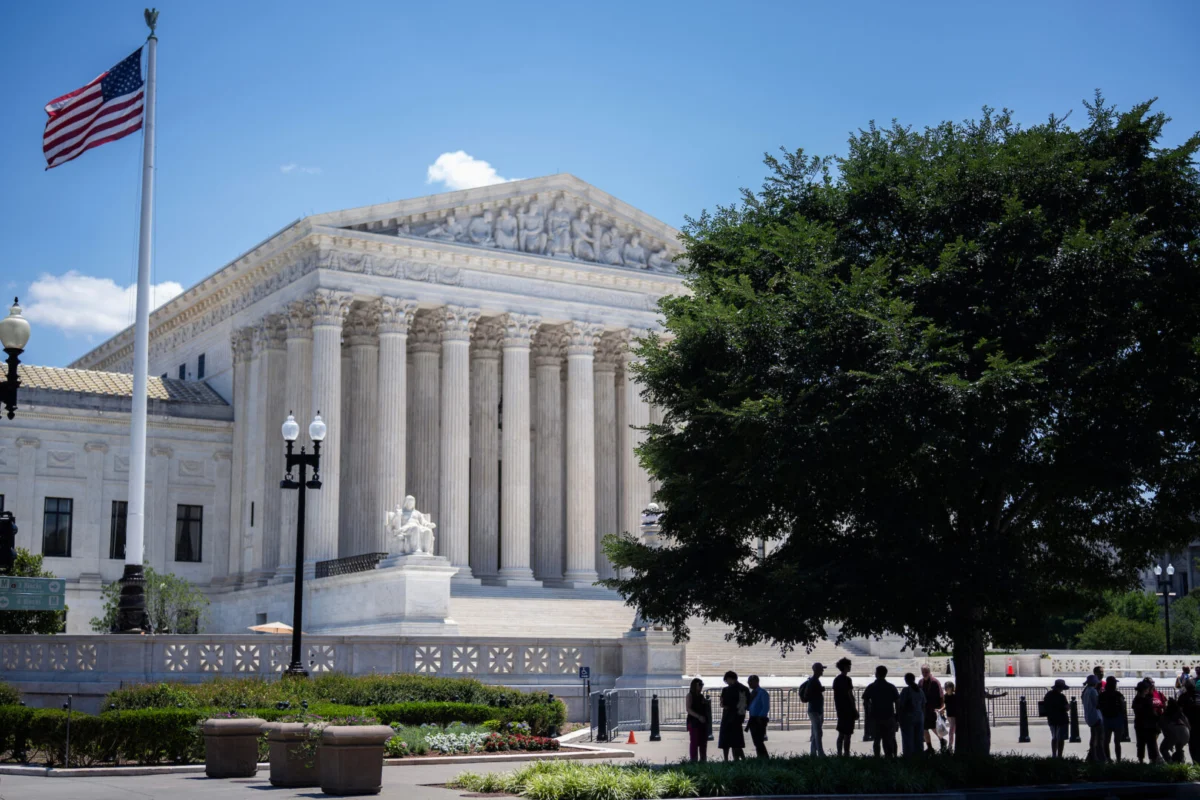
In a decisive move aimed at preventing electoral instability, the U.S. Supreme Court on Friday effectively shelved Missouri’s attempt to implement a controversial new congressional map, opting instead to reinstate the electoral boundaries originally enacted in 2022. The unsigned order from the nation’s highest court set aside a Monday ruling from a three-judge panel of the U.S. Court of Appeals for the 8th Circuit, which had mandated that the state utilize the updated 2025 redistricting plan. The Supreme Court’s intervention comes at a critical juncture, as the state is already deep into the administration of its general election cycle.
The high court’s order was notably blunt regarding the timing of the litigation. “At this late date, ordering reversion to the 2025 map in the midst of an ongoing election would usher in electoral chaos,” the ruling stated. The justices provided no dissents, signaling a unified front in their desire to prioritize administrative continuity over the state’s recent legislative redistricting efforts. Furthermore, the Court issued a rare directive to lower courts, urging them to refrain from further mandates requiring the use of the 2025 lines, effectively closing the door on the latest round of redistricting challenges for this cycle.
A Chronology of Legal and Legislative Maneuvering
The current impasse is the result of a multi-year tug-of-war between Missouri’s Republican-led legislature and voting rights advocates. The sequence of events leading to the Supreme Court’s Friday intervention reflects the volatility inherent in state-level redistricting battles:
- 2022: Missouri enacts a congressional map following the decennial census. These are the lines that the Supreme Court has now ordered the state to maintain for the 2026 general election.
- Early 2025: Missouri Republicans adopt a new, aggressive redistricting plan designed to shift the partisan balance of the state’s delegation.
- August 2026: The state conducts its primary elections using the newly drawn 2025 map.
- September 2026: The Missouri Supreme Court rules that the 2025 map cannot be used for the November general election because a citizen-led petition effort, organized by the group "People Not Politicians Missouri," is pending. The state court orders the use of the 2022 map.
- Mid-October 2026: Federal District Judge Stephen R. Clark rules that Missouri must use the 2025 lines, citing the fact that the primary election had already been held under those boundaries.
- Late October 2026: The U.S. Supreme Court pauses Judge Clark’s ruling, sending it to the 8th Circuit.
- Monday, October 2026: The 8th Circuit panel upholds the use of the 2025 map.
- Friday, October 2026: The U.S. Supreme Court issues its final order, staying the 8th Circuit’s decision and reinstating the 2022 lines.
The Partisan Stakes of the 2025 Map
The legislative effort to replace the 2022 boundaries was viewed by political analysts as a calculated move to secure an additional House seat for the Republican Party. Under the 2025 proposal, the GOP was positioned to be favored in seven of Missouri’s eight congressional districts. Perhaps most significant was the impact on the 5th District, currently represented by Democrat Emanuel Cleaver II.
Data provided by Inside Elections with Nathan L. Gonzales highlights the dramatic shift the 2025 map would have forced upon the Kansas City-area district. The 5th District, as it currently stands under the 2022 map, is a stronghold that supported Kamala Harris by 23 percentage points in the 2024 presidential election. Under the proposed 2025 lines, however, that same territory would have been transformed into a district that Donald Trump would have carried by 18 points. This 41-point swing illustrates why the map became the focal point of intense litigation.
The Argument for "Continuity of Constituency"
The plaintiffs in the federal lawsuit—led by Republican candidate Bob Onder, along with other candidates and voters—argued that the transition back to the 2022 map is not merely a logistical challenge but a constitutional one. Their legal theory, termed "continuity of constituency," posits that voters have a right to be represented by the candidate they selected during the primary election.
In their filing to the Supreme Court, the plaintiffs noted: “More than 1.4 million Missourians could not vote for the congressional district nominees who will appear on their November 2026 general election ballot, and more than a quarter-million Missourians who voted in the August 2026 primary election cast a vote for a congressional district candidate who now cannot represent them.” They argued that the confusion caused by switching maps post-primary fundamentally undermines the democratic process by disconnecting the electorate from their chosen representatives.
State Officials and the Looming Administrative Crisis
State officials found themselves in an unenviable position, caught between conflicting rulings from state and federal judiciaries. In their emergency application to the Supreme Court, the state acknowledged that the legal uncertainty had already caused significant administrative damage.
Officials argued that, regardless of the map eventually chosen, the state would be unable to conduct an "orderly" 2026 General Election. Using the 2025 map would have forced the state to miss critical federal deadlines for the distribution of mail-in ballots, effectively disenfranchising overseas and military voters. Conversely, sticking to the 2022 map—which the Supreme Court has now mandated—risks litigation regarding the eligibility of candidates who ran in districts defined by the 2025 lines.
“The result is chaos on both sides of Election Day: confusion over how to conduct the election now, and uncertainty over the rules governing its results,” the state argued in its emergency application.
Broader Implications and Judicial Precedent
The Supreme Court’s decision to step in underscores the "Purcell principle," a long-standing judicial doctrine that discourages federal courts from changing election rules close to an election date. By citing the potential for "electoral chaos," the justices reaffirmed their commitment to administrative stability over the potential correction of perceived local redistricting errors.
For Missouri, the immediate aftermath involves a scramble by election officials to revert to the 2022 boundaries while managing the expectations of a confused electorate. For the rest of the country, the case serves as a stark reminder of the legal volatility that can arise when state legislatures attempt to redraw boundaries in the shadow of a pending election.
As the 2026 general election nears, the focus shifts from the courtroom back to the ballot box. While the legal battle over the map has been effectively quieted by the high court, the political ramifications—including the potential for further litigation over candidate eligibility and the legitimacy of the results—remain a cloud over the state’s electoral process. The Supreme Court’s instruction to lower courts to stop ordering the use of the 2025 map serves as a final, if severe, effort to ensure that the November results are finalized without further judicial interference.