
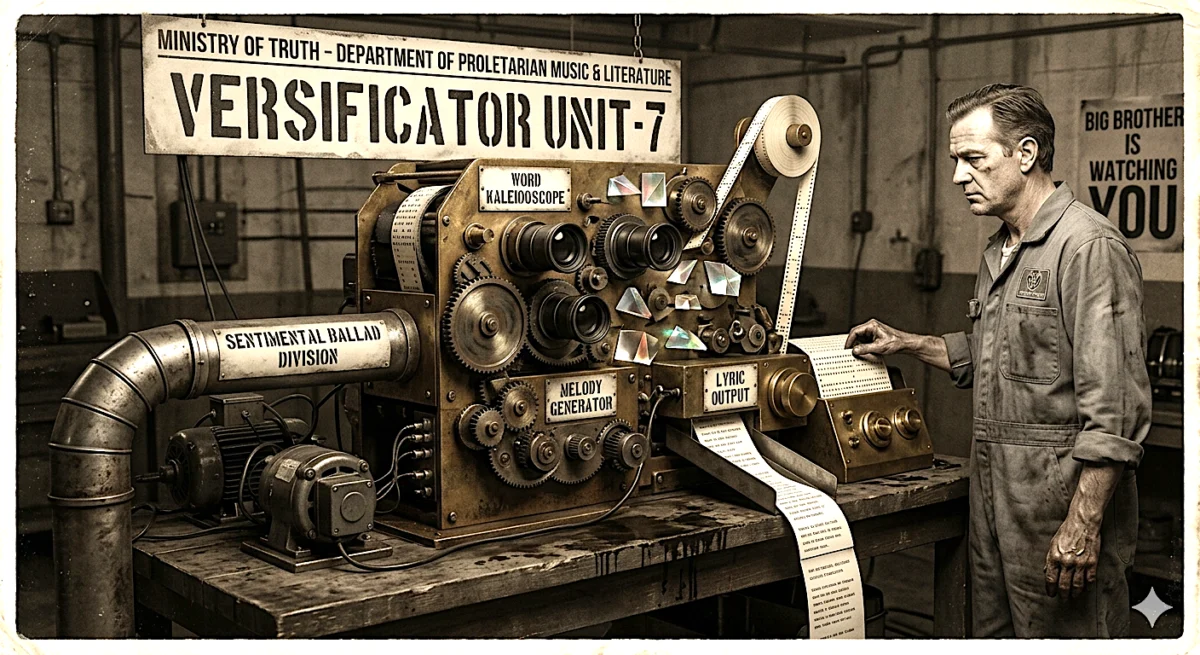
The intersection of mid-20th-century dystopian literature and 21st-century generative artificial intelligence has revealed a startlingly accurate prophecy hidden within the pages of George Orwell’s 1949 masterpiece, Nineteen Eighty-Four. While contemporary discourse frequently focuses on Orwell’s warnings regarding state surveillance and the erosion of objective truth, a specific technological device mentioned in the novel—the "Versificator"—has emerged as a direct precursor to the modern phenomenon known as "AI slop." As large language models (LLMs) and generative algorithms begin to saturate the digital landscape with high-volume, low-quality content, the mechanisms of Orwell’s Ministry of Truth appear less like fiction and more like a blueprint for the current state of automated media production.
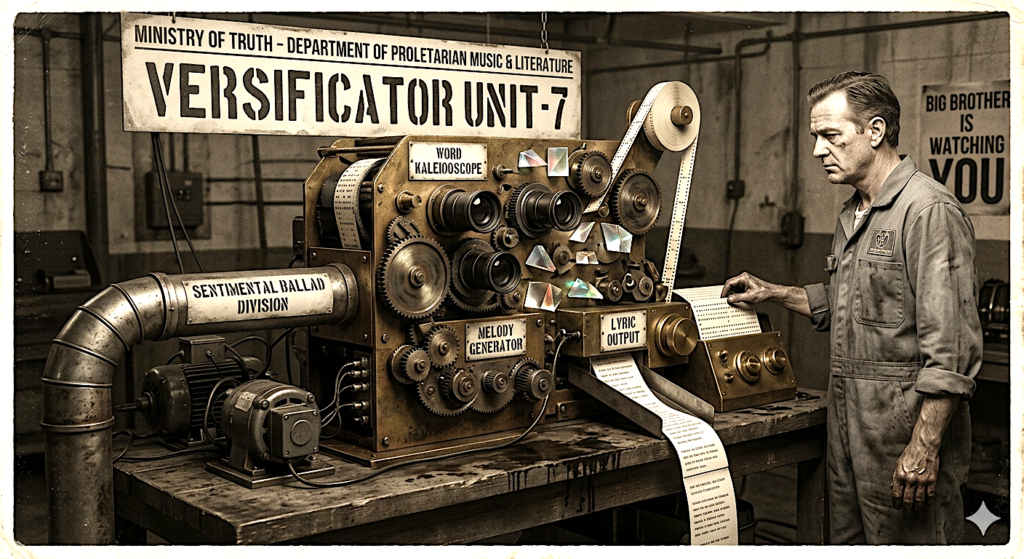
In the world of Nineteen Eighty-Four, the protagonist Winston Smith operates within a sprawling bureaucracy designed to manufacture and manipulate reality. Among the various departments of the Ministry of Truth (Minitrue) is a sector dedicated to the creation of "proletarian literature." This department utilized the Versificator, a mechanical device capable of producing music, drama, and literature without human creative input. Orwell described the output as "rubbishy newspapers containing almost nothing except sport, crime and astrology, sensational five-cent novelettes, films oozing with sex, and sentimental songs." This automated production was intended to keep the "proles"—the disenfranchised working class—pacified with a steady stream of mindless entertainment, ensuring they remained politically inert.
The Technological Evolution of Automated Content
The historical trajectory of automated content generation has moved through several distinct phases, often characterized by periods of intense optimism followed by "AI winters"—stagnant intervals where research stalled due to hardware limitations or lack of funding. In 1980, the renowned science fiction author Isaac Asimov famously critiqued Nineteen Eighty-Four, arguing that Orwell’s technological predictions were poorly conceived. Writing during an AI winter, Asimov contended that Orwell failed to foresee the actual development of computers, noting that the world of 1984 lacked the sophisticated digital infrastructure that was beginning to emerge in the late 20th century.
However, the 2020s have validated Orwell’s conceptual vision in ways Asimov did not anticipate. The emergence of generative pre-trained transformers (GPT) and similar architectures has enabled the mass production of text, imagery, and audio that mirrors the output of the Versificator. Unlike the symbolic AI of the 1980s, which relied on rigid rules and logic, modern generative AI utilizes statistical probability to predict the next token in a sequence, allowing it to mimic human styles with uncanny efficiency. This has led to the rise of "AI slop": a term used by digital culture critics to describe the deluge of uncurated, AI-generated content designed to capture clicks, satisfy search engine algorithms, or fill social media feeds with "engagement bait."
Analyzing the Impact of "AI Slop" on Modern Discourse
The primary concern regarding AI slop is not merely its lack of quality, but its sheer volume. Recent data from web monitoring organizations suggests a significant shift in the composition of the internet. According to research from NewsGuard, a firm that tracks online misinformation, there has been a multi-hundred-percent increase in "unreliable AI-generated news outlets" (UAINOs) since 2023. These sites often operate with little to no human oversight, churning out thousands of articles daily to farm programmatic advertising revenue.
This phenomenon aligns with the "Dead Internet Theory," a once-fringe conspiracy theory that has gained academic and mainstream traction. The theory posits that a substantial portion of internet traffic and content is no longer human-generated but is instead a closed loop of bots interacting with AI-generated material. In this environment, the "human intervention" that Orwell noted was absent in the Versificator’s songs has become a vanishing luxury. The economic incentive structure of the modern web—where quantity often trumps quality for the purposes of Search Engine Optimization (SEO)—has created a fertile environment for the very "mechanical" culture Orwell feared.
Chronology of the Rise of Synthetic Media
To understand how Orwell’s vision manifested, it is necessary to examine the timeline of automated media development:
- 1949: Publication of Nineteen Eighty-Four, introducing the Versificator as a tool for the mechanical production of "pabulum" for the masses.
- 1950s–1960s: Early experiments in computer-generated poetry and music (e.g., the Illiac Suite) demonstrate that machines can follow basic aesthetic rules.
- 1980: Isaac Asimov critiques Orwell, dismissing the idea of the Versificator as a "poor prophecy" because it lacked a realistic technical foundation based on the computing trends of the time.
- 2010s: The rise of algorithmic curation on platforms like Facebook and YouTube begins to prioritize high-frequency content, setting the stage for automation.
- 2022: The public release of ChatGPT and Midjourney marks the beginning of the generative AI boom, making tools for mass content production available to the general public.
- 2024–2026: The term "AI slop" enters the lexicon as social media platforms are flooded with AI-generated "inspirational" images, hallucinated news stories, and low-effort novels on platforms like Amazon Kindle Direct Publishing.
Economic Drivers and Public Reception
The proliferation of AI slop is driven by a convergence of low production costs and high-frequency distribution. In the mid-20th century, producing a "five-cent novelette" still required a printing press and a distribution network. In the 2020s, an AI can generate a 50,000-word manuscript in minutes, which can then be uploaded to global marketplaces instantly.
Market data indicates that the "prole-feed" Orwell described—low-brow, sensationalist content—remains highly profitable. Platforms like TikTok and Facebook have seen a surge in AI-generated "slop" that utilizes psychological triggers, such as hyper-saturated imagery or emotionally manipulative narratives, to garner engagement. While critics argue that this content devalues human creativity, the metrics often tell a different story. Much like the sentimental songs in Orwell’s dystopia, which the proles sang with genuine enthusiasm, AI-generated content often finds a massive, uncritical audience. This suggests that the "undemanding nature of the public," as noted by cultural commentators, is a key component in the success of automated media.
Broader Implications for Information Integrity
The implications of this shift extend beyond entertainment into the realm of political and social stability. Orwell’s Ministry of Truth used the Versificator to ensure that the populace remained distracted and incapable of critical thought. In a contemporary context, the saturation of the information ecosystem with AI slop makes it increasingly difficult for individuals to discern fact from fiction.
Technological analysts warn of "model collapse," a theoretical scenario where future AI models are trained on the output of current AI models, leading to a degradation of information quality and a reinforcement of biases. If the "collective human intelligence" is replaced by a recursive loop of synthetic data, the ability to maintain an objective record of history—the very task Winston Smith struggled with—may be lost.
Furthermore, the environmental cost of maintaining the server farms required to generate this "slop" is substantial. Estimates suggest that a single generative AI query consumes significantly more electricity than a standard Google search. Thus, the rise of the modern Versificator is not only a cultural and cognitive threat but also a material one.
Official Responses and Future Outlook
In response to the rising tide of synthetic media, various regulatory bodies and tech corporations have begun to implement countermeasures. The European Union’s AI Act and various legislative efforts in the United States have sought to mandate the labeling of AI-generated content. Meanwhile, tech giants like Google have updated their algorithms to penalize "unhelpful" content that appears to be produced solely for SEO purposes.
However, the efficacy of these measures remains to be seen. The "arms race" between AI generators and AI detectors is ongoing, with generators often staying one step ahead. Literary scholars and tech critics suggest that the only true defense against the rise of AI slop is a renewal of individual human discernment. As Orwell’s work implies, the most effective tool against a mechanical monopoly on culture is the human capacity for critical analysis and the demand for authentic, human-driven narratives.
The Versificator was a minor detail in Nineteen Eighty-Four, yet it has proven to be one of Orwell’s most prescient observations. It serves as a reminder that the degradation of language and culture is often a precursor to the loss of political agency. In an era where "slop" is becoming the default state of the digital world, the value of human-produced literature, art, and journalism has never been higher. The challenge for the future lies in whether society will succumb to the ease of the automated kaleidoscope or insist on the complexity of the human experience.









Leave a Reply