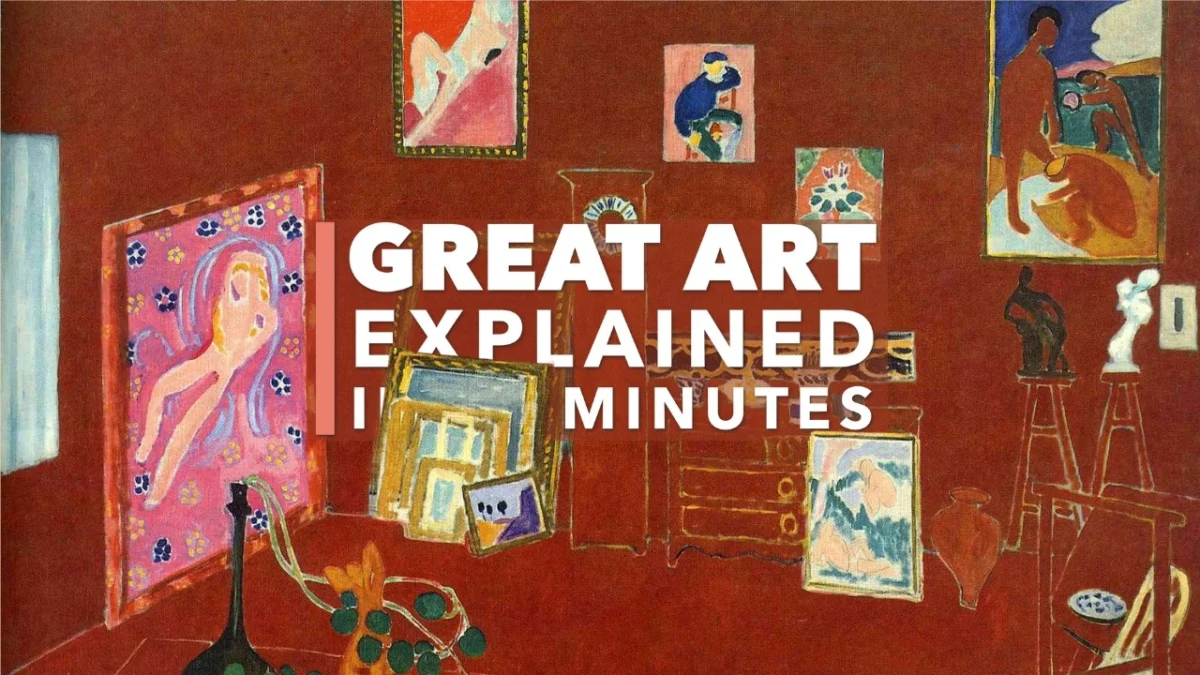
Painted in 1913 at his studio in Issy-les-Moulinaux, Henri Matisse’s The Red Studio stands today as a towering achievement of modern art, housed prominently in the Museum of Modern Art (MoMA) in New York. Yet, the canvas—dominated by a vibrant, unconventional expanse of Venetian red that covers nearly three-quarters of its surface—did not always enjoy critical acclaim. For decades following its creation, the painting faced rejection from patrons, traveled across international exhibitions, and even spent more than ten years hanging inside the smoky environment of a London nightclub before finally being recognized for its profound influence on postwar abstraction.
The genesis of The Red Studio reflects a period of intense experimentation for Matisse. Having already cemented his status as a leading figure among the Fauvists—a group celebrated and criticized for their radical, non-naturalistic use of color—Matisse sought to challenge the traditional boundaries of perspective and representation. When an inquisitive journalist visited the artist shortly after the completion of the work, Matisse candidly admitted to a sense of artistic mystery regarding his own creation. "I like it, but I don’t completely understand it," Matisse reportedly stated. "I like it, but I don’t know why I precisely painted it this way."
Chronology of Rejection and Re-evaluation
The path of The Red Studio from creation to canonical masterpiece was marked by persistent hesitation from the contemporary art establishment:
- 1911–1913 (Initial Rejection): Despite commissioning major works like Dance and Music, Matisse’s loyal Russian patron Sergei Shchukin ultimately rejected The Red Studio, unnerved by its radical departure from visual reality. The painting was subsequently rejected by audiences and critics in London and fared little better at the groundbreaking 1913 Armory Show in the United States, which introduced European avant-garde art to American audiences.
- 1926 (Paris Debut): More than a decade after its creation, the painting finally made its debut in Paris. By this time, European public sensibilities and critical frameworks had begun to evolve, slowly catching up to the visionary strides Matisse had made years prior.
- 1927–Late 1930s (The Gargoyle Club Era): In 1927, the painting found a buyer in the owner of London’s exclusive Gargoyle Club. A frequent haunt for the cultural elite and the generation known as the "Bright Young Things," the nightclub served as an unlikely gallery space where The Red Studio hung undisturbed for over a decade.
- Post-War Acquisition and Legacy: The painting eventually transitioned into institutional care, ultimately finding a permanent home at MoMA. There, it became a crucial touchstone for a new generation of American abstract expressionists.
Artistic Analysis and the Subversion of Tradition
Art historians and curators have long analyzed the structural mechanics of The Red Studio to understand its departure from nineteenth-century artistic norms. Rather than relying on traditional chiaroscuro or linear perspective to denote depth, Matisse flattened the pictorial space. The deep red hue serves not merely as a background color, but as an active, unifying force that absorbs the objects within the studio—furniture, sculptures, and earlier paintings by the artist—rendering them as ghostly, simplified outlines in yellow, orange, and blue.
According to MoMA curator Ann Temkin, the painting prefigured the massive color-field experiments of the mid-twentieth century. The canvas presents "a big expanse of color that doesn’t describe anything, that just is there for its own expressive purposes." Gallerist and art historian James Payne notes in his detailed analyses that the work effectively broke nearly every established rule of Western painting inherited from the Renaissance. By dissolving physical walls into a psychological landscape of pure chromatic energy, Matisse created what many scholars consider to be one of the most innovative self-portraits in the history of art, deliberately omitting his
own physical form while meticulously cataloging the artifacts of his creative mind.
Broader Impact and Postwar Implications
The eventual integration of The Red Studio into the narrative of modern art history profoundly influenced the trajectory of postwar American painting. During the late 1940s and 1950s, artists such as Mark Rothko, Barnett Newman, and Ellsworth Kelly frequently visited MoMA to study Matisse’s handling of scale, color saturation, and spatial autonomy.
These younger practitioners expanded upon Matisse’s premise, stripping away figurative elements entirely to focus on the emotional and spiritual resonance of pure color fields. The journey of The Red Studio—from a misunderstood commission rejected by contemporary collectors, through the unconventional setting of a London social club, to the halls of a premier modern art institution—illustrates the often volatile trajectory of artistic innovation. What once scandalized early twentieth-century viewers now stands as an indispensable bridge between European fauvism and American abstraction, permanently altering the visual vocabulary of modern art.