
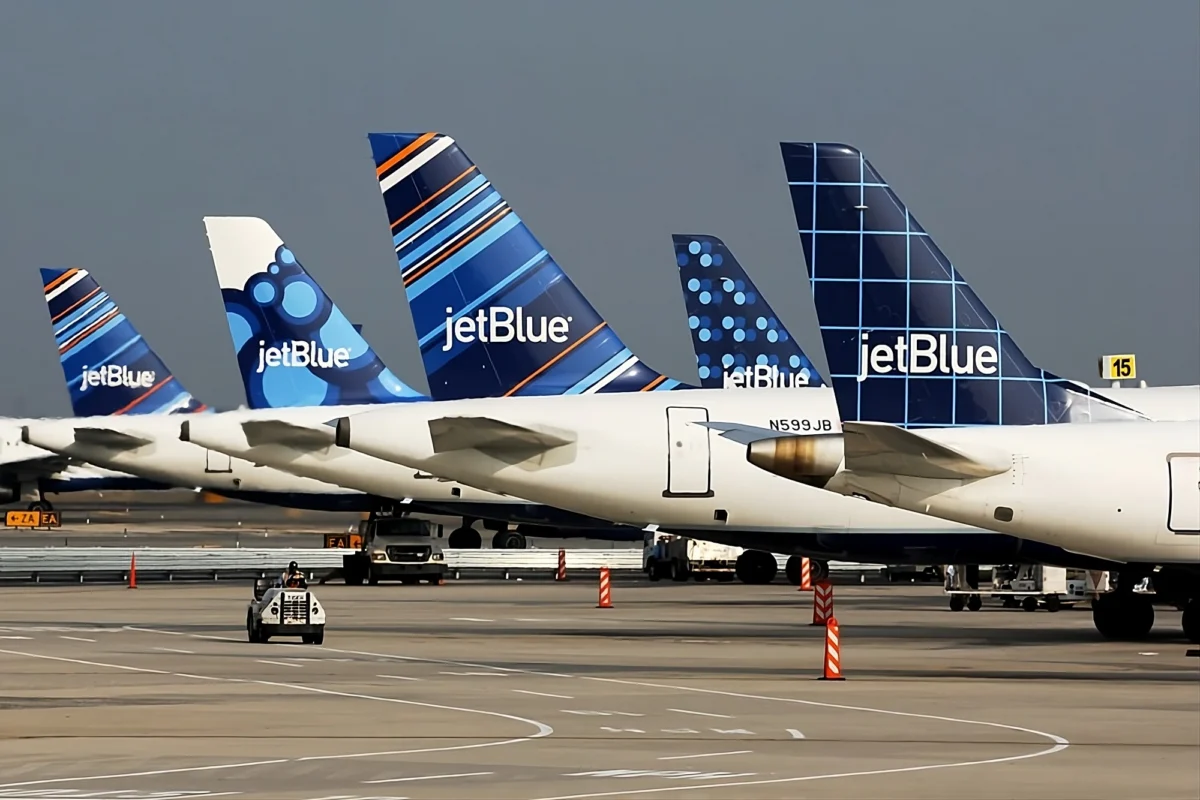
David Neeleman, the founder of JetBlue Airways and the current Chief Executive Officer of Breeze Airways, has issued a stark warning regarding the financial viability of his former airline. In remarks made during a private pilot briefing on April 14, 2026, which were subsequently leaked by aviation industry watchdog JonNYC, Neeleman suggested that the combination of historically high jet fuel prices and a staggering debt load could push JetBlue into bankruptcy proceedings before the end of the year. The comments offer a rare and candid assessment from one of the industry’s most influential figures, highlighting the precarious position of the New York-based carrier as it navigates a turbulent post-merger-attempt landscape.
According to the leaked transcript, Neeleman cited analysis from JP Morgan’s Jamie Baker, which projected that JetBlue could face annual losses exceeding $1.3 billion if fuel prices remain at elevated levels. With jet fuel costs recently peaking at $4.80 per gallon and currently hovering near the $4.00 mark, the financial pressure on the airline has reached a critical juncture. Neeleman’s assessment suggests that JetBlue’s options for recovery are narrowing, as its high interest payments on nearly $9 billion in debt leave little room for operational error or market volatility.
The Financial Mechanics of a Crisis: Fuel and Debt
The core of Neeleman’s concern lies in the intersection of volatile commodity pricing and rigid corporate debt structures. For most airlines, fuel represents the largest or second-largest variable expense. When fuel prices spike, carriers must either raise ticket prices—risking a drop in passenger demand—or absorb the costs, which directly erodes profit margins. Neeleman pointed to projections suggesting that at a sustained fuel price of $4.50 per gallon, JetBlue’s financial model becomes unsustainable.
The situation is exacerbated by the airline’s significant leverage. JetBlue currently carries approximately $9 billion in debt, a figure that has grown as the airline sought to modernize its fleet and navigate the complexities of the previous years’ market shifts. Neeleman noted that the airline is currently paying over $600 million annually in interest alone. If the company were to take on further obligations or if interest rates were to shift unfavorably, that service cost could climb toward $800 million.
This "debt stranglehold," as Neeleman described it, prevents the airline from investing in the growth initiatives necessary to compete with larger legacy carriers like Delta, United, and American. Furthermore, it makes the airline an unattractive target for acquisition. While rumors have circulated that United Airlines might be interested in absorbing JetBlue to consolidate its market share, Neeleman dismissed these theories. He claimed that sources within United have expressed deep concern regarding JetBlue’s debt profile, indicating that United is unwilling to take on the financial liability required to integrate the carrier.
A History of Industry Disruption: The Neeleman Perspective
To understand the weight of these comments, one must look at David Neeleman’s extensive history in the aviation sector. Neeleman is not merely a former executive; he is a serial entrepreneur who has reshaped the industry multiple times. After co-founding Morris Air in 1984 and selling it to Southwest Airlines, he served on Southwest’s Executive Planning Committee. He later founded JetBlue in 1998, positioning it as a "high-frills, low-cost" alternative that brought live television and leather seats to the budget market.
Following his departure from JetBlue in 2007, Neeleman went on to found Azul Brazilian Airlines, which became a dominant force in South America, and WestJet in Canada. He also led the privatization of TAP Air Portugal in 2015. His current venture, Breeze Airways, focuses on underserved secondary markets, utilizing a low-overhead model that stands in stark contrast to the heavy-capital requirements currently burdening JetBlue.
Because of this track record, Neeleman’s insights carry significant weight among investors and industry analysts. However, it is also noted that he is no longer an objective observer. As the head of Breeze Airways, a competitor in the domestic space, his public or semi-private critiques of other airlines are often viewed through the lens of competitive strategy. Nonetheless, the specific financial figures he cited—supported by institutional research from JP Morgan—provide a factual basis for his pessimistic outlook.
The Failed Merger and the Path to Isolation
JetBlue’s current predicament is inextricably linked to its failed attempt to acquire Spirit Airlines. The $3.8 billion merger, which was intended to create the nation’s fifth-largest airline, was blocked by a federal judge in early 2024 on antitrust grounds. The Department of Justice argued that the merger would eliminate a key low-cost competitor and lead to higher fares for budget-conscious travelers.
The collapse of the Spirit deal left JetBlue in a strategic vacuum. The airline had spent years and significant capital preparing for the integration, only to be left as a "standalone" entity in an industry increasingly dominated by "The Big Four" (American, Delta, United, and Southwest). Furthermore, the dissolution of the Northeast Alliance (NEA) with American Airlines—also mandated by federal regulators—stripped JetBlue of a critical partnership in its primary hubs of New York and Boston.
Neeleman’s remarks suggest that JetBlue’s "best hope" for survival may ironically depend on the total failure of its former merger partner. He noted that if Spirit Airlines were to go out of business, it would reduce capacity in key markets like Fort Lauderdale, allowing JetBlue to capture more market share and potentially stabilize its revenue. However, even in this scenario, Neeleman warned that JetBlue would still need fuel prices to drop back to approximately $2.50 per gallon just to keep its "nose above the water."
Comparative Analysis: The Broader Airline Market
While JetBlue struggles, other carriers have found varying degrees of stability. The legacy carriers—Delta, United, and American—have benefited from a surge in premium international travel and robust loyalty program revenues. Southwest Airlines, despite its own operational challenges, maintains one of the strongest balance sheets in the industry.
In contrast, the "middle-tier" and "ultra-low-cost" carriers (ULCCs) are facing a period of reckoning. Frontier Airlines and Spirit Airlines have both struggled with profitability as the domestic market becomes oversaturated with low-fare seats. Neeleman had previously predicted in late 2025 that Spirit and Frontier would eventually be forced to merge to survive, a prediction that remains a possibility as Spirit explores restructuring options.
The challenge for JetBlue is that it occupies a unique space between the budget carriers and the premium legacies. It has higher operating costs than Spirit or Frontier due to its service model and primary hub locations (which are among the most expensive airports in the world to operate out of), but it lacks the global network and corporate contract base of a Delta or United. This "squeezed middle" position is particularly dangerous during periods of high fuel prices and economic cooling.
Chronology of Recent Events Leading to Financial Strain
- Mid-2023: The Department of Justice moves to block the JetBlue-Spirit merger, citing concerns over competition and fare increases.
- Late 2023: A federal court orders the dissolution of the Northeast Alliance between JetBlue and American Airlines, ending a revenue-sharing agreement that had bolstered JetBlue’s New York operations.
- Early 2024: The JetBlue-Spirit merger is officially terminated. JetBlue is forced to pay a termination fee to Spirit, further impacting its cash reserves.
- Late 2025: Jet fuel prices begin a steady climb, driven by geopolitical instability and refinery constraints, reaching over $4.50 per gallon.
- April 14, 2026: David Neeleman addresses Breeze Airways pilots, highlighting JetBlue’s $1.3 billion projected loss and $9 billion debt load.
- Current State: JetBlue continues to implement cost-cutting measures, including route rationalization and deferring aircraft deliveries, in an attempt to preserve liquidity.
Market Reactions and Industry Implications
The leaking of Neeleman’s comments has sparked intense discussion among aviation analysts. While JetBlue has not issued an official response to the leaked recording, the company’s recent financial filings acknowledge the "significant headwinds" posed by fuel volatility and the need for "disciplined capital management."
If JetBlue were to seek Chapter 11 bankruptcy protection, it would not necessarily mean the end of the airline. Many major carriers, including Delta and United, have successfully used the bankruptcy process to restructure debt, renegotiate labor contracts, and emerge as leaner, more competitive entities. However, the process is inherently disruptive and could lead to a reduction in service to smaller markets, a decrease in the workforce, and significant losses for shareholders.
For the traveling public, a JetBlue bankruptcy or a significant downsizing would likely mean fewer choices and higher fares in the Northeast corridor. JetBlue has historically acted as a "price disciplinarian," forcing larger carriers to lower their fares on overlapping routes. The loss of that competitive pressure would be a significant blow to consumer affordability.
Analysis of Potential Outcomes
As the industry looks toward the remainder of 2026, three primary scenarios emerge for JetBlue:
- The Survival Pivot: Fuel prices stabilize below $3.00, and the airline successfully executes a radical cost-cutting plan that allows it to service its debt while maintaining a reduced footprint. This would likely involve exiting non-core markets and focusing exclusively on high-performing routes.
- Strategic Acquisition: Despite Neeleman’s skepticism, a larger carrier or a private equity firm could see value in JetBlue’s assets—specifically its slots at JFK and Boston Logan—and move to acquire the airline at a distressed price, assuming the debt can be restructured.
- Restructuring via Chapter 11: The airline files for bankruptcy to shed its $9 billion debt burden. This would allow it to continue operations while legally forcing creditors to accept less than what they are owed, potentially setting the stage for a more sustainable future.
Neeleman’s candid assessment serves as a reminder of the fragility of the aviation business model. In an industry where profit margins are famously thin, the combination of high debt and high fuel is a recipe for crisis. Whether JetBlue can navigate this "tough spot" remains to be seen, but the founder’s words have certainly increased the scrutiny on the airline’s next move. As fuel prices continue to hover at levels that challenge even the most efficient operators, the clock is ticking for one of America’s most recognizable airline brands.









Leave a Reply