
Microsoft is significantly expanding its sovereign cloud portfolio, unveiling a suite of advanced governance, encryption, and operational control tools designed to address the complex security requirements of government agencies and highly regulated industries. As artificial intelligence becomes deeply embedded in enterprise infrastructure, the imperative for digital sovereignty—the ability for organizations to control their data’s location, access, and lifecycle—has transitioned from a regulatory preference to a critical operational requirement.
The latest initiative, detailed by Douglas Phillips, president and chief technology officer of Microsoft Specialized Clouds, represents a strategic pivot toward "sovereign-by-design" computing. By integrating granular management capabilities across public, private, and hybrid cloud environments, Microsoft aims to mitigate the risks associated with data residency and unauthorized access, particularly as cross-border data flows face increasing scrutiny from global regulators.

The Sovereign Control Panel: A Centralized Governance Hub
At the heart of the new offering is the Sovereign Control Panel, slated for a public preview debut at the upcoming Microsoft Ignite conference. This centralized dashboard within the Azure portal is designed to act as a mission-control center for IT administrators. Historically, managing sovereignty across disparate cloud regions, on-premises data centers, and partner-hosted environments required a patchwork of compliance tools and manual auditing processes.
The Sovereign Control Panel simplifies this by offering a unified view of data residency settings, automated compliance monitoring, and real-time risk identification. By providing administrators with the ability to visualize the footprint of their sensitive workloads, Microsoft is lowering the barrier to entry for organizations that have historically been hesitant to migrate critical infrastructure to the cloud due to the opacity of traditional cloud management interfaces.
Strengthening Human and Technical Oversight
A primary concern for organizations in the European Union and the European Free Trade Association (EFTA) is the prospect of "foreign access" to sensitive production systems. To address these concerns, Microsoft is implementing the "Data Guardian" feature. This protocol mandates that any access to production systems within these specific jurisdictions must be overseen by personnel physically located within the EU or EFTA. This ensures that the human element of cloud maintenance aligns with regional data protection mandates, such as the General Data Protection Regulation (GDPR).
Complementing this, the "Production Touch Ledger" provides an immutable, tamper-resistant record of all administrative actions taken on a system. This creates a high-fidelity audit trail that satisfies the stringent transparency requirements mandated by financial regulators and national security agencies. Furthermore, Microsoft has achieved general availability for its external key management via Azure Managed HSM. This capability empowers organizations to retain sole control over their encryption keys, effectively decoupling the security of their data from the cloud provider’s underlying infrastructure.
The Shift Toward Sovereign Private Cloud
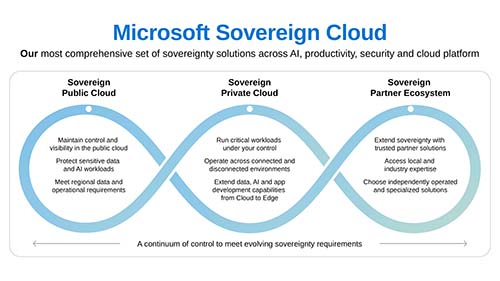
For organizations that cannot operate in a public cloud environment due to security or connectivity constraints, Microsoft is expanding its "Sovereign Private Cloud" offerings. This push includes the integration of GitHub Enterprise Local and the ability to host AI models locally via GitHub Copilot. By running these services on Azure Local, organizations can leverage the power of generative AI without exposing their proprietary datasets to external cloud-based model training or inference processes.
This capability is particularly vital for sectors such as defense, healthcare, and critical utilities, where intermittent internet connectivity or the need for "air-gapped" operations remains the standard. The ability to deploy Azure-native services within a self-contained, private environment marks a significant milestone in Microsoft’s strategy to harmonize the efficiency of modern cloud-native development with the security of traditional on-premises data centers.

Chronology of Sovereign Cloud Evolution
The current expansion is the latest phase in a long-term strategic initiative by Microsoft to capture the highly regulated enterprise market. The timeline of this evolution highlights the urgency with which the company has had to adapt to the rise of AI:
- 2022–2023: Microsoft launches the "Microsoft Cloud for Sovereignty" initiative, focusing on data residency and compliance guidelines for public sector entities.
- Early 2024: Introduction of localized data residency guarantees in response to increased regulatory pressure from the European Commission regarding cloud competition and data protection.
- Mid-2024: Initial integration of AI-ready infrastructure, acknowledging that generative AI requires a more complex security stack than traditional database workloads.
- October 2026: Announcement of the Sovereign Control Panel, Data Guardian, and the integration of Project Perception’s "Guardian Agents" to secure AI-driven workflows.
Addressing the "Agentic Insider" Threat
The technical expansion of the sovereign cloud does not occur in a vacuum. It is deeply connected to Microsoft’s broader efforts to secure autonomous AI. As reported in recent assessments of the company’s "Project Perception" initiative, the rise of agentic AI—autonomous software capable of executing complex workflows without human intervention—has introduced a new security paradigm.
Microsoft identifies these autonomous agents as "agentic insiders." Because these agents operate with elevated privileges to perform tasks, they represent a significant attack surface. To counter this, Microsoft is deploying "Guardian Agents," a layer of security software tasked specifically with monitoring the behavior of other AI agents. These Guardian Agents utilize behavioral analysis to evaluate whether an AI’s actions are deviating from predefined safety protocols. If an agent begins to access unauthorized data or attempts to perform an anomalous operation, the Guardian Agent is programmed to intervene.

Industry Implications and Market Analysis
The broader implication of this strategy is that Microsoft is redefining the "shared responsibility model." Traditionally, the cloud provider was responsible for the security of the cloud, while the customer was responsible for security in the cloud. With the integration of sovereign controls and Guardian Agents, Microsoft is moving toward a model of "shared oversight."
For the global market, this is a clear response to the "Digital Sovereignty" movement. Countries such as France and Germany, along with regional blocs like the EU, have expressed a desire for a "European Cloud" that is independent of non-European service providers. By offering tools that allow customers to effectively "lock out" even the cloud provider from their data, Microsoft is proactively neutralizing the argument that cloud adoption inherently compromises national or organizational independence.
Furthermore, the integration of local AI hosting capabilities serves to mitigate the "latency and control" argument against AI adoption. By allowing organizations to keep their data local while utilizing the Microsoft ecosystem for development and orchestration, the company is bridging the gap between legacy infrastructure and the AI-driven future.

Strategic Outlook: Oversight as a Competitive Advantage
As AI technologies move from experimental projects to the backbone of critical infrastructure, the risks associated with failure—whether through unauthorized data access, system malfunction, or malicious AI behavior—increase exponentially. Microsoft’s focus on oversight is not merely a defensive measure; it is a strategic competitive advantage.
By providing a robust, transparent, and auditable framework, Microsoft is positioning itself as the "sovereign-first" choice for the global public sector. While competitors continue to iterate on pure performance and scalability, Microsoft’s recent announcements suggest that in the coming years, the ability to provide "digital assurance" will be the primary metric by which enterprise cloud providers are judged.
The integration of the Sovereign Control Panel and the expansion of the Sovereign Private Cloud indicate that the future of enterprise technology will be defined by a delicate balance: the desire for the transformative potential of AI, tempered by the non-negotiable requirement for absolute control over the digital assets that power modern society. As these new tools roll out to customers, the market will be watching closely to see if they can effectively simplify the complex, often cumbersome, world of regulatory compliance while maintaining the agility of a global cloud provider.