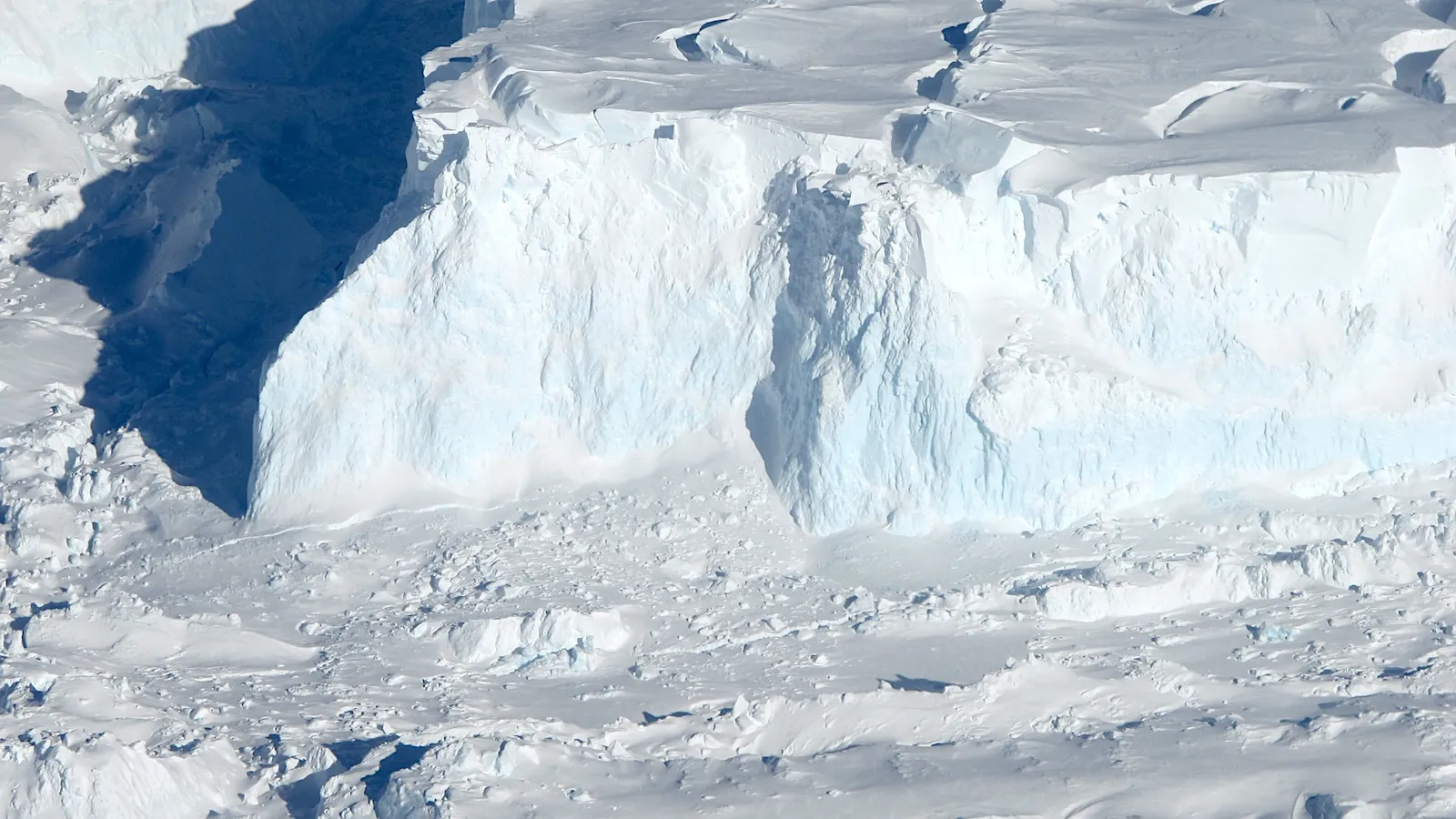
At the remote edge of the Antarctic continent, a colossal mass of ice roughly equivalent to the size of the state of Florida is currently undergoing unprecedented destabilization. Widely recognized by the scientific community as the Thwaites Glacier—and more ominously dubbed the Doomsday Glacier—this critical formation functions as a massive physical barrier holding back catastrophic volumes of oceanic water displacement. Recent breakthroughs in glaciological modeling have delivered alarming insights: the mechanisms driving Thwaites’ deterioration are far more aggressive than previously understood, indicating that the glacier could accelerate global sea level rise at double the rate previously projected by climatologists.
The urgency surrounding Thwaites stems from its structural role within the broader West Antarctic Ice Sheet. Acting essentially as a colossal cork, the glacier restrains a vast inland bowl of ice, much of which rests at elevations below current sea level. As the outer edges of Thwaites retreat, the interior ice sheet becomes directly exposed to warming ocean currents. This dynamic establishes a dangerous and self-reinforcing feedback loop of accelerated melting and structural collapse. While the total volume of ice contained within Thwaites alone is sufficient to raise global coastlines by roughly two feet, a total systemic failure of the entire West Antarctic basin could ultimately drive sea levels upward by as much as ten feet, threatening coastal populations, global infrastructure, and low-lying island nations worldwide.
Chronology of Discovery and Modeling Breakthroughs
For decades, tracking the physical retreat of the Doomsday Glacier from space via satellite imagery provided a clear yet concerning picture of rapid ice loss. However, translating these observations into accurate predictive models proved to be a formidable scientific hurdle. For years, computer simulations designed to forecast the future behavior of Thwaites failed a fundamental validation test: they were routinely unable to replicate the historical retreat patterns captured by satellites over the past thirty years. Because these models could not accurately hindcast recent history, climatologists lacked confidence in their long-term projections.
The turning point arrived with a landmark study published in Nature Communications, which successfully integrated a critical missing physical mechanism into ice-sheet simulations. Led by Mattia Poinelli, a glaciologist at the University of California, Los Angeles, the research team focused on the grounding zone—the precise area where the underside of the glacier rests directly upon the seabed.
Historically, scientific consensus treated the grounding zone as a fixed boundary. Recent observations, however, revealed that this boundary is highly dynamic, oscillating back and forth with the ocean tides. As the massive weight of the glacier bobs vertically with tidal movements, warm ocean water is actively pumped beneath the ice shelf. This hydrodynamic action carves out miles-long channels and extensive networks of internal fractures, exponentially increasing the rate of sub-glacial melting.
When Poinelli and his colleagues incorporated tidal pumping and grounding zone dynamics into their computer simulations, the model successfully matched historical satellite observations for the first time. The upgraded model yielded stark projections: Thwaites could become permanently unpinned from its stabilizing seafloor anchoring point as early as 2038, with a staggering 60 percent probability that this unpinning will occur before the close of the twenty-first century. Such an event would trigger an irreversible escalation in the rate of ice discharge.
Quantitative Data and Projected Impacts
Quantifying the physical output of the Doomsday Glacier provides a sobering metric for coastal vulnerability. Under current climate stabilization scenarios where atmospheric and oceanic temperatures remain relatively constant, the updated model indicates that Thwaites will contribute approximately three centimeters of direct global sea level rise by the year 2100. Although three centimeters may initially appear modest, this figure represents a doubling of previous estimates generated by older, less sophisticated modeling software.
To contextualize this contribution, historical data reveals that over the past three decades, Thwaites has already accounted for roughly four percent of global sea level rise, totaling approximately 10 centimeters of vertical water expansion. This seemingly incremental rise has had immediate, observable consequences across the globe. In the United States, coastal erosion exacerbated by rising sea levels has sent residential properties in North Carolina crashing into the Atlantic Ocean. Simultaneously, indigenous communities in the Solomon Islands and coastal villages in Senegal have been forced to abandon their ancestral lands and relocate to higher ground due to encroaching tides and increased storm surge vulnerability.
Furthermore, Poinelli emphasizes that global greenhouse gas emissions are not holding steady; rather, global temperatures continue to track upward, with each successive decade statistically outstripping the last. Consequently, real-world observations over the coming decades are expected to outpace even the grim projections of the latest predictive models.
Comparative Dynamics: Thwaites Versus Pine Island Glacier
To explore potential mitigation pathways, researchers have also examined how neighboring glacial systems would respond under theoretical best-case climate scenarios. In July, a separate study published in Geophysical Research Letters utilized an advanced ice-sheet model to simulate a hypothetical geoengineering or aggressive emissions-reduction scenario where ocean-driven melt was artificially neutralized for both Thwaites and the adjacent Pine Island Glacier—the single fastest-melting glacier in Antarctica. Together, Thwaites and Pine Island represent the overwhelming majority of Antarctica’s ongoing contribution to global sea levels.
Despite their geographic proximity and shared exposure to warming circumpolar deep water, the two colossal glaciers demonstrated vastly different recovery potentials. According to Rosie Williams, an ice sheet modeler at the British Antarctic Survey and lead author of the Geophysical Research Letters study, Pine Island Glacier possesses a relatively intact outer shelf that would allow it to stabilize and begin regenerating ice within a single decade under cooler ocean conditions, potentially returning to its mid-twentieth-century volume over time.
Thwaites, conversely, exhibited a much more severe structural deficit. Even if ocean melting were abruptly halted, Thwaites would continue to hemorrhage ice and elevate global sea levels for a minimum of 150 years. Researchers attribute this disparity to the profoundly degraded state of the glacier: the eastern sector of Thwaites is significantly thinned, while the western sector has largely disintegrated into a chaotic mélange of floating icebergs. Consequently, even in a theoretical best-case climate stabilization scenario, Thwaites may already be structurally doomed to complete disintegration.
Institutional Perspectives and Adaptation Implications
The scientific community maintains that while the physical momentum of the Doomsday Glacier is exceptionally difficult to interrupt, fatalism is not an appropriate policy response. Institutional representatives emphasize that policy decisions made today carry profound weight regarding the timing and velocity of future environmental changes.
"There are many other unknowns, but this solves a specific and very important piece of the puzzle," noted Mattia Poinelli, highlighting the necessity of continued refinement in cryospheric research. By successfully incorporating sub-glacial tidal dynamics into predictive frameworks, researchers have eliminated a major blind spot in climate science, enabling governments and civil engineers to plan with greater accuracy.
Echoing this sentiment, Rosie Williams stressed that individual fractions of a degree in global temperature reduction hold immense practical value for global adaptation efforts. While aggressive mitigation strategies may not instantly halt the demise of Thwaites, lowering global greenhouse gas emissions remains vital for preserving other vulnerable ice shelves across both the West and East Antarctic ice sheets.
"The more we can slow it down," Williams concluded, "the longer we have to adapt to any change that’s coming."
As global policymakers, coastal planners, and international scientific bodies digest these findings, the imperative for robust coastal defense infrastructure and aggressive emissions reduction targets becomes ever more pressing. The fate of the Doomsday Glacier serves as a critical stress test for the planet’s interconnected climate systems, underscoring the reality that events unfolding at the literal bottom of the world will inexorably reshape human geography along coastlines everywhere.